

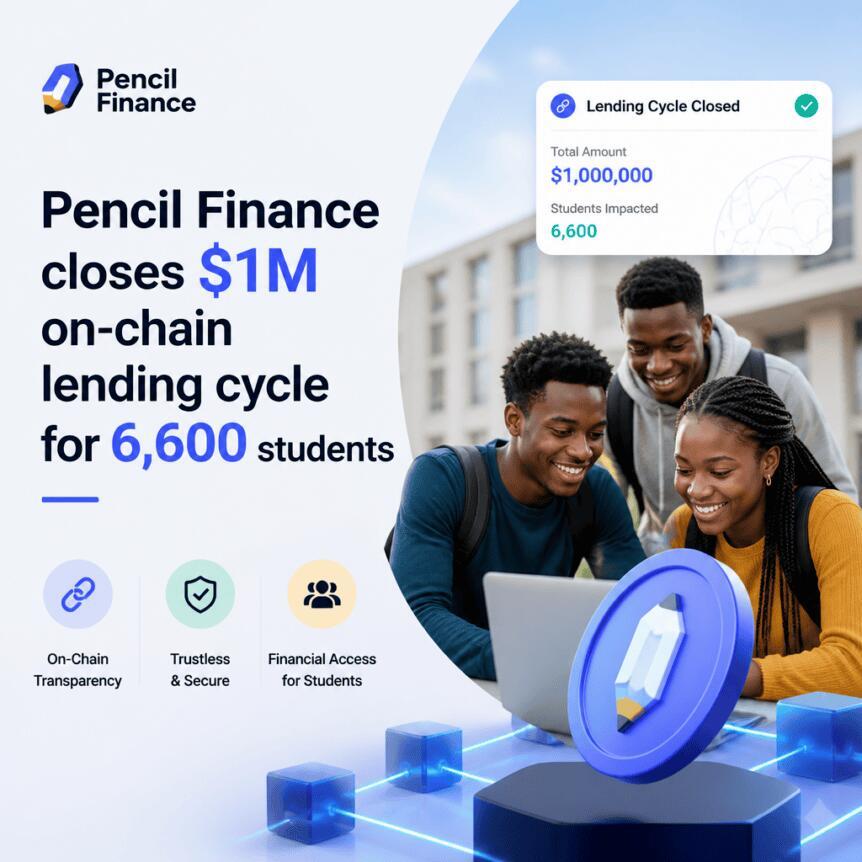
Pencil Finance Closes $1M On-Chain Lending Cycle For 6,600 Students


In a Thursday announcement shared with Cointelegraph, the project described the full process as transparently recorded on the blockchain: capital was deployed onchain as a lender, borrowers repaid, and repayment was routed back to the bundle's funders with yield.
Key takeaways- Pencil Finance completed its first fully onchain student loan cycle using $1 million in deployed capital. The program supported about 6,600 students across 118 schools and universities in Southeast Asia. Funding was structured into senior (fixed returns) and junior (variable returns with first-loss risk) tranches. Pencil says roughly 1,050 students received direct funding, with 50% of borrowers female and 93% from lower-income households. The company frames the cycle as an example of blockchain-recorded lending for student financing that traditional lenders often overlook.
Pencil Finance's announcement centers on the mechanics of its student loan bundle being executed onchain from deployment through repayment. The protocol said it deployed $1 million in capital as a lender on the blockchain for a defined loan cycle, then received repayments from borrowers. Those repayments, according to the company, were distributed back to the bundle's funders and produced yield.
The project also emphasized that the lending process was recorded onchain end to end, pointing to transparency as a core feature of the approach. Pencil claims the completed cycle is the first-ever“fully onchain lending cycle” that finances student loans with activity transparently captured on a blockchain network.
Tranche structure behind the $1 million bundleWhile the overall figure is $1 million, Pencil's program was funded through a structured tranche model. The company said the bundle was funded in July 2025 by Animoca Brands, Open Campus, and New Campus.
Under the arrangement described by Pencil, the capital was split into a senior tranche and a junior tranche. The senior tranche carries fixed returns, while the junior tranche provides variable returns and bears first-loss risk-meaning it is designed to absorb losses before the senior portion is impacted.
For investors and participants, this split is significant because it changes how risk and reward are distributed. Fixed-return exposure is paired with a loss-absorbing layer, which can make the senior tranche more attractive depending on the credit performance of the underlying borrowers, while still giving junior tranche holders potential upside commensurate with the added risk.
Who received financing, and wherePencil Finance said the completed onchain loan cycle provided financing to roughly 6,600 students across 118 schools and universities in Southeast Asia. In its breakdown of direct funding, the protocol reported that about 1,050 of those students received direct funding.
Pencil also described borrower demographics and credit-gap positioning. The loans were intended for students underserved by traditional lenders, with the company reporting that 50% of borrowers were female and 93% came from lower-income households.
These figures matter because they frame the lending program not as a generalized education finance product, but as targeted support for segments that often struggle to access standard forms of credit. The scale across institutions-118 schools and universities-also suggests the protocol is aiming for broad distribution rather than a narrow pilot.
RWAs and tokenized credit: a broader trendThe Pencil announcement arrives as tokenized RWAs continue to move from theory into more operational examples-particularly in lending and asset-backed structures. In July, Cointelegraph reported that Brazil's B3 stock exchange issued a loan denominated in 100,000 Brazilian reais (about $19,600), secured by“10 tokenized cows.” Each cow was represented by a unique digital token tied to an encrypted digital identity, while AI-powered smart collars from Cowmed were used to monitor each animal's health. The comparison is useful because it highlights a recurring theme in the RWA sector: digitization of real-world collateral and processes to improve traceability and automation.
Student lending, however, differs from collateralized commodity examples. Instead of tokenizing a static asset like a cow, the onchain activity in Pencil's model focuses on credit deployment, repayment flows, and the structured allocation of returns and risks across tranches. If the program's claimed transparency and cycle execution can be repeated, it offers a blueprint for how tokenized credit could be operationalized for education financing-an area where data collection, verification, and enforcement are often the hardest parts for traditional lenders.
Still, several practical questions remain for observers: the long-term performance of the loans, how defaults (if any) affected tranche outcomes, and how the protocol scales the underwriting and administration needed to operate across many schools. Pencil says the first cycle is complete, but investors and partners will likely want to see follow-on cycles and more performance details over time.
For now, the key thing to watch is whether Pencil's onchain lending flow-deployment, repayment routing, and tranche mechanics-holds up in subsequent cycles, and whether this model attracts additional capital for student borrowers in underserved regions.
Risk & affiliate notice: Crypto assets are volatile and capital is at risk. This article may contain affiliate links.
Legal Disclaimer:
MENAFN provides the
information “as is” without warranty of any kind. We do not accept any
responsibility or liability for the accuracy, content, images, videos,
licenses, completeness, legality, or reliability of the information
contained in this article. If you have any complaints or copyright issues
related to this article, kindly contact the provider above.
Comments
No comment