

Kashmir's Trekking Ban Left A Legal Fight In Its Wake


Sameer, an advocate from Srinagar, had spent the day trekking with a group of 39 people in this Bandipora belt. According to a legal notice he later sent to a local man named Showkat Ahmad, the vehicle was stopped in the forest.
ADVERTISEMENTShowkat and several associates surrounded it, the notice says, and demanded money described as payment for security and protection.
Sameer had already given Showkat Rs. 3,000 before the trek, after asking him to arrange permission for the group and provide a guide.
ADVERTISEMENTThe notice alleges that another Rs. 2,000 changed hands that night, followed by Rs. 3,100 after further threats, a total of Rs. 8,100.
It also accuses Showkat and his associates of taking Sameer's Osprey bag, which held a GoPro, a DSLR camera, three camera batteries and Rs. 6,000 in cash.
The document cites provisions of the Bharatiya Nyaya Sanhita on extortion, intimidation and dishonest inducement, and demands the return of the property within 15 days.
Showkat tells a different story.
He says he had secured permission for the group and expected the trekkers to bring local guides.
During the night, he says, an army major and the local police post called to say some of the trekkers had lost their way.
“I received this call that some four men part of the trekking group were left behind,” he said.“I got alerted, and I accordingly responded to that and went to the jungle to secure their passage.”
The money he later sought, he says, covered his guiding charges and the work of arranging access.
Showkat says he wants the dispute resolved through talks rather than allowed to become a lasting grievance.
The competing claims have turned one night into a legal fight, but they also raise a bigger question for Kashmir's mountains: how can tourism grow when the government closes popular trails while more visitors want to explore them?
Kashmir had spent years building trekking into a serious tourism product. By 2026, the Forest Department had mapped roughly 84 trekking routes, and officials had encouraged local communities to build livelihoods around adventure tourism.
Then security concerns changed the landscape.
After the April 2025 attack in Pahalgam, which killed 25 tourists and a local resident, authorities closed between 48 and 50 of the valley's 87 tourist destinations, citing inadequate security cover.
The Forest Department followed with its own closures, and police departments compiled lists of routes running deep into forests that had drawn growing numbers of trekkers in recent years.
Some destinations reopened faster than others.
By June 2026, the government had reopened 40 prominent sites, but a broad trekking prohibition remained.
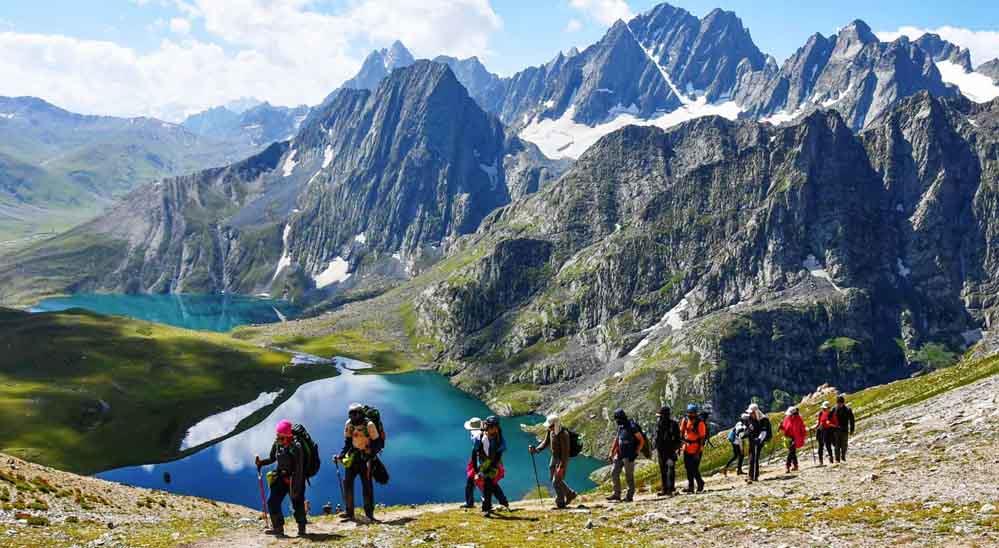
The Kashmir Great Lakes circuit, including Vishansar, Gadsar and Gangabal, along with Tarsar-Marsar and the Kishtwar-Ladakh trail stayed closed, even as 90 border routes near the Line of Control opened for the first time.
Officials pointed to fresh terror activity in the Pir Panjal range to justify continued restrictions around Margan Top, Chuharnag, Sinthan Top and the Danwass forests near Tangmarg.
The closures have come with a cost, as nearly 200 adventure-tour operators run businesses in the valley, according to the Adventure Tour Operators Association of Kashmir. Hundreds of guides, pony owners and support workers depend on a short season concentrated in June, July and August.
Some operators took loans for equipment and now struggle to repay them. Industry figures estimate that reopening the trails could lift tourist numbers by at least 20 percent.
That mismatch between demand and access helps explain how someone like Showkat can turn a trail ban into an opportunity.
A local intermediary who knows the checkpoints, the forest paths and the right people to call can become the only bridge between a trekker and a landscape officially closed to them.
Read Also Govt Makes Permission Mandatory for Trekking, Camping in Bhadarwah Lost in Ladakh Cold, Tourists Survive, Rescued AliveThe Kudara dispute shows how easily the roles of guide, gatekeeper and enforcer can blur into one.
Basic records could settle much of the disagreement. Who issued the group's permission? Did it come with a fee? Was Showkat authorized to collect payment? Did the Army or police actually call him about missing trekkers?
Those answers would show whether Kudara was a private dispute over a guide's charges or a glimpse of a wider informal system built around restricted trails.
The timing has its own impact, as trekking companies were still advertising Kashmir Great Lakes trips for September as late as August, even as major routes stayed off-limits.
On August 31, Lieutenant Governor Manoj Sinha ordered the reopening of the Naranag-Gangabal trek, a sign that the wider shutdown is beginning to lift.
Sameer and Showkat may eventually settle their dispute, but the larger problem remains unresolved: the government closed the trails, yet people continued to use them.
That disconnect has left the mountains in a legal grey area, where private operators can control routes, collect fees and operate without clear public oversight.

Legal Disclaimer:
MENAFN provides the
information “as is” without warranty of any kind. We do not accept any
responsibility or liability for the accuracy, content, images, videos,
licenses, completeness, legality, or reliability of the information
contained in this article. If you have any complaints or copyright issues
related to this article, kindly contact the provider above.
Comments
No comment