

Neurology Device Market Size To Hit USD 48.44 Billion By 2035, At A CAGR Of 10.83% - SNS Insider


Austin, United States, Sept. 03, 2026 (GLOBE NEWSWIRE) -- According to SNS Insider, The Neurology Device Market
Neurostimulation and neuromodulation devices, AI-enabled neuroimaging systems, and brain-computer interface solutions are being utilized for improving neurology care services as the investments in brain mapping studies are leading towards innovations in precision neuroscience treatments.
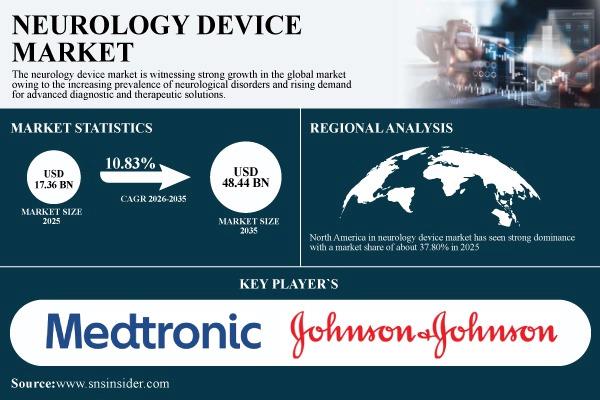
Neurology Device Market Key Highlights
- Market size, 2025: USD 17.36 Billion Market forecast, 2035: USD 48.44 Billion CAGR: 10.83% from 2026 to 2035 Largest region: North America, approximately 37.80% share in 2025 Fastest-growing region: Asia Pacific, approximately 12.60% share in 2025 Largest application: Neurostimulation, approximately 34.85% share in 2025 Fastest-growing application: Neurorehabilitation, approximately 18.17% CAGR Largest device type: Magnetic Resonance Imaging Devices, approximately 33.25% share in 2025 Fastest-growing device type: Deep Brain Stimulation Devices, approximately 16.15% CAGR Largest end user: Hospitals, approximately 45.60% share in 2025 Fastest-growing end user: Home Care Settings, approximately 18.29% CAGR
Market Relevance
Neurology treatment has emerged to be one of the crucial components of current medicine where according to WHO's estimation more than 1 out of every 3 individuals suffers from various neurologic problems and about 1 billion suffer from these diseases. There are about 12 million new patients with stroke every year while there are 50 million patients who have epilepsy disease.
Neurology Device Market Overview
The market is made up of neurostimulation, neuroimaging, and neurorehabilitation devices, which include MRI equipment, deep brain stimulation, and EEG monitoring devices, which are being used in hospitals, neurology practices, and at home. The MRI technology continues to play an important role in the accurate diagnosis of brain disorders using non-invasive methods, and both deep brain and spinal stimulation devices are used in the treatment of Parkinson's disease, epilepsy, and chronic pain conditions.
Strategic Market Outlook
Opportunities for growth lie in the increased research funding for neuroscience, which includes the U.S. NIH BRAIN initiative with funding for more than 1,000 ongoing projects for brain mapping, neural circuits decoding, and neurostimulation. According to the OECD, more than 54% of the usage of neurology devices in the advanced healthcare system lies in neurostimulation and interventional uses.
Lack of skilled personnel and the process of regulatory approval remain a key barrier. The neurology devices need skilled operators, but the lack of training in developing countries impedes the use of such technology, in addition to various certification needs for manufacturers.
Neurology Device Market Regional Analysis
North America held approximately 37.80% of the global market in 2025, making it the largest region. The United States accounted for approximately 78.65% of North American revenue, with neurological disorders impacting more than 1 in 6 adults and an annual incidence of about 795,000 strokes; over 500,000 DBS evaluations are conducted annually in the U.S.
The U.S. Neurology Device Market was valued at USD 5.16 Billion in 2025 and is expected to reach around USD 11.90 Billion by 2035, at a CAGR of 8.73% from 2026 to 2035. Parkinson's disease affects nearly 1 million people in the U.S., with approximately 90,000 new cases diagnosed annually, and the population aged 65 and older exceeds 58 million.
The Europe Neurology Device Market was valued at USD 5.21 Billion in 2025 and is expected to reach USD 13.76 Billion by 2035, at a CAGR of 10.20% from 2026 to 2035. Germany accounted for approximately 28.50% of European revenue. Neurological disorders affect over 179 million people across Europe, and over 21% of the EU population is aged 65 or older, with neurostimulation and monitoring device adoption exceeding 35% of tertiary neurological care centers.
The Asia-Pacific region is positioned to register the fastest CAGR growth, with a market share of about 12.60% in 2025. China accounted for approximately 42.00% of regional revenue. Separately, regional data shows Asia Pacific accounting for about 21.9% of global market share in 2025, with neurostimulation representing over 54% of product utilization in major hospitals, and Japan leading regional adoption with a 35.4% share in interventional neurology device usage.
Middle East & Africa: The UAE accounted for approximately 18.50% of regional revenue in 2025. Low-income countries average only 0.1 neurologists per 100,000 population compared with a global median of 3.1, while over 24% of countries have stand-alone neurological policies.
Latin America: Brazil accounted for approximately 46.00% of regional revenue in 2025.
Buy the Neurology Device Market Report with Competitive Analysis and 2035 Forecast:Neurology Device Market Segment Analysis
By Application: Neurostimulation held approximately 34.85% market share in 2025 due to the increasing prevalence of Parkinson's disease, epilepsy, and chronic pain disorder. The neurorehabilitation segment is estimated to grow at the fastest rate of around 18.17% CAGR during the forecast period due to the increasing burden of strokes and traumatic brain injuries and rising demand for robotic rehabilitation devices.
By Device Type: Magnetic Resonance Imaging Devices accounted for around 33.25% market share in 2025, due to its precision in diagnosing brain disorders and ability to be performed without any intrusion. Deep brain stimulation devices have been the fastest growing category, with a CAGR of about 16.15%. This is mainly due to increasing cases of Parkinson's disease and epilepsy.
By End User: The hospitals hold a market share of 45.60% in 2025 due to the presence of technologically equipped neurological centers and expertise. The Home Care Settings is expected to be the highest growth segment with 18.29% CAGR because of increasing preference for telepatient care and launch of portable neuro devices.
Neurology Device Market Key Trends
- Increasing adoption of neurostimulation and neuromodulation devices for Parkinson's disease, epilepsy, depression, and chronic disorders. Growing integration of AI in neuroimaging systems improving diagnostic accuracy and real-time clinical decision support. Rising investment in brain mapping research driving innovation in advanced neurotechnology. Expanding use of minimally invasive neurological procedures reducing patient recovery time. Increasing development of brain-computer interface technologies linking brain signals and external systems.
Competitive Landscape
The Neurology Device Market includes established medical device manufacturers, neuroimaging technology developers, and neurostimulation specialists, with competition centred on deep brain stimulation, thrombectomy, and adaptive neuromodulation innovation.
In 2026, Penumbra received FDA clearance for its next-generation Thunderbolt thrombectomy system for advanced neurovascular clot removal in acute ischemic stroke treatment. In 2025, Medtronic expanded its BrainSense adaptive deep brain stimulation system integration across Parkinson's treatment workflows and digital neuromodulation platforms. Boston Scientific expanded its neuromodulation portfolio in 2025 through the acquisition of Nalu Medical, enhancing peripheral nerve stimulation and chronic pain treatment capabilities. Abbott strengthened its neuromodulation portfolio in 2024, focusing on spinal cord stimulation and neurostimulation device advancements for chronic pain treatment.
Major key players include
- Medtronic Boston Scientific Corporation Abbott Laboratories Johnson & Johnson Siemens Healthineers GE HealthCare Koninklijke Philips N.V. Stryker Corporation Penumbra, Inc. LivaNova PLC Nihon Kohden Corporation Natus Medical Incorporated Integra LifeSciences Holdings Corporation Elekta AB Terumo Corporation Olympus Corporation Canon Medical Systems Corporation MicroPort Scientific Corporation Cadwell Industries B. Braun Melsungen AG


Legal Disclaimer:
MENAFN provides the
information “as is” without warranty of any kind. We do not accept any
responsibility or liability for the accuracy, content, images, videos,
licenses, completeness, legality, or reliability of the information
contained in this article. If you have any complaints or copyright issues
related to this article, kindly contact the provider above.
Comments
No comment