

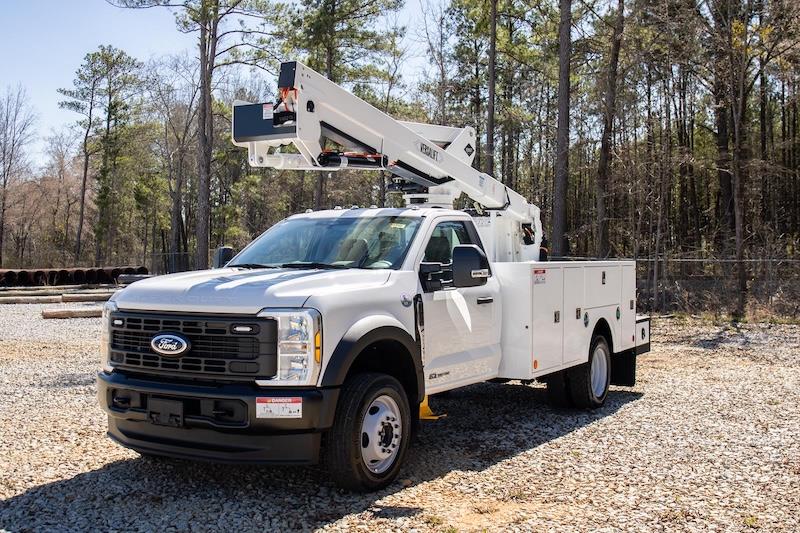
Signs Your Business Has Outgrown Its Current Work Vehicle


Nobody flagged it, because the truck started fine and got everybody home. That's the thing about outgrowing a vehicle: it almost never announces itself with a breakdown.
It shows up as fifteen extra minutes here, a rented trailer there, a job you quoted but didn't bid because hauling the material would have taken three runs.
Most owners looking at commercial work trucks are already six months past the point where the current one stopped fitting the work.
So here's how to spot that line before it costs you a season.
The Payload Math Nobody Runs Until it's Too LatePull the door jamb sticker on your truck. Find the GVWR, then subtract the curb weight. What's left is your real payload, and it's almost always smaller than the number in your head.
Now start subtracting. Two crew members at 200 pounds each. A full fuel tank. The ladder rack, the toolboxes, the compressor bolted to the bed. Some of that upfit weight came out of your payload the day it was installed, and nobody recalculated afterward.
What's left is what you can legally carry. If your typical load is bumping that ceiling, you're not running a truck that's a little small. You're running one that's outside its rating every time it leaves the shop, and your insurance carrier will find that interesting after an incident.
Run this number today. It takes four minutes and it settles most of the argument.
Four Signs That Show Up Before the Breakdown DoesThe failure signals arrive in a rough order, and they're easy to miss because each one looks like a bad day rather than a pattern.
You're making a second trip most days. One extra run a day at 45 minutes is roughly 180 hours a year of billable time turned into windshield time. That's the sign that costs the most and gets noticed the least.
Tools have migrated into the cab. When the bed is full and the passenger footwell is holding a grinder, the storage outgrew the truck before the payload did. Sometimes an upfit fixes that. Sometimes it means the chassis is already maxed.
You're renting or towing on jobs that used to be a single load. Trailers solve capacity, and they create new problems: slower routes, parking headaches on tight residential streets, and a weight threshold that can change your licensing picture entirely.
Shop visits cluster. Two unplanned repairs in six weeks on a vehicle you've owned five years isn't luck running out. It's a duty cycle running past what the truck was spec'd for.
What You're Seeing vs. What it Actually Means When Downtime Starts Costing More Than a PaymentThis is the calculation that changes minds, and almost nobody does it.
Take your average revenue on a working day, divide by the number of trucks that produce it, and that's roughly what one vehicle sitting in a bay costs you.
For a lot of trade businesses that lands somewhere between $400 and $800 a day once you count the idle crew, the rescheduled customer, and the load the other truck has to absorb. Ryder cites industry downtime benchmarks in that same range for a single truck out of service.
Now compare that to a monthly payment on a replacement. Four bad days a year and the math already tilts. Eight and it isn't close.
The broader cost picture backs this up. The American Transportation Research Institute's 2026 report put the industry-average cost to operate a truck at $2.336 per mile in 2025, the highest in the report's history, with costs excluding fuel up 4.2% to $1.854 per mile. Repair and maintenance was among the fastest-rising categories, up 8.6%.
That's heavy-duty Class 8 data, so your Class 3 service truck won't match those numbers directly. The direction is what matters: the cost of keeping an aging vehicle running is climbing faster than it used to.
Old trucks used to be cheap. They aren't anymore.
The Weight Line That Changes Who Can Legally Drive itHere's the one that catches growing businesses off guard, usually at a weigh station.
Under FMCSA rules, a Class B commercial driver's license is required for any single vehicle with a gross vehicle weight rating of 26,001 pounds or more. A Class A applies to combinations with a gross combination weight rating of 26,001 pounds or more where the towed unit is rated above 10,000 pounds.
That second one is the trap. Your F-350 might be rated at 14,000 pounds, and your trailer at 14,000 pounds. Actual scale weight could be nowhere near the limit, but the combined rating is 28,000 pounds, and the rating is what governs.
The GVWR on the federal certification label controls the determination regardless of what the truck actually weighs that day, so running a vehicle rated above the threshold without the right license is a serious violation even when the bed is empty.
If you've started towing to compensate for a truck that's too small, you may have quietly moved your operation across a licensing line. Worth checking the FMCSA guidance and your own state's rules, since states administer testing and endorsements and the details vary. Texas DPS, for instance, publishes its classification breakdown separately.
Sometimes moving up to a properly rated single chassis is the cheaper answer than towing forever. Sometimes it isn't. But you should know which side of the line you're on before a state trooper tells you.
Upfit or Replace: How to Tell Which One You Need Quick way to sort this.If the chassis has payload and towing capacity left over and the problem is organization, storage, or access, you have an upfit problem. A service body, a shelving package, or a properly specced ladder rack solves it for a fraction of a replacement.
If you're at or over the payload ceiling, or the duty cycle is chewing through brakes and transmissions, adding equipment makes it worse. Every pound of upfit comes straight out of what you can carry.
The honest test: would this truck still work if you deleted every piece of equipment on it and started over? Yes means upfit. No means shop. Browsing commercial work trucks by body type and vocation rather than by brand tends to surface the right answer faster, since the body and upfit specs are what actually determine whether a vehicle fits your work.
Run This Two-Week Log Before You ShopDon't buy off a hunch. Track four things for ten working days:
-
Extra trips to the yard or supply house per day
Jobs where you towed, rented, or split the load
Bids you passed on because of hauling capacity
Days the vehicle was unavailable
Two weeks of that turns a vague feeling into a number your accountant can work with. It also tells you what to buy, since a business making capacity trips needs different specs than one losing days in the shop.
Buy for the Work You're Winning, Not the Work You Had
Most owners replace a truck with a slightly better version of the same truck. Then they outgrow it again in two years and wonder why.
Spec against the jobs you're bidding on now, plus whatever you've been turning down. If your crew grew from two to four, the cab configuration matters more than the bed. If material hauling doubled, payload matters more than towing.
The truck that fit you at 12 jobs a month probably doesn't fit you at 30. That's not a failure. That's growth showing up in the one place nobody thinks to look.
What did your last two weeks actually cost you?

Legal Disclaimer:
MENAFN provides the
information “as is” without warranty of any kind. We do not accept any
responsibility or liability for the accuracy, content, images, videos,
licenses, completeness, legality, or reliability of the information
contained in this article. If you have any complaints or copyright issues
related to this article, kindly contact the provider above.
Comments
No comment