

Azerbaijan Calls For International Funding To Turn Mine Action Into 'Peace Infrastructure'


Azerbaijan has called for greater international support for mine action, arguing that demining should be treated not only as a humanitarian responsibility but also as an essential component of peacebuilding and the long-term normalization of relations between Azerbaijan and Armenia.
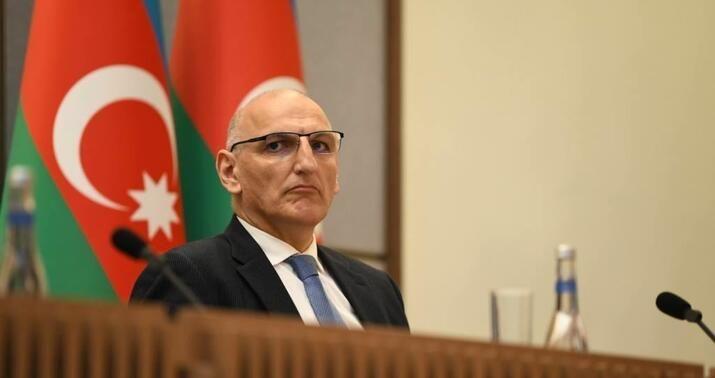
Addressing the second day of the 4th International Mine Action Conference in Baku on Thursday, Elchin Amirbayov, Representative of the President of Azerbaijan on special assignments, said peace could not be considered complete while landmines continued to threaten lives, obstruct the return of internally displaced persons and hinder economic recovery.
“The shooting has stopped. But the mines have not,” Amirbayov said.
He stressed that the physical consequences of war continue to affect the prospects for sustainable peace.
“Peace cannot be considered complete while the physical consequences of war continue to threaten lives, block movement, limit economic activity, slow down return of IDPs and stand in the way of normalization of inter-state relations,” Amirbayov said.
According to him, humanitarian demining has therefore become “much more than a humanitarian task” and should increasingly be viewed as a peacebuilding effort.
“You cannot build peace on unsafe ground,” he said, noting that the UN Peacebuilding Commission had also recognized mine action as an enabler of peacebuilding, reconciliation and recovery.
Amirbayov recalled the August 8, 2025 Washington process between Azerbaijan and Armenia, when the text of the peace agreement was initialled and the two countries' leaders signed a joint declaration outlining a vision for relations beyond their decades-long conflict.
He said that since the Washington meeting, Azerbaijan and Armenia had experienced de facto peace, with no military escalation between the two countries, while government and civil-society dialogue, trade, economic interaction and connectivity initiatives had continued.
“We hope that very soon the remaining obstacle will be removed to enable the parties to sign the peace agreement and to codify peace,” Amirbayov said.
However, he argued that political agreements alone were insufficient to make peace tangible for communities.
“Peace has to be made visible on the ground,” he said, pointing to landmines as one of the major obstacles to this process in Azerbaijan.
Since the end of the 2020 war, 437 people in Azerbaijan have been killed or injured by landmines, according to Amirbayov. He said each new casualty not only represents a humanitarian tragedy but also affects public confidence in the normalization process.
“Every mine explosion today has consequences far beyond the immediate victim. It hampers the atmosphere in which peace is being built,” he said.
Amirbayov also highlighted the scale of the contamination, saying more than 13 percent of Azerbaijan's territory had been affected by mines and unexploded ordnance, while 75 percent of mine-contaminated territory remained affected by the threat.
The issue has become particularly significant as Azerbaijan continues its large-scale reconstruction and Great Return process in the territories previously affected by the conflict.
Former internally displaced persons are returning, while residential areas, roads, schools, hospitals and economic infrastructure are being reconstructed.
“You cannot rebuild a community before you can safely clear the ground beneath it,” Amirbayov said.
Against this backdrop, he called for a stronger and more predictable international role in Azerbaijan's mine-action efforts.
According to Amirbayov, approximately 95 percent of financing for mine action in Azerbaijan currently comes from the country's own state resources, while only around 5 percent comes from international sources.
“We believe that this imbalance can and needs to change,” he said.
Amirbayov proposed the creation of a long-term international funding mechanism for Azerbaijan's mine action, emphasizing the need for predictable, multi-year financing rather than relying primarily on emergency contributions and individual projects.
Such funding, he said, would allow Azerbaijan to plan operations, recruit and train personnel, invest in equipment and accelerate the clearance of contaminated areas.
“We need to finance the solution, not simply manage the problem,” Amirbayov said.
He also called for stronger international cooperation on mine-action technologies, including artificial intelligence, drones, satellite imagery, advanced surveying, mechanical demining and data technologies.
“Azerbaijan has the ambition to become a regional centre of excellence in mine action and is open to such cooperation,” he said.
Amirbayov further proposed making mine action part of confidence-building efforts in the South Caucasus, arguing that humanitarian issues can create opportunities for practical cooperation even when political questions remain sensitive.
He described mine clearance as the opposite of the purpose of mines, which he said are designed to stop movement, prevent people from returning, keep land unproductive and preserve fear.
“Demining does exactly the opposite. It opens roads, reconnects communities, restores livelihoods and enables return. It also creates confidence in the future,” Amirbayov said.
He urged the international community to view each cleared area as part of the infrastructure of peace.
“Perhaps we should begin to think of every mine clearance not simply as a humanitarian operation, but as a small part of peace infrastructure,” he said.
Concluding his remarks, Amirbayov said Azerbaijan and Armenia had a“unique opportunity to turn a page” and build a South Caucasus based on peace, connectivity, economic cooperation and good-neighbourly relations.
“If we want peace to be sustainable, durable and irreversible, we must remove the remnants of war both from the ground and from existing political and legal framework,” he said.
“Let us make peace something people can walk on, live on, build on - and pass on to their children.”

Legal Disclaimer:
MENAFN provides the
information “as is” without warranty of any kind. We do not accept any
responsibility or liability for the accuracy, content, images, videos,
licenses, completeness, legality, or reliability of the information
contained in this article. If you have any complaints or copyright issues
related to this article, kindly contact the provider above.
Comments
No comment