

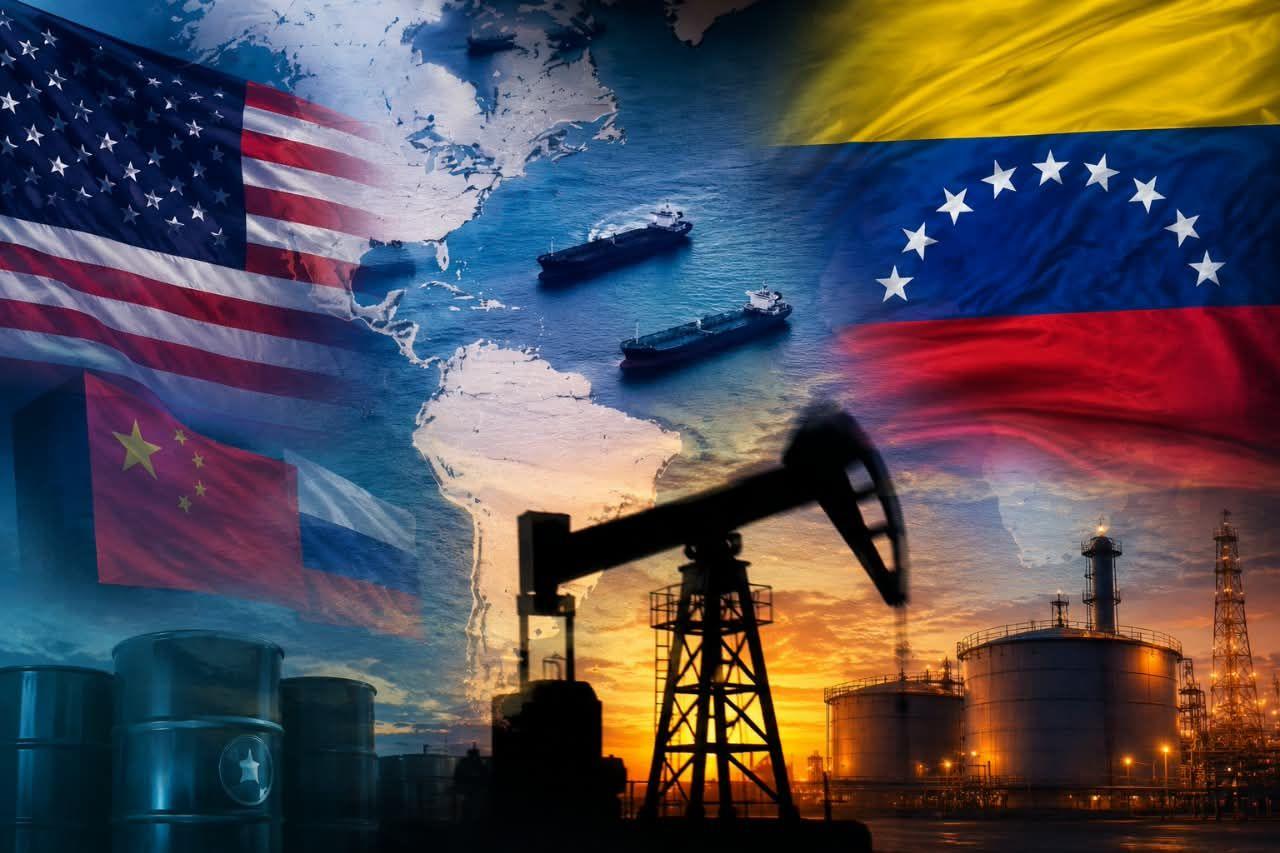
Washington's Venezuela Oil Deal Threatens China And Russia's Energy Grip


Late summer handed the oil market something it hadn't seen in decades. Washington and Caracas signed an energy agreement that can seriously change the balance of power in the global oil market. In practice, its implications stretch far beyond production figures and corporate profits. It could reshape who has influence over Venezuelan oil, weaken the position of China and Russia, and give Washington a new source of leverage in a global market already being strained by wars, sanctions and insecure shipping routes.
At the heart of the agreement is a long-term development plan involving North American Blue Energy Partners (NABEP), which has reportedly been granted a 100-year framework to develop 17 Venezuelan oil fields. The Venezuelan government expects these projects to generate more than $209 billion in tax revenues, while private operators are expected to play a major role in increasing production.
What Washington gets:
The terms secured by the US side are unusual even by the standards of major international oil agreements.
-
The Pentagon's Office of Strategic Capital receives a 35% stake
in NABEP's parent company;
The US State Department is guaranteed the right to purchase 20%
of total production at the cost of production;
For the remaining 80% of output, the United States receives the
right of first refusal;
The US side has veto power over the appointment of board
members;
A majority of the board members must be US citizens.
This structure effectively gives Washington direct influence not only over Venezuela's oil production, but also over where a significant share of that crude will ultimately be sold.
There is also an obvious geopolitical dimension to the agreement. Of the 14 new NABEP contracts, several relate to fields previously handled by Chinese companies, including Sinopec and China National Petroleum Corporation, and one of the fields was managed by a Russian entity. Thus, Washington is not just gaining access to Venezuelan reserves - it is simultaneously displacing China and Russia from a number of strategically important oil projects.
Energy Secretary Chris Wright told CNBC that Venezuelan output could clear 1.5 million barrels per day in the first half of next year. Today the country pumps about 1.25 million.
That gap between what Venezuela has and what Venezuela produces is the whole story in one line. Years of underinvestment, mismanagement and sanctions turned a petro-superpower into an underperformer. For the United States, greater access to Venezuelan oil could provide a new source of supply at a time when global energy markets are under growing pressure. The agreement could also give Washington another card to play in its dealings with OPEC and its production and pricing policies. If Venezuela eventually reduces its dependence on OPEC or even considers leaving the organization, the impact could be felt across the wider oil market.
Venezuela has 303.008 billion barrels of proven oil reserves as of 2025, making it the country with the largest proven reserves in the world and accounting for around 17.17% of global oil reserves, estimated at 1.765 trillion barrels. The country's proven reserves are equivalent to approximately 3,540.5 years of domestic consumption, based on 2024 consumption levels. In other words, if consumption remained at that level and Venezuela did not export any oil, its proven reserves alone would theoretically last for around 3,540 years, excluding any undiscovered or unproven resources.
For years China has been one of the most important buyers of Venezuelan crude and one of its most important financiers - oil-for-loans arrangements that kept Caracas solvent when nobody else would take the call. Russia, for its part, has maintained tight political and energy ties with the Maduro government.
If American firms end up as the dominant investors and operators, both find themselves with markedly less room to maneuver in one of the world's most resource-rich producers.
Countries with enormous oil reserves are increasingly finding themselves constrained not by a lack of resources, but by sanctions, conflict and disruptions to transportation routes. Russia and Iran, for example, remain under extensive sanctions that complicate their access to international markets. Meanwhile, the security situation in the Middle East has created additional risks for energy exporters.
The Strait of Hormuz has become a dangerous place for ships, with rising security risks threatening one of the world's most important energy corridors. The same is true of the Red Sea, where attacks on commercial shipping have increased insurance costs and forced some vessels to take longer routes. For major producers in the Gulf, including Saudi Arabia and Qatar, the problem is therefore not simply how much oil and gas they can produce. It is also whether those resources can reach international buyers safely.
Seen against this wider backdrop, the US-Venezuela deal takes on an entirely different color. With gasoline prices climbing as the US-Iran war drives up energy costs, bringing more oil onto the market from outside the Middle East could offer some much-needed relief at the pump. According to CNBC, the push comes as affordability and gas prices loom over the midterm election. [note: the 2026 United States Senate elections are scheduled to be held on November 3, 2026]
Earlier, U.S. Secretary of the Interior Doug Bergum said on Fox Business that the agreement would "shift the geopolitical center of the global energy market [...] away from the bottlenecks of the Middle East" back to the Western Hemisphere.
However, the question of the agreement's political durability remains. A 100-year term is far longer than the lifespan of any current administration in either Caracas or Washington. Even now, lawyers and energy experts are questioning the legitimacy of certain elements of the deal, as well as the absence of a fully competitive bidding process.

Legal Disclaimer:
MENAFN provides the
information “as is” without warranty of any kind. We do not accept any
responsibility or liability for the accuracy, content, images, videos,
licenses, completeness, legality, or reliability of the information
contained in this article. If you have any complaints or copyright issues
related to this article, kindly contact the provider above.
Comments
No comment