

Our Pay Is Called A 'Salary', But Were Roman Soldiers Really Paid In Salt?


Recently, though, as I contemplated its fortnightly appearance and disappearance, I started thinking about the origin of the word“salary”. As a historian of the ancient Roman Empire, I often think about the modern legacy it continues to bestow.
It's a common belief that the English word“salary” derives from the Latin word salarium because Roman soldiers were sometimes paid in actual blocks of salt.
Sal, the Latin word for salt, also turns up in various other salt-related words in English, from saline to salami.
While it's an attractively neat idea, there are some significant problems with this theory. Here's what we actually know about how Roman soldiers were paid.
Worth one's saltThere's strong evidence salt was a valuable and widely used commodity in the ancient world. For a society without modern refrigeration, it played an important role in food preservation (particularly for meat and fish). It was also portable, so it's not surprising that the idea of soldiers being paid in salt caught on.
Peter Gainsford, a New Zealand-based classicist, points out the English word“salary” does indeed derive from the Latin“salarium”, which translates to“stipend or money allowance”.
But, Gainsford argues, while there is a link between“salarium” and“sal”, the Latin word for salt, there is no evidence this link is because Roman soldiers were paid in salt.
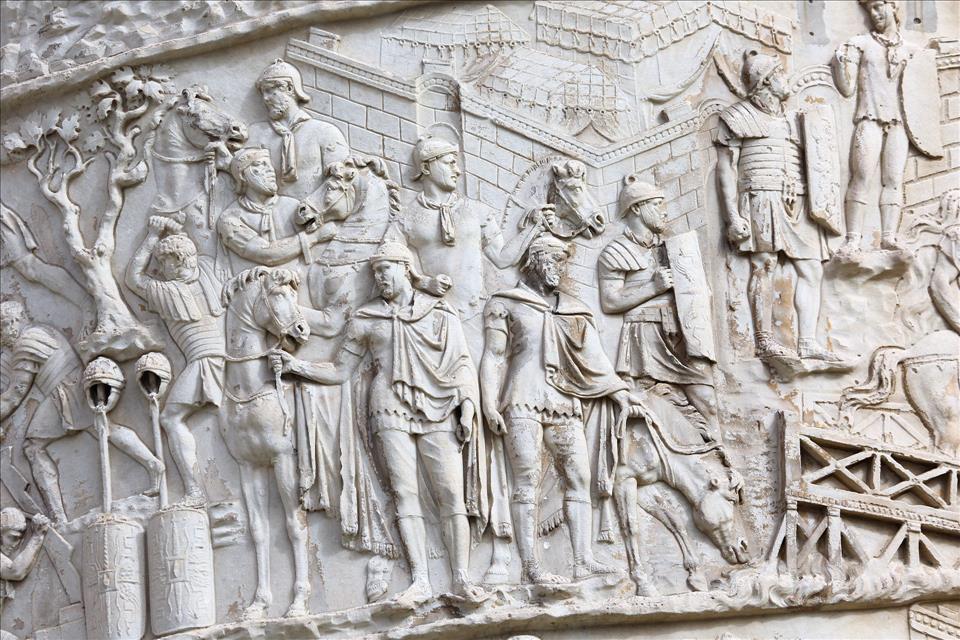
'Loyalty of the soldiers'The evidence we have suggests Roman soldiers were paid principally in coins, especially silver coins. Roman silver coins often contained images with military themes.
Coins depicting Fides, goddess of good faith and mutual trust, and the term fides militum, meaning“loyalty of the soldiers”, were among the most common.
The ancient Roman historian Livy claimed the Roman state took responsibility for the regular pay of soldiers in 405 BCE. Livy doesn't tell us the amount, just that they were now paid by the state.
This payment was called the stipendium – from which the modern word“stipend” derives. Up to this point, soldiers had served at their own expense.
Payment of the stipendium was made in instalments three times a year. Deductions were made for clothing, food and even funeral provisions before the net amount was paid to soldiers.
More than three centuries later, in around 50 BCE, Julius Caesar doubled the stipendium to 225 denarii per year. A loaf of bread at the time cost up to a quarter of one denarius.
By the end of the second century CE, the amount had increased to 600 denarii. Note, these were the figures for ordinary foot soldiers or legionaries. Centurions and other officers were paid at considerably higher rates.
Getting a bonusOver time, however, the stipendium was not enough. Problems with inflation, especially in the third century CE, led to soldiers demanding greater pay.
Supplemental payments were made to soldiers, especially in a form called donativa which were essentially a kind of bonus. These bonuses significantly increased the total income they received.
Donativa were paid annually and bound the army's loyalty more directly to individual emperors. Emperors understood that paying donativa at lower amounts or refusing to pay them altogether potentially caused disloyalty.
As the emperor Septimius Severus (reigned 193–211 CE) lay on his deathbed, advice he gave to his sons demonstrated the importance of this idea clearly:“Be harmonious, enrich the soldiers, and scorn all other men.”
Other perks of the jobOnce a Roman soldier swore the military oath, known as the sacramentum, it was typically expected he would give 25 years of service.
However, regular income – together with the possibility of bonuses – made serving in the army an attractive proposition for many. There were other benefits for soldiers, too.
On their retirement, soldiers received the praemia militiae, a lump sum of 3,000 denarii (12,000 sesterces) at the time of Augustus' reign towards the end of the first century BCE. This increased over time.
In the fourth century CE (and perhaps earlier), soldiers also received an allowance for food, clothing and other items. This was raised from a special tax called the annona militaris.
An ancient inflation crisisA crisis in the silver currency in the third century saw soldiers lose faith in its value.
In the fourth century, during the reign of the emperor Constantine (306–337), a new gold piece was minted. This was known as the solidus.
The solidus weighed 4.5 grams, replacing the earlier aureus of 7.5 grams. It became the most trusted and reliable denomination in the Roman world for a thousand years.
Soldiers were its key beneficiary and there is a popular suggestion that the word“soldier” derives from solidus.
However, similar to suggestions of the origins of“salary” and salt, there is no clear evidence that“soldier” derives from solidus.
Read more: This history of currencies suggests the US dollar's dominance may fade – but it will happen slowly
A grain of truth?Thousands of words in modern English and European languages have their origins in Latin (and also ancient Greek). The connection between“salary” and the Latin word salarium is an example.
The preservation qualities of salt made it a vital commodity for soldiers. On campaign and in barracks it was a necessity.
There is no evidence, however, that this was connected to Roman soldiers being paid in salt. Coins did that job admirably.


Legal Disclaimer:
MENAFN provides the
information “as is” without warranty of any kind. We do not accept any
responsibility or liability for the accuracy, content, images, videos,
licenses, completeness, legality, or reliability of the information
contained in this article. If you have any complaints or copyright issues
related to this article, kindly contact the provider above.
Comments
No comment