

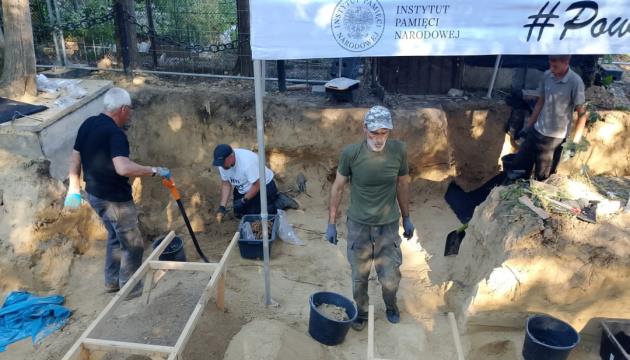
Remains Of 17 Polish Army Soldiers And Seven German Troops Exhumed In Lviv


“The burials are arranged in three rows, each 45–50 meters long. In the first row, which we have partially examined, we found about 20 burial pits. We exhumed the remains of six Polish Army servicemen from them. There are items confirming this: uniform buttons bearing the Polish coat of arms, various fasteners, hooks and rings characteristic of Polish soldiers' equipment. We did not find any military identification devices, also known as dog tags, in these burials,” the head of the society said.
Search teams also exhumed from the first row the remains of seven soldiers from German armed formations, specifically the 1st Mountain Division of the German Wehrmacht, which was partly made up of Austrian citizens. Three of them had identification tags.
“We notified the German War Graves Commission in Ukraine about this. They immediately found in their archival records a list of German servicemen who died in Holoskiv, which gives dates of death ranging from September 14 to 20, 1939. We also know that Polish soldiers died during the same period. The German servicemen were buried among the Polish soldiers. They had no military equipment or weapons with them. All these indications suggest that local residents buried the dead after the fighting had ended, as the military units did not take the bodies with them,” Horbach said.
Search teams have also fully examined the second row of graves, where they found approximately 40–50 individual burial pits.
“Here we exhumed the remains of 11 people. One of them had an identification tag clearly indicating that he was a Catholic, so he was most likely Polish by nationality. It is difficult to identify the nationality of the other exhumed Polish Army servicemen because there are no items in the graves that could help establish their identity. This unit included Poles, Ukrainians and representatives of other nationalities who served in or were mobilized into the Polish Army,” the head of the Pamiat Society for Searching for War Victims added.
Ukrainian and Polish specialists are continuing the exhumation work at Holoskivske Cemetery in Lviv. The work is preliminarily expected to continue until October 2.
Read also: Former Polish PM urges Poland and Ukraine to resolve historical disputes and look aheadAs reported by Ukrinform, on August 25, about 30 specialists from Ukraine and Poland began search and exhumation operations at Holoskivske Cemetery in Lviv, which will continue until October 2. The exhumation research is being conducted in implementation of agreements reached through the work of the Ukrainian-Polish Working Group on National Memory.
On the Ukrainian side, the search and exhumation work is being carried out by a team from the Pamiat Society for Searching for War Victims; on the Polish side, by staff of the Institute of National Remembrance of the Republic of Poland and Wroclaw Medical University.
According to search operations conducted in 2010 and 2019, 110–120 individual graves of Polish Army soldiers were identified at the cemetery. The soldiers were killed in battles against units of German military formations that surrounded Lviv from the west and south in September 1939.
Photos provided by Lubomyr Horbach

Legal Disclaimer:
MENAFN provides the
information “as is” without warranty of any kind. We do not accept any
responsibility or liability for the accuracy, content, images, videos,
licenses, completeness, legality, or reliability of the information
contained in this article. If you have any complaints or copyright issues
related to this article, kindly contact the provider above.
Comments
No comment