

Infertility Drugs Market Size To Hit USD 7.58 Billion By 2035, At A CAGR Of 6.03% - SNS Insider


Austin, United States, Sept. 02, 2026 (GLOBE NEWSWIRE) -- According to SNS Insider, The Infertility Drugs Market
New-generation gonadotropin products, injectable-oral combined treatments, and AI-aided individualized treatment approaches are helping in modernizing infertility treatment, whereas online pharmacies are making the distribution of fertility drugs more widespread through the integration of telemedicine.
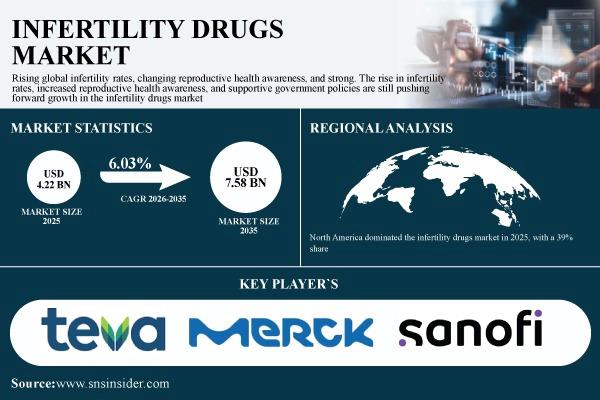
Infertility Drugs Market Key Highlights
- Market size, 2025: USD 4.22 Billion Market forecast, 2035: USD 7.58 Billion CAGR: 6.03% from 2026 to 2035 Largest region: North America, approximately 39% share in 2025 Fastest-growing region: Asia Pacific, approximately 6.53% CAGR Largest & fastest-growing drug class: Gonadotropins, approximately 39% share in 2025 Largest distribution channel: Hospital pharmacies, approximately 53% share in 2025 Fastest-growing distribution channel: Online pharmacies, approximately 6.63% CAGR Largest route of administration: Oral, approximately 46.8% share in 2025 Fastest-growing route of administration: Transdermal/intranasal, approximately 7.4% CAGR Largest & fastest-growing end user: Women, approximately 73% share in 2025
Market Relevance
Infertility treatment has gained importance in today's reproductive health sector with an estimate from WHO that 48 million couples are affected around the globe along with 186 million people affected. Increased infertility cases reported by CDC in the age range of 15 to 44 years for the U.S. women which are around 12% along with increased number of ART clinics in the U.S., which have reached a figure of 489 clinics has greatly increased the need for medicines.
Infertility Drugs Market Overview
This market is made up of gonadotropins and other hormonal drug types that can be accessed through hospitals and internet pharmacies. These drugs are delivered through various modes such as oral, injection, transdermal, and intranasal. Recombinant FSH and hCG drugs continue to play an integral role in ovulation induction and hormonal therapy in assisted reproduction technology (ART) and IVF treatment cycles.
Strategic Market Outlook
Growth opportunities exist in personalized medicine that includes reproductive prediction via the use of artificial intelligence and recombinant hormones based on personalized protocols. The development of genomic tests until 2024 enhanced the success rate of preimplantation genetic testing by improving its accuracy and the expansion of public funding – especially 70% public funding of reproductive treatment costs in Japan and continued NHS coverage in the UK - expanded the target market.
The lack of insurance coverage and high cost of procedures are key limiting factors. On average, patients go through 2.5 treatment cycles before conceiving where each round of IVF costs from USD 15,000 to USD 30,000 and 19 US states provided insurance coverage for infertility treatment up to 2024.
Infertility Drugs Market Regional Analysis
North America held approximately 39% of the global market in 2025, making it the largest region, with the United States accounting for approximately 78% of regional revenue, supported by 489 ART centers nationwide and government regulation extending health insurance coverage for assisted reproductive technology and fertility hormone therapy.
The U.S. Infertility Drugs Market was valued at approximately USD 1.28 Billion in 2025 and is expected to reach approximately USD 2.28 Billion by 2035, growing at a CAGR of approximately 5.92%.
The Europe Infertility Drugs Market was worth USD 1.27 Billion in 2025 and is anticipated to reach USD 2.22 Billion by 2035, expanding at a CAGR of 5.80% from 2026 to 2035. Germany accounted for approximately 24% of European revenue in 2025, supported by government backing of biosimilar infertility treatment drugs and NHS coverage of fertility drugs in the UK.
The Asia-Pacific region is the fastest-growing region with a CAGR of approximately 6.53%, with China contributing approximately 37% of regional revenue in 2025. Japan finances 70% of fertility treatment costs, while India serves as a major producer of low-cost infertility treatment drugs.
Middle East & Africa: Saudi Arabia leads regional demand at approximately 26% of regional revenue in 2025.
Latin America: Brazil leads regional demand at approximately 36% of regional revenue in 2025.
Buy the Infertility Drugs Market Report with Competitive Analysis and 2035 Forecast:Infertility Drugs Market Segment Analysis
By Drug Class: The Gonadotropins held nearly 39% of market share in 2025 with respect to recombinant FSH and hCG for ovulation induction and hormone therapy for ART and IVF procedures and this category of product is projected to grow at a faster rate.
By Distribution Channel: Hospital pharmacies have a share of 53% in the market as of 2025, due to the convenience of access and their associations with ART and fertility centers. Online pharmacies are growing at the fastest rate, with a CAGR of 6.63%.
By Route of Administration: The market share of oral administration was about 46.8% in 2025. The highest CAGR route was transdermal/intranasal route at around
By End-User: Women accounted for around 73% market share in 2025, reflecting that female infertility affects approximately 12% of U.S. women aged 15 to 44, and this segment is also expected to witness the fastest growth.
Infertility Drugs Market Key Trends
- Development of next-generation gonadotropin formulations aimed at reducing ovarian hyperstimulation syndrome risk Growing adoption of combination oral-injectable therapies to enhance ovarian stimulation and IVF success rates Increasing use of artificial intelligence to personalize hormone therapy selection and predict reproductive outcomes Expansion of online pharmacy distribution through telemedicine integration Ongoing stem cell and regenerative medicine research targeting male reproductive disorders
Major key players include
- Teva Pharmaceutical Industries Ltd. Merck KGaA Ferring B.V. Bayer AG Livzon Pharmaceutical Group Inc. Mankind Pharma Limited Sanofi S.A. Pfizer Inc. IBSA Institut Biochimique SA Organon & Co. Fuji Pharma Co., Ltd. Cipla Limited Sun Pharmaceutical Industries Ltd. Dr. Reddy's Laboratories Ltd. Lupin Limited Gedeon Richter Plc. Besins Healthcare Theramex Laboratoire CCD Genea Biomedx


Legal Disclaimer:
MENAFN provides the
information “as is” without warranty of any kind. We do not accept any
responsibility or liability for the accuracy, content, images, videos,
licenses, completeness, legality, or reliability of the information
contained in this article. If you have any complaints or copyright issues
related to this article, kindly contact the provider above.
Comments
No comment