

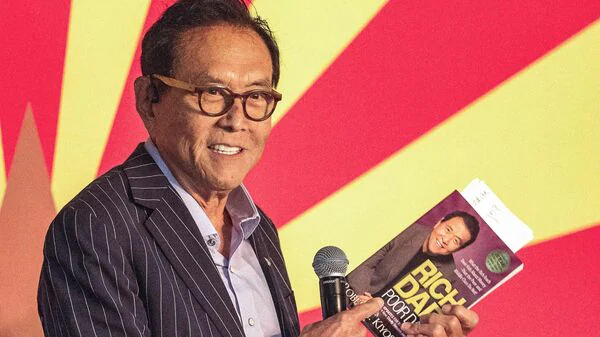
'Rich Dad Poor Dad' Self-Help Author Robert Kiyosaki Is $1.2 Billion In Debt, But...


Far from hiding the staggering balance, the 79-year-old author has actively flaunted it, framing aggressive borrowing for cash-generating assets as a quintessential wealth-building playbook.
“So, I'm a billion two in debt,” he told the“Get Rich Education” podcast. However, he added that people“[s]hould not do what I do, right?”
As ironic as it sounds, Kiyosaki said he has been studying debt since 1974.“If you're going to learn to use debt, you'd better take some education.”
Also Read | Real cost of financial ignorance: Robert Kiyosaki explains 'what is expensive' Truth behind the $1.2 billion debtThe massive debt figure is widely misunderstood, said his ex-wife and business partner, Kim Kiyosaki. She told Vanity Fair clairified that the amount does not represent money the best-selling author personally owes, but is attached to real estate.
“We have a lot of apartment houses with our partners,” Kim said, putting the portfolio at some 1,500 units.“So technically, yes, we have all this debt,” she said, noting that Kiyosaki's personal share is small.
“He loves to say things that shock,” Kim told the magazine, adding that Kiyosaki uses the billion-dollar figure to grab attention before explaining“why investment debt is good.”
According to Vanity Fair's estimates, Kiyosaki's portion of the debt could be between $30 million and $60 million if his claim that he pulls in roughly $3 million a year is accurate.
Also Read | 'Global economy is crashing': Robert Kiyosaki repeats market crash prediction Kiyosaki's investment strategyAccording to Vanity Fair, Kiyosaki's ten-figure debt is actually by design: he leverages growing real estate equity to unlock tax-free income through new loans. To manage the downside, each asset is housed within its own limited liability company, effectively fire-walling individual investments against default.
“If it all comes to hell, you can talk to my attorney,” Robert Kiyosaki told the magazine.“Firewalls - that's the way the rich play the game.”
What do experts say about it?Financial experts weighed in on Kiyosaki's staggering debt pile in a report by The New York Post, revealing sharp division over the strategy.
Calling the approach“a great strategy,” tax professional and real-estate investor David A. Perez told The Post that carrying high property debt is“actually very normal.”
Since borrowing against equity avoids an outright sale, it generates tax-free liquidity, Perez explained-even if it ramps up mortgage costs and crimps operational cash flow.
But wealth consultant John Poole urged extreme caution, telling The Post:“I think there's good debt and there's bad debt, and then there's $1.2 billion of debt, which you better know exactly what in the world you're doing.”
Pointing out that leverage acts“like a chainsaw financially coming down” if values stall, Poole dismissed the idea of relying on endless refinancing.“It doesn't go on forever. There has to be a payday... [Kiyosaki] may call this the 'Rich Dad debt,' but for the average investor, it could turn out to be 'Poor Dad bankruptcy' really quickly.”
Also Read | Gold at $10,000, Silver at $200? Robert Kiyosaki says market crash is imminent About Robert KiyosakiRobert Kiyosaki built a massive financial-education empire on the back of 'Rich Dad Poor Dad', a title first self-published in 1997 that has since crossed 44 million copies in sales, according to Vanity Fair.
The blockbuster book pits the contrasting life lessons of two mentor figures: Kiyosaki's biological father, the 'Poor Dad', and the father of his childhood best friend, the titular 'Rich Dad'.
His biological father, Ralph Kiyosaki, was Hawaii's state superintendent of education who launched an unsuccessful bid for lieutenant governor in 1970. The 'Rich Dad' was later revealed to be Richard Kimi, a prominent Hawaii entrepreneur whose hospitality portfolio once included the Waikiki Biltmore Hotel.
Drawing from these influences, Kiyosaki has long championed parking money in cash-flowing assets like real estate, minimising tax exposure, and drawing a hard line between "good debt" taken to acquire investments and "bad debt" used to finance personal consumption.

Legal Disclaimer:
MENAFN provides the
information “as is” without warranty of any kind. We do not accept any
responsibility or liability for the accuracy, content, images, videos,
licenses, completeness, legality, or reliability of the information
contained in this article. If you have any complaints or copyright issues
related to this article, kindly contact the provider above.
Comments
No comment