

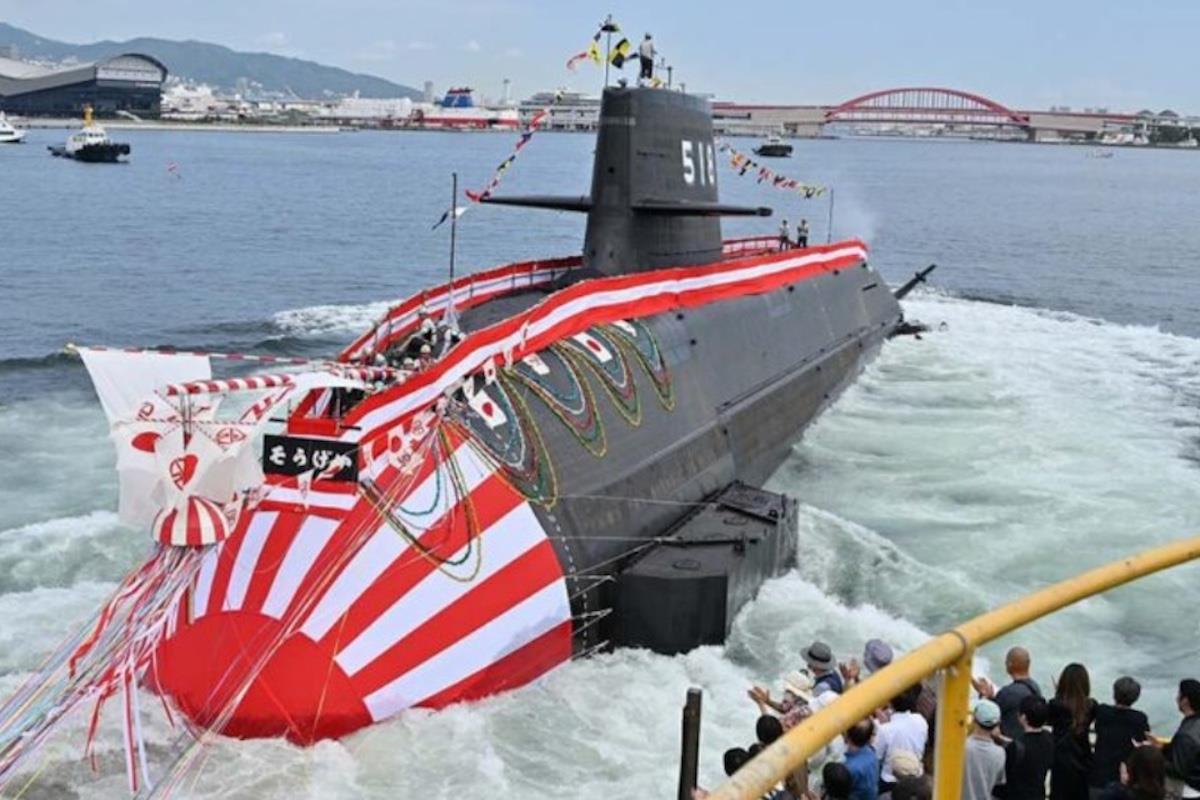
Japan's Hypersonic Subs Bring It Closer To The Nuclear Edge


Japan's Ministry of Defense (MoD) officially included plans to develop underwater-launched hypersonic missiles in the fiscal year 2027 budget request, intended to strengthen its standoff“counterstrike capability” against adversary bases, multiple media outlets reported.
A MOD rendering shows a submarine with two or three vertical launch system (VLS) tubes, each carrying seven or eight solid-fuel boost-glide Hyper Velocity Gliding Projectile (HVGP) missiles.
A boost-glide weapon uses a large rocket booster to reach the upper atmosphere, with the glider coasting to the target at Mach 5 and faster. While practical, the large booster limits the missile count, and each maneuver costs energy with no speed recovery.
Later versions of the HVGP are designed for longer range, with the Enhanced Capability Version Block 2A having a 2,000-kilometer range and the Block 2B planned for 3,000 kilometers.
Japan is also developing scramjet-powered hypersonic cruise missile (HCM) technology for future underwater launch.
Unlike a boost-glide weapon, an HCM uses a booster to accelerate to the speed at which its scramjet can operate; the engine then ingests supersonic airflow and sustains thrust in flight. That could enable a more compact missile, but the technology remains complex and immature.
Alongside crewed platforms, Japan is researching launch capabilities to arm modular unmanned underwater vehicles (UUVs) with long-range strike weapons, thereby supplementing Japan's smaller submarine fleet.
Deploying these stealthy, submerged strike systems would create a persistent, hard-to-detect threat capable of holding Chinese naval combatants and amphibious fleets at risk across the First Island Chain during a regional conflict.
The program, included in Japan's broader FY2027 defense budget request, signals a shift toward more survivable maritime strike platforms.
The key question is whether Japan's submarine-launched hypersonic weapons can overcome the operational and political limits of its counterstrike posture while also laying the foundations for a more survivable-and potentially nuclear-capable-sea-based deterrent.

Legal Disclaimer:
MENAFN provides the
information “as is” without warranty of any kind. We do not accept any
responsibility or liability for the accuracy, content, images, videos,
licenses, completeness, legality, or reliability of the information
contained in this article. If you have any complaints or copyright issues
related to this article, kindly contact the provider above.
Comments
No comment