

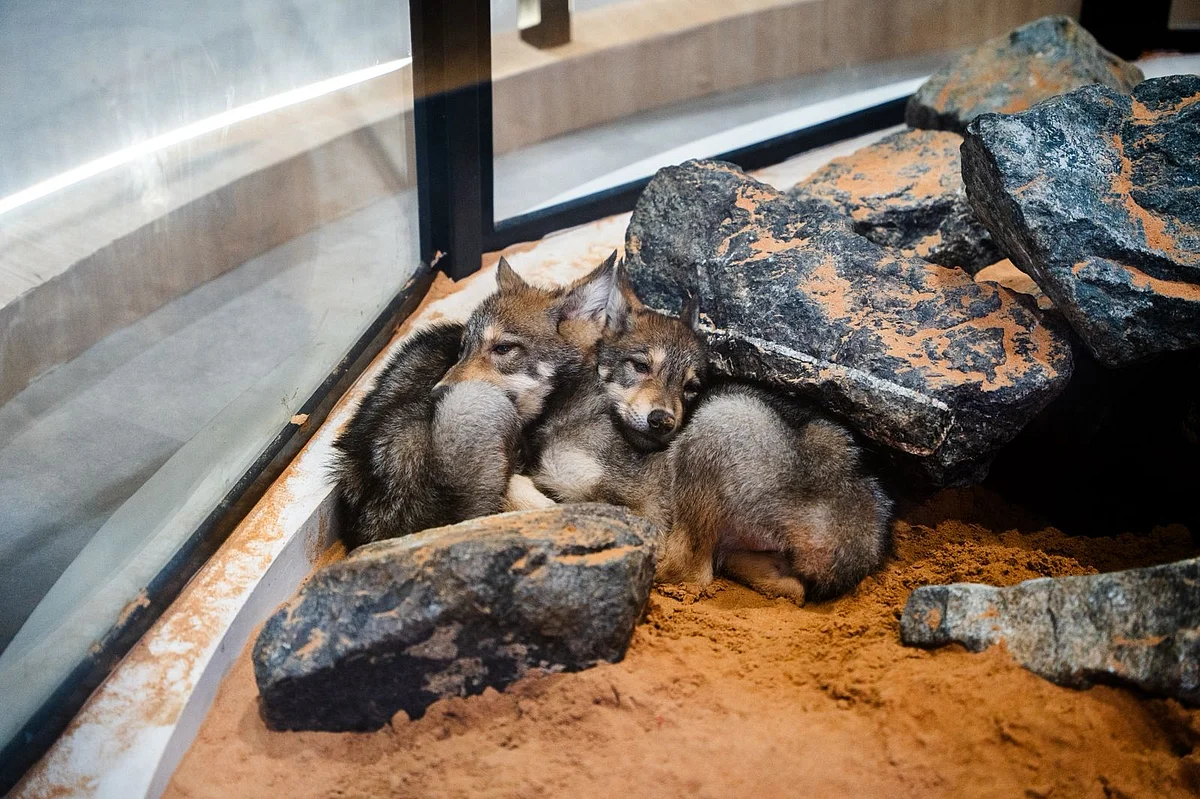
Over 20 Cloned Wolves In UAE Offer New Hope For Protecting Rare Species


- By: Haneen Dajani
They started out unusually comfortable around humans, allowing researchers to sit beside them and play with them. But after about eight months, the cloned wolves began showing more of the instincts expected of a wild predator.
More than 20 cloned wolves are now alive at the UAE Biotech Research Centre, marking a significant expansion of its pioneering work in cloning and genetic preservation, a researcher has revealed. The wolves include Arabian, brown and northwestern varieties, Sultan Al Khoori, a junior researcher at the centre, told Khaleej Times.
Recommended For YouThe Arabian wolves were being showcased at the Abu Dhabi International Hunting and Equestrian Exhibition (Adihex) until September 6, giving visitors a close look at the animals being monitored as part of the centre's conservation work. Different wolf varieties are being brought to the exhibition on different days. On Monday, August 31, two Arabian wolves were on display, while brown wolves had been showcased the previous day. The northwestern wolves are also due to be presented during the exhibition.
Stay up to date with the latest news. Follow KT on WhatsApp Channels.
The young Arabian wolves were energetic during the showcase, running and playing inside their enclosure. They became visibly agitated when the door to the enclosure opened, while appearing more cautious around unfamiliar visitors.
The behaviour was markedly different when a specialist entered the enclosure to feed them. The wolves remained calm around her and allowed her to interact with them, reflecting the close relationship that researchers have developed with the animals during their early stages of life.
Al Khoori said the animals were initially surprisingly easy to handle.“The first thing we noticed was that we could deal with them easily,” he said.
Researchers initially had to spend significant amounts of time with the wolves as part of the scientific work, with close monitoring and interaction needed to ensure the project was progressing successfully.
The young wolves were initially comfortable around people. Researchers could sit with them and play with them, and they behaved in ways that were more familiar than expected from an animal that would eventually develop into a predator.
But that began to change as they grew.“At around eight months, they started to take on their natural behaviour,” Al Khoori said.
The change is part of the centre's ongoing monitoring of the animals, with specialists observing how the cloned wolves develop and adapt as they mature.
What does the UAE Biotech Research Centre do?The centre is not simply producing the animals and leaving them without further monitoring. Specialists follow their development closely to establish whether the cloning programme is successful and what impact it could have on the conservation of rare animals.
Some Arabian wolves have been moved into protected reserves after reaching around six to seven months of age, Al Khoori said. The centre is also working with public reserves and parks, with plans to place the animals in locations where people can eventually see them.
However, the researchers are not rushing to release the wolves into the wild. The UAE's desert environment can be challenging for the animals, Al Khoori said, while the availability of natural food is limited.
Arabian wolves can feed on smaller animals such as rabbits and birds, but limited food availability can push them towards livestock, potentially bringing them into conflict with people.
“When there is no food, they go and attack people's livestock,” he said, adding that people may then begin hunting the wolves.
What happens next?For now, the cloned wolves will remain in protected environments, where specialists can provide conditions suited to the different varieties.
The centre can provide shaded and dark areas, grassy spaces, air-conditioned environments and other conditions to help the animals cope with the UAE's climate, Al Khoori said.
The researchers are also taking extensive precautions to protect the animals' health.
Because the wolves are part of a scientific project, staff limit unnecessary interaction with them and follow strict hygiene procedures. Anyone entering their area must disinfect themselves and the surrounding space to reduce the risk of transmitting infections.
Al Khoori said the centre's aim is not simply to produce cloned animals, but to establish whether the technology can become a successful tool for conservation.
“We want to preserve these breeds,” he said.
The centre is particularly interested in preserving wolf populations native to the region, including the Arabian wolf, which Al Khoori said is considered almost extinct in the UAE.
The project also reflects an effort to preserve animals that are specific to the Gulf region, while similar work is being considered for other wolf populations from different parts of the world.
Genetically authentic clonesAl Khoori said the centre is also focused on ensuring the animals being cloned are genetically authentic.
When genetic material is collected, researchers seek material from animals in the UAE and check that they are not hybrids before using it, he said.
The objective is to preserve an authentic lineage rather than produce an animal that is genetically mixed and then label it as an Arabian wolf.
“We want to develop something authentic, something that has certification and documentation,” he said.
The centre is now monitoring the wolves closely to determine how successful the project ultimately proves to be and what role cloned animals could play in wider conservation programmes.
Any future breeding or release programmes would depend on the specialists managing the reserves and whether the animals could safely be introduced into suitable environments, Al Khoori said.
“We don't want to rush these things,” he said, stressing that decisions on breeding and possible release would need to take into account the animals' environment and the wider impact on the ecosystem.
The centre's longer-term goal is to help return threatened animal populations and preserve their genetic resources, with cloning potentially providing another tool for conservation.
ALSO READ- Breakfast with lions? Dubai Safari Park offers rare experience with wild cats How world's first cloned camel 'Injaz' was born in Dubai 17 years ago today Look: How extinct animals like dodo, woolly mammoth are 'resurrecting' in Dubai

Legal Disclaimer:
MENAFN provides the
information “as is” without warranty of any kind. We do not accept any
responsibility or liability for the accuracy, content, images, videos,
licenses, completeness, legality, or reliability of the information
contained in this article. If you have any complaints or copyright issues
related to this article, kindly contact the provider above.
Comments
No comment