

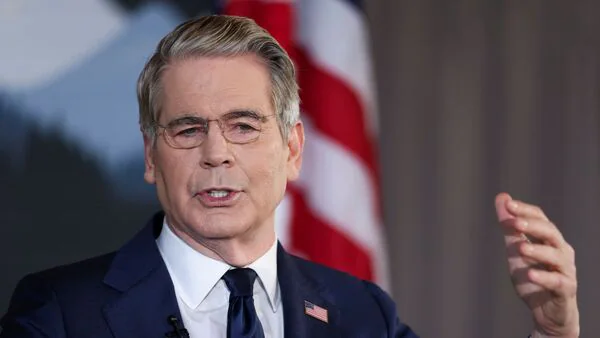
US Treasury Secretary Bessent Says Strait Of Hormuz Could Become 'Worthless' In Two Years


“That will be bypassed in two years,” Bessent said on the sidelines of a gathering of global finance chiefs in Asheville, North Carolina.“In two years, the Strait of Hormuz will be like a worthless piece of water.”
Bessent's comments came amid renewed tensions between the United States and Iran, with the two sides exchanging strikes on Monday. Two oil tankers attempting to leave the Strait of Hormuz were also struck by projectiles late on Monday, according to maritime security consultant Marisks.
The waterway is one of the world's most important energy chokepoint, carrying a significant share of global oil and gas shipments from Gulf producers. Iran's control over the strait has become a central issue in the conflict.
US steps up economic pressure on IranBessent also outlined further steps Washington is considering to increase economic pressure on Tehran.
The Treasury Department has taken a more prominent role in the US campaign against Iran in recent weeks. Bessent said Washington would likely announce sanctions against another bank this week and an additional bank next week.
Last week, the US targeted branches of Egypt's second-largest bank, Banque Misr, in the United Arab Emirates over their business dealings with Iran. Bessent said Washington deliberately avoided sanctioning the parent bank in Egypt.
“We did not sanction them because we did not want to go back to the Egyptian parent,” Bessent said.
Bessent added that the US is also examining whether to target aircraft leasing companies as part of its broader effort to isolate Iran economically.
China remains a key focusChina's role in Iran's oil trade remains a major issue for Washington as more than 90% of Iranian oil exports go to China.
Despite US calls for countries to sever financial and commercial ties with Tehran, Washington has not publicly taken similar action against China over its purchases of Iranian oil.
Bessent defended the administration's approach, saying he had held private discussions with Chinese officials about Iran during the G20.
The Treasury secretary also argued that sanctions are more effective when combined with restrictions on Iran's ability to move goods and generate revenue.
“When everyone says, 'Well, sanctions don't work,' I can tell you, sanctions plus a blockade work,” Bessent said.
“We are burying the head of the Iranian snake,” he added.“The snake doesn't know it's dead yet, but it will stop wiggling when the sun goes down.”
Hormuz remains criticalBessent's comments come as the latest attacks have renewed concerns about the safety of commercial shipping through the Strait of Hormuz.
The waterway connects the Persian Gulf with the Gulf of Oman and the Arabian Sea and is a crucial route for oil exports from Saudi Arabia, Iraq, Kuwait, the UAE and Iran.
Any prolonged disruption could push up global energy prices and add to inflationary pressures. The recent attacks on tankers have already raised concerns among traders and shipping companies about whether the recovery in oil flows through the strait can continue.
Also Read | Iran hails Putin's support, says Tehran-Moscow can counter US 'unilateralism'
Legal Disclaimer:
MENAFN provides the
information “as is” without warranty of any kind. We do not accept any
responsibility or liability for the accuracy, content, images, videos,
licenses, completeness, legality, or reliability of the information
contained in this article. If you have any complaints or copyright issues
related to this article, kindly contact the provider above.
Comments
No comment