

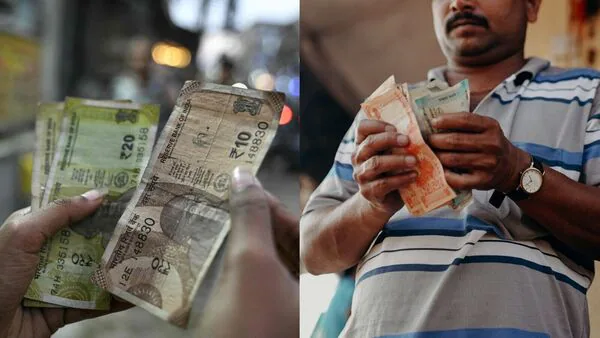
India Eyes Plastic Notes: How Govt Plans To Keep Polymer Currency Secure From China, Pakistan Influence


The latest report on the procurement also hints at the security concerns surrounding the production of Indian currency notes. Going by the same report, bidders have been required to sign an undertaking. It is described as a confidentiality agreement and a no-agent pact, declaring that their operations in India will be firewalled from any operations they may have in China and Pakistan. This condition suggests that while India is open to global suppliers, it is working to establish a separation between the Indian currency supply chain and the bidders' operations in its two neighbouring countries.
Earlier in July, an Expression of Interest (EOI) raised a requirement of 68,000 reams of BOPP (Biaxially Oriented Polypropylene)-based polymer substrate, 34,000 reams each for two denominations, each ream comprising 500 sheets, as per ANI.
Also Read | ₹10, ₹20 notes may be first polymer currency; RBI's printer seeks bids: Repor Indian and foreign firms in the raceReportedly, these samples submitted by bidders will be tested across different climatic zones. Only those eligible will be allowed to make it to the final tender.
Applicants are also reportedly required to submit proof of net financial worth, manufacturing capacity, and eligibility for security clearance.
Among the companies reportedly in the race is Indian substrate manufacturer Cosmo First, which has partnered with UK-based banknote manufacturer De La Rue. The report added that Cosmo First has listed De La Rue as its technical partner, with the latter expected to provide security features for the polymer substrate. Australia's CCL Secure, which supplies polymer solutions to around 40 central banks, is another reported bidder who may supply polymer for Indian banknotes.
The final polymer substrate is expected to meet specific requirements.
The material must include security features, including a clear window with a portrait, a metallic numeral, a magnetic pseudo-thread, a shadow image, and an iridescent pattern, suitable for printing at the BRBNMPL and SPMCIL presses.
Also Read | Bankers brace for upfront cost on ATM cassettes as RBI pushes polymer notes No animal tallow in polymer notesApart from these requirements, bidders have been asked to certify that the material supplied to BRBNMPL contains no animal tallow or its DNA. Concerns over animal-derived materials in banknotes in countries such as the UK have been reported to be one reason behind the RBI's hesitation over polymer currency.
India's proposed transition to polymer notes is likely not to be an immediate replacement of the current paper currency.
The Indian Express also reported that the RBI is probably aiming for a combination of polymer and conventional cotton-based currency for the count, with ₹10 and ₹20 denominations likely becoming the first ones in polymer format. Polymer banknotes are marketed as more durable and secure than the traditional cotton-based notes. CCL Secure claimed that polymer notes can last six times longer than paper currency.
The government has not yet confirmed a full-scale rollout of polymer banknotes.

Legal Disclaimer:
MENAFN provides the
information “as is” without warranty of any kind. We do not accept any
responsibility or liability for the accuracy, content, images, videos,
licenses, completeness, legality, or reliability of the information
contained in this article. If you have any complaints or copyright issues
related to this article, kindly contact the provider above.
Comments
No comment