

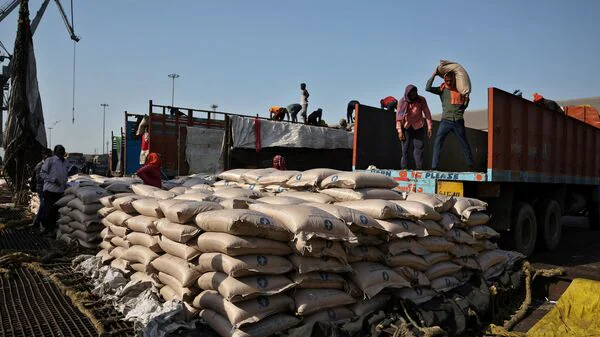
Govt Shifts Raw Sugar Import Quota To Daily Allocation Amid Rising Prices


Average retail sugar prices have surged 37.5% to ₹63.28 per kilogram as of 31 August from ₹46.02 per kg a year ago, according to government data. Demand for sugar typically rises ahead of the festive season.
The shift comes as the government halves the stockholding limit for sugar dealers to 2,000 quintals from 4,000 quintals, effective 15 September through 30 November, tightening curbs on hoarding and speculative trading. The earlier 4,000-quintal limit had been imposed from 1 August.
Also Read | Centre slashes sugar dealers' stock limit to 2,000 quintals from 15 SeptemberFrom Tuesday (1 September), bulk consumers have also been barred from holding sugar stocks exceeding 15 days of consumption, while central and state government teams are carrying out physical verification of sugar stocks at mills to check hoarding and artificial scarcity.
States and sugar mills have additionally been advised to begin crushing from 15 October 2026. The government expects this to raise sugar production in October from the usual 300,000-400,000 tonnes to more than 1 million tonnes, improving availability during the festive season.
Current-season sugar production is estimated at around 30.6 million tonnes, down from an initial estimate of about 34.3 million tonnes, according to government data. It attributed the shortfall to factors including red rot, top borer disease, and waterlogging caused by excess rainfall.
Daily quotaEligible sugar mills and refiners can apply for allocation of 2,02,550 tonnes of raw sugar remaining under the 1 million tonnes TRQ notified in August, according to a government notification dated 1 September. Applications amounting to 7,97,450 tonnes have already been received against the original quota, it said.
The fresh application window will remain open for seven days, until 7 September from the date of publication of the notice. Eligible mills and refiners can submit applications online through the Directorate General of Foreign Trade (DGFT ) website under the Import Management System and the TRQ section, it said.
Applications received up to 5:30pm on a given day will be treated as one batch and processed together for allocation on the following working day, subject to scrutiny and eligibility. Applications received after 5:30pm will be carried forward and clubbed with the next day's batch, it said.
Also Read | Sugar spike puts FMCG margins under fresh pressureFor each day's batch, allocation will be made strictly in the order of aggregate demand received that day, on a self-declaration basis, subject to availability of the remaining quota, it said.
The government order has also specified a pro rata mechanism if applications exceed the available quantity. If the cumulative quantity applied for during a day, together with quantities already allocated up to the preceding day, exceeds the remaining 2,02,550 tonnes, the available quantity will be distributed among applicants in proportion to the quantity sought by each applicant, it said.
A pro-rata mechanism means allocating the available quantity in proportion to each applicant's share of the total quantity demanded.
Once the entire balance quota is exhausted or allocated, applications received on subsequent days will not be considered for allocation, and applicants will be informed through the DGFT portal, the notice said.
The date and time recorded on the DGFT's online portal will determine the day to which an application belongs. The DGFT said that manual or offline submissions will not be considered.
The move effectively provides eligible importers another opportunity to secure a portion of the remaining quota, while shifting the allocation of the balance quantity to a rolling daily process rather than another one-time allocation. The approach also provides for proportional allocation if demand on any given day exceeds the quota remaining.
Also Read | Crop loss or diversion for ethanol: what's driving sugar prices? Price impact“The daily allocation of the remaining import quota would provide greater flexibility to respond to changes in domestic sugar availability and prices, compared with a one-time allocation. The mechanism could help ensure that quotas are released in line with market requirements rather than being concentrated in a single allocation,” said Binod Anand, agricultural economist and member of the Centre's high-powered Committee on MSP.
Paras Tyagi, a Delhi-based public policy practitioner, said that the move will help curtail further price spikes and stabilize supplies during the peak festive season. "However, a complete correction in prices to pre-inflation levels will depend on the actual arrival of imported raw sugar and the speed at which it is processed.”

Legal Disclaimer:
MENAFN provides the
information “as is” without warranty of any kind. We do not accept any
responsibility or liability for the accuracy, content, images, videos,
licenses, completeness, legality, or reliability of the information
contained in this article. If you have any complaints or copyright issues
related to this article, kindly contact the provider above.
Comments
No comment