

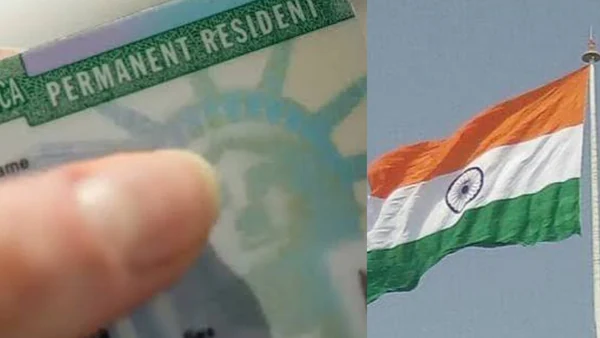
US Green Card: How 7% Country Cap Could Trap 1 Million Indians In 179-Year Wait - Is There A Way Out? Expert Weighs In


“According to a National Foundation for American Policy analysis, a high-skilled foreign national from India with a labor certification application or an employment-based immigrant petition filed in January 2026 or later has a potential wait time for a Green Card (permanent residence) of 179 years in the employment-based second preference (EB-2), 38 years in the employment-based third preference (EB-3) and 5 years in the employment-based first preference (EB-1),” the NFAP's August policy brief mentioned.
The study estimates that nearly one million Indian nationals are currently caught in the employment-based Green Card backlog, accounting for around 79% of the total applicants waiting in the queue. The country-based cap on Green Cards has reportedly led to considerably longer waiting periods for Indian professionals in the US seeking permanent residency.
Indian professionals currently have three main employment-based routes to seek a US Green Card. The EB-1 category, or first preference, covers people with extraordinary ability in fields such as science, business, the arts and sports. EB-2, the second preference, is intended for workers with advanced degrees, while EB-3 covers professionals with bachelor's degrees as well as other skilled workers.
Also Read | US weighs bond of $100,000 for some green-card applicants abroadThe US issues around 140,000 employment-based Green Cards each year. However, the rules generally limit nationals of any single country to no more than 7% of the total allocation.
Besides these three employment categories, the system includes EB-4, which is meant for certain“special immigrants”, including religious workers, and EB-5, which is designed for eligible foreign investors.
Also Read | Supreme Court sides with Trump in key Green Card deportation disputeThe analysis also points to the impact of country-specific limits on Green Cards, which have resulted in significantly longer waits for Indian applicants. By comparison, professionals from countries such as China and the Philippines generally encounter shorter queues.
Is there a way out?The 179-year calculation overlooks the protections available to H-1 workers after their I-140 petition is approved, Rajiv Khanna, an immigration lawyer, told LiveMint.
Once they complete the required period, eligible employees can continue receiving H-1B extensions while waiting for their Green Card priority dates to become current, he added.
Also Read | Bad news for Green Card aspirants? US citizenship fee could cost up to ₹1 lakhThe expert noted that since the I-140 stage generally takes around one to one-and-a-half years, workers may also gain the ability to change employers while continuing to qualify for H-1B extensions beyond the usual six-year limit.
“The mathematics ignores several realities. First, when an employee on an H-1B in the Green Car process has been working for 180 days after their Green Card intermediate step, which is I-140, approved, they have an assurance of keeping H-1B extensions going as long as the dates don't become current, which then gives them the green card. Also, that process, arriving at I-140, typically takes 1 to 1.5 years,” he said.
“So, the employee enjoys a degree of freedom at the point where they can even change employers and still keep getting H-1B extensions beyond the limit of 6 years. While this is not an ideal setup, it certainly gives us some amelioration, some relief from the drastic consequences of long waits,” Khanna mentioned.
He identified another factor that could affect the projected wait: periodic fluctuations in the Green Card system. According to him, such changes have occurred several times and can lead to a rise in the number of green cards approved, potentially shortening waiting periods for some applicants.
“The second thing that math ignores is that many times there are blips in the system and that is not as infrequent as people would think. The blips in the system cause an upsurge in Green Card approvals and numbers. This has happened multiple times, so that keeps hope going," Khanna stated.
“Freedom to change employers within a year and a half or so, combined with blips in the system that can cut short the Green Card time, is very helpful,” he noted.
He acknowledged that the system is not ideal, but said having a Green Card would make it considerably easier for professionals seeking to build their lives in the United States.
“But it is what it is, and many professionals, because of several reasons, one of the main reasons used to be that we were at the cutting edge of many technologies; I am not sure that is true anymore, simply because of the way the current administration has cut short funding for research and dropped down the hiring of talent,” the immigration lawyer said.
“It has become very difficult to predict where the US will be in the next 10 years,” he cautioned.

Legal Disclaimer:
MENAFN provides the
information “as is” without warranty of any kind. We do not accept any
responsibility or liability for the accuracy, content, images, videos,
licenses, completeness, legality, or reliability of the information
contained in this article. If you have any complaints or copyright issues
related to this article, kindly contact the provider above.
Comments
No comment