

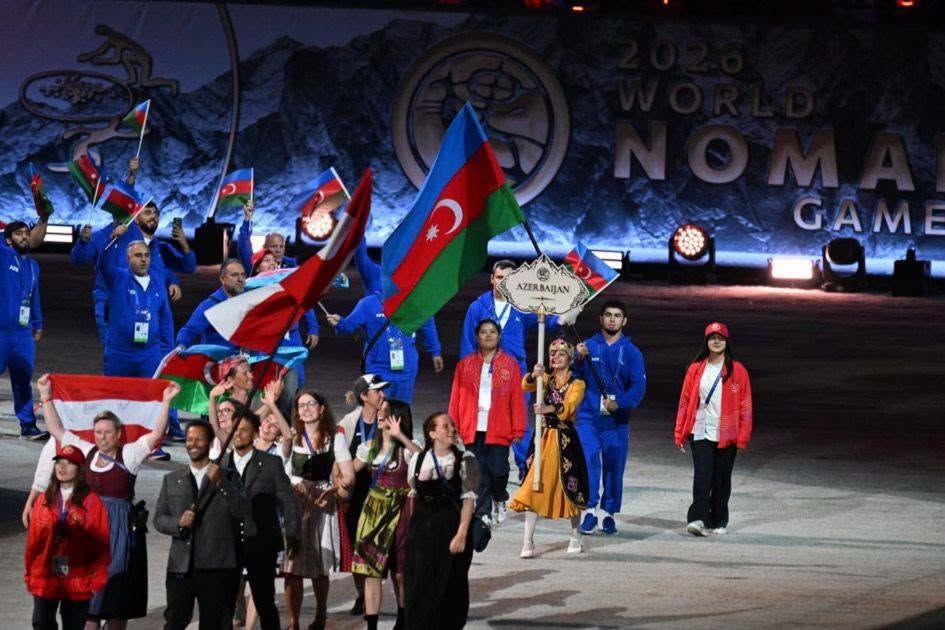
Azerbaijan Brings Its Traditional Heritage To World Nomad Games


Long before modern stadiums, scoreboards and Olympic medals, sport was part of everyday life.
Strength was tested on wrestling grounds, horsemanship was passed from one generation to another, and games of strategy brought communities together. Many of those traditions remain alive today, and this week they have found a common stage in Kyrgyzstan.
The 6th World Nomad Games are underway in Bishkek and around Issyk-Kul, bringing athletes and delegations from more than 100 countries together for a week of competition, culture and traditional sports.
The Games officially opened on August 31 at Bishkek Arena, while the main competitions are being held in and around Cholpon-Ata and other venues in the Issyk-Kul region. The event runs through September 6.
There is a distinctive character to the programme. Alongside familiar forms of wrestling, the Games feature horseback competitions, traditional martial arts, national games and disciplines that have rarely appeared on the world's major sporting calendars. In total, 43 traditional sports disciplines are included in this year's programme.
Kyrgyzstan is hosting an event where sport and history come together. The athletes have come to compete, but the sports they represent carry stories of their own - stories about how different communities travelled, worked, celebrated and trained.
Among the participants are Azerbaijani athletes, bringing their own national sporting traditions to the competition.
Azerbaijan is represented by a 17-member delegation comprising 10 athletes, six coaches and one delegation official. Azerbaijani competitors are taking part in nine disciplines: alysh, Kyrgyz kuresh, kushtingiri, wrestling, pahlavan wrestling, Kazakh kuresi, guresh, mas-wrestling and mangala.
Azerbaijan's centuries-old traditions take the spotlight
Some of these competitions have deep roots in Azerbaijani sporting culture. Wrestling, in particular, has been part of the country's traditions for centuries, while the figure of the pahlavan remains deeply rooted in Azerbaijani folklore. The pahlavan was more than a strong man capable of defeating an opponent. He represented courage, discipline and honour - qualities that helped turn wrestling into a respected part of community life.
That heritage takes on a new dimension at the World Nomad Games. An Azerbaijani wrestler stepping onto the mat in Kyrgyzstan is not simply competing in another tournament. The athlete is representing a tradition that has been passed from one generation to another, alongside wrestlers carrying their own traditions from across Central Asia and beyond.
The similarities are striking, even where the rules differ. Azerbaijani wrestling, Kazakh kuresi, Kyrgyz kuresh and Uzbek kurash developed in different environments and have their own techniques, but they share an emphasis on strength, balance, skill and respect between opponents.
Azerbaijan has been building its presence in the field of traditional sports for years. The country has taken part in international ethnosport initiatives and has hosted events aimed at giving traditional sports a wider audience.
One of the most notable gatherings came in Baku in March 2022, when the city hosted the 5th Ethnosport Forum organised by the World Ethnosport Confederation. The forum brought together 140 participants from 45 countries to discuss the development and revival of traditional sports.
Azerbaijan has also put its own landscape and traditions at the centre of ethnocultural events. The International National Highland Festival in Goygol combines traditional sports with handicrafts, folklore and other elements of highland culture. Its fourth edition was held in August 2025 with international participation.
These events have helped bring traditional sports beyond local celebrations and into wider international discussions. The World Nomad Games take that process to a much larger scale.
This year's event has attracted participants from more than 100 countries. The scale of the gathering is matched by its setting. Issyk-Kul, surrounded by the mountains of Kyrgyzstan, provides a striking backdrop for competitions rooted in the history of nomadic societies.
Horse sports naturally occupy a prominent place. For centuries, horses were central to movement, trade, warfare and communication across the steppe. At the Games, that relationship appears in a sporting form, with riders demonstrating speed, control and endurance.
Wrestling tells another part of the story. In many cultures across Central Asia and the Turkic world, wrestling was not simply entertainment. It was a test of physical ability and character, often associated with festivals, celebrations and community gatherings.
Then there are games such as mangala, where physical strength gives way to calculation and patience. The presence of such disciplines is a reminder that traditional sport has never been limited to contests of speed or power.
A spectator can move from a wrestling contest to an equestrian event and then to a traditional board game, encountering different pieces of history at every turn.
The gathering carries particular significance for the Turkic world. Azerbaijan, Kyrgyzstan, Kazakhstan, Uzbekistan, Turkiye and other Turkic countries have distinct national identities, but they also share layers of history, language, customs and cultural practices. Traditional sports are among the most visible places where those connections can still be seen.
The World Nomad Games bring these similarities into the same arena without erasing the differences between them. Each country arrives with its own athletes, rules and traditions, creating opportunities to learn from one another.
Azerbaijan's participation is also part of a longer relationship with the Games. Azerbaijani athletes have competed at every previous edition since the event was launched in Kyrgyzstan in 2014. The first three editions were held in Cholpon-Ata in 2014, 2016 and 2018, before the fourth Games moved to Iznik, Turkiye, in 2022 and the fifth to Astana, Kazakhstan, in 2024.
In February 2026, Azerbaijan's Association of National Sports signed a partnership agreement with the International Secretariat of the World Nomad Games on preparations for this year's event. Under the agreement, the association, together with relevant state bodies, was authorised to help form Azerbaijan's national delegation, including athletes and representatives of culture and science.
The country's participation comes at a time when Azerbaijani sport is enjoying a strong international run.
At the Paris 2024 Summer Olympics, Azerbaijan won seven medals - two gold, two silver and three bronze. Judokas Hidayat Heydarov and Zelim Kotsoyev became Olympic champions, while taekwondo athlete Gashim Magomedov and boxer Alfonso Dominguez won silver. Greco-Roman wrestler Hasrat Jafarov and freestyle wrestlers Magomedkhan Magomedov and Giorgi Meshvildishvili took bronze.
Azerbaijani athletes also collected 1,718 medals at world and European championships, World and European Cups and other international competitions in 2024, including 666 gold, 465 silver and 587 bronze medals.
Those figures belong to modern competitive sport, while the World Nomad Games look further back - to the sports and games that existed before today's international federations, rankings and world championships. Yet the two worlds meet in Kyrgyzstan.
An athlete can carry a national tradition into a modern international competition, where performance is measured by rules and results while the meaning of participation reaches beyond the scoreboard.
The World Nomad Games give traditional sports something that many of them rarely receive: a global audience.
A wrestling style known mainly within one country can suddenly be seen alongside other national forms. A traditional game can attract spectators who have never encountered it before. Young athletes can meet competitors from another part of the world and return home with techniques, friendships and new ideas.
Traditions survive when people practise them. They need athletes, coaches, organisers and, most importantly, younger generations willing to learn them.
This is where events such as the World Nomad Games can make a difference.
The immediate task facing Azerbaijan's 10 athletes is competition. They will test their strength and skill against international opponents and seek the best possible results in their respective disciplines.
At the same time, every contest offers an opportunity to show a part of Azerbaijan - its wrestling traditions, national games and sporting customs that have been handed down through generations.
By September 6, the medals will have been decided, and the arenas will begin to quieten. The competitions will be over, but the traditions represented there will not disappear with the closing ceremony.
They will return with the athletes to their home countries, back to training halls, villages, festivals and sporting clubs. In Azerbaijan, as elsewhere, they will continue through the people who practise them and the younger athletes who decide to take up the challenge.
The winners will leave with medals, but every participating country will also leave something of itself behind - and take a little of the wider sporting heritage home.

Legal Disclaimer:
MENAFN provides the
information “as is” without warranty of any kind. We do not accept any
responsibility or liability for the accuracy, content, images, videos,
licenses, completeness, legality, or reliability of the information
contained in this article. If you have any complaints or copyright issues
related to this article, kindly contact the provider above.
Comments
No comment