

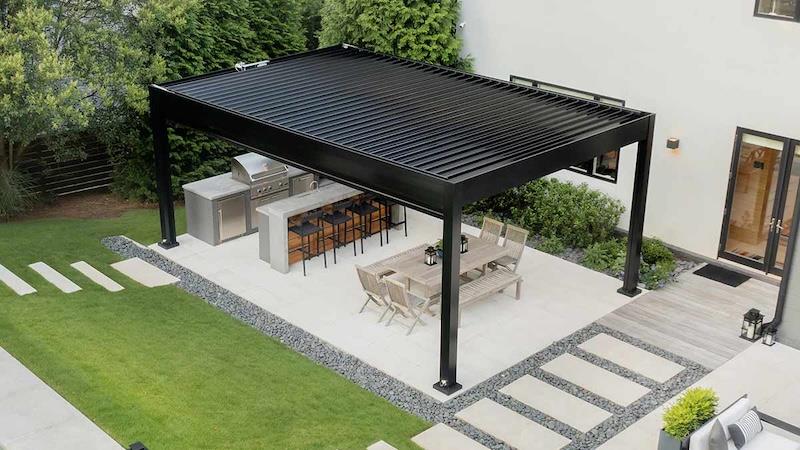
How Automated Pergolas Are Transforming Modern Outdoor Spaces


Blazing sun, an out-of-nowhere rainstorm, or just plain heat, and suddenly that nice outdoor spot isn't so nice anymore.
One solution gaining attention is the motorized louvered pergola. Unlike a traditional pergola with a fixed structure, this type of outdoor covering uses adjustable roof louvers that can change position according to the needs of the space.
The development of automated pergolas has added another layer of convenience by allowing these adjustments to be controlled electronically or, in some systems, automatically.
What is a Motorized Louvered Pergola?Basically, the roof is made up of horizontal or angled slats. On a motorized setup, those slats are wired to an electric mechanism so they can rotate on their own – no manual cranking required.
How much sun gets through depends entirely on the angle. Open the louvers up and light and air flow right through. Close them and you've got shade and rain protection instead.
A lot of the newer systems let you rotate the louvers through a pretty wide range of positions, so you end up with way more control than you'd get from an old-school fixed roof, where the light and airflow are basically the same no matter the time of day.
How Automation WorksThe automation part is really what separates these from the older-style pergolas. Instead of someone having to physically go operate the roof every time the weather shifts, sensors and electronics can just handle it.
A rain sensor, for example, can pick up on precipitation and close the roof before you even realize it's started raining. On top of that, most systems still give you manual options too - a remote, a wall panel, or an app on your phone, depending on what you've got installed.
If your setup is tied into a smart home system, it gets even more connected – lighting, screens, and the roof itself can all be controlled from the same place.
That doesn't mean you're totally hands-off, though. Automation just gives you more ways to deal with the space depending on what's going on outside.
Managing Sunlight and AirflowOne of the nicer things about adjustable louvers is being able to dial in exactly how much sun and airflow you want. Fully open, you get full sunlight. Partially closed, you cut down the glare without shutting out light completely.
That flexibility really pays off as the day goes on. Morning sun is usually fine, even nice, but by mid-afternoon it can get to be a bit much. Being able to adjust on the fly means you're not just stuck dealing with whatever the roof gives you.
Airflow is another piece of it. A solid roof blocks air completely, but louvers can stay cracked open so air keeps moving through – which keeps the space from feeling stuffy while still giving you some cover.
Rain Protection and DrainageWeather protection is a big factor when you're picking any kind of outdoor structure. Most modern louvered systems use interlocking or gapless roof designs so that when the louvers are shut, water isn't getting through.
Some setups also come with built-in gutters and hidden drainage channels, meant to catch rainwater and steer it away from the space instead of just letting it pour straight down.
Add automatic rain response into that mix and it gets even easier – the roof shuts itself the second the sensors pick up rain, so you're not stuck watching the sky or running outside mid-downpour.
Materials and Structural ConsiderationsWhat the pergola's actually made of affects everything – how long it lasts, how much maintenance it needs, how it looks. Aluminum is the go-to for most modern louvered systems because it's light but still stands up well outdoors.
Structural strength matters a lot too, especially if you're somewhere that gets hit with strong wind or heavy snow. The R-BLADE system, for instance, comes with specific wind-load and snow-load ratings, plus a Miami-Dade County Notice of Acceptance.
Still, any of those numbers and approvals need to be checked against your actual location and local building codes before you install anything.
Custom Configurations for Different SpacesNo two outdoor spaces are the same size or shape, so having flexibility in the design really matters. Motorized pergolas can go wall-mounted or freestanding, whatever fits the space better.
On bigger projects, you'll sometimes see multiple zones set up, where different sections of the outdoor area can be controlled separately from each other.
What works for someone's backyard patio isn't going to be the same setup a rooftop terrace, restaurant, or hotel needs – it really comes down to size and how the space gets used.
You can also throw in extras like lighting, fans, heaters, motorized screens, speakers, or cooling systems. None of that changes what the pergola is fundamentally doing, but it does mean the space can get used year-round instead of just a few months out of the year.
Maintenance and Long-Term UseYes, there are electrical and mechanical parts involved, but if the system's installed correctly, keeping up with it isn't a huge chore. Just keep the structure clean, and check the gutters and drainage every so often for leaves and other gunk that builds up.
It's also worth keeping an eye on the moving parts and the electronics themselves. A quick inspection now and then can catch a weird motor noise, a damaged louver, a drainage issue, or an electrical problem before it turns into something bigger.
What to Consider Before InstallationBefore you install one of these, there's a few things worth thinking through first. Size and shape of the space are the obvious ones, but local climate matters just as much – wind, snow, rain, heat, sun exposure, all of it factors into what design actually makes sense for your situation.
Don't skip checking permit requirements and building regulations either, since those change from place to place and can depend on things like the size of the structure, whether it's attached to your house, and other structural details.
At the end of the day, motorized louvered pergolas are a real step up from the basic shade structures people are used to – they're built to actually adapt.
Between the adjustable roof, the electronics, the weather sensing, and how customizable the whole setup is, you get a lot more say over sunlight, airflow, and rain protection than you would otherwise.
Instead of being stuck with one fixed function, these systems can flex with whatever the day, or the season, throws at them.

Legal Disclaimer:
MENAFN provides the
information “as is” without warranty of any kind. We do not accept any
responsibility or liability for the accuracy, content, images, videos,
licenses, completeness, legality, or reliability of the information
contained in this article. If you have any complaints or copyright issues
related to this article, kindly contact the provider above.
Comments
No comment