

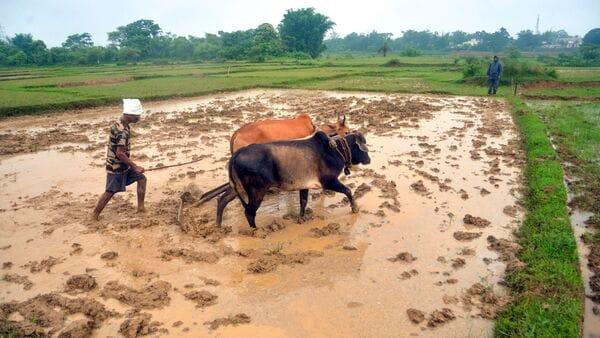
Below-Normal September Rains Raise Crop, Inflation Risks


India is likely to receive less than 91% of its long-period average (LPA) rainfall in September, the IMD said on Monday. The September LPA, based on the 1971-2020 climatological record, is 167.9 mm.
Many parts of the country are likely to receive below-normal rainfall during the month. However, parts of northwest, northeast, east, east-central and southeast peninsular India are likely to receive normal to above-normal rainfall, the weather office said.
Rainfall was 35.4% below normal in June, 1% above normal in July, and 16.3% below normal in August. The country received 213.3 mm of rainfall in August against the normal 254.9 mm. Cumulative rainfall across the country from 1 June to 31 August stood at 603.7 mm, 13.8% below the normal.
Also Read | IMD to use AI to give farmers 10-day warning before monsoon hits"Currently, strong El Niño conditions are prevailing over the equatorial Pacific Ocean, with sea surface temperature (SST) anomalies remaining above normal across the central and eastern equatorial Pacific. These conditions are expected to strengthen further in the coming months," said Mrutyunjay Mohapatra, director general of meteorology, IMD.
During September, monthly average maximum temperatures are likely to be above normal over most parts of the country, except some parts of northwest, westcentral and northeast India, where they are likely to be normal to below normal.
The IMD had cut its June-September monsoon forecast to 90% of the LPA from 92% on 29 May, citing El Niño conditions. India last recorded a below-normal monsoon in 2023, when rainfall was 95% of the LPA. The department also expects August rainfall alone to remain below normal at less than 94% of the LPA.
Inflation risksExperts said another spell of weak rainfall could hit kharif crops and vegetables, hurting farm incomes, rural demand and food prices.
"IMD's below-normal September outlook is a concern, as monsoon has already been volatile this season with June sharply deficient, July briefly improving, and August again slipping into a deficit," said Anjal Prakash, professor of public policy at FLAME University, Pune.“If September rainfall stays weak, the stress will be felt most in rainfed agriculture, particularly paddy, pulses, and oilseeds, where moisture availability is critical for the grain-filling stage.”
Also Read | Rainfall below normal? How accurate are predictions by Skymet, IMD?A rainfall deficit could also delay preparations for rabi crops in some regions and add upside pressure to food inflation, particularly vegetables and edible oils, Prakash said. Weak farm incomes could also weigh on rural demand, he added.
India's retail inflation accelerated to 4.45% in July, driven by higher food and fuel prices, according to provisional data from the ministry of statistics and programme implementation on 12 August. Food inflation stood at 5.52% in July, up from 5.32% in June.
In August, the Reserve Bank of India's Monetary Policy Committee (MPC) lowered its inflation projection to 5% from 5.1%, but flagged risks from a likely below-normal monsoon amid El Niño conditions, volatile energy prices and potential second-round effects of higher input costs.
According to Mohapatra, below-normal rainfall can hurt agriculture, water resources, hydropower generation, ecosystem sustainability, and drinking water availability, besides increasing the risk of heat stress in several regions. Timely preparedness measures - including water conservation, efficient resource management, and agricultural contingency planning - by concerned agencies and stakeholders can help mitigate these impacts, he said.
Southwest monsoon accounts for more than 70% of India's annual rainfall, while about 45% of the country's net sown area remains rain-fed. A good monsoon supports rural demand, while weak rainfall weighs on consumption.
Sowing under pressureThe RBI in its August bulletin said deficient and uneven monsoon amid El Niño conditions poses some risks to agriculture sector's outlook and rural demand.
India's kharif crop acreage remained below last year's level as of 28 August, with a sharp decline in rice and maize sowing offsetting gains in pulses, according to the agriculture ministry's weekly crop coverage data.
The total area under major kharif crops stood at 107.1 million hectares as of 28 August, down 1.9 million hectares from 109 million hectares during the corresponding period last year. Rice, the country's main kharif crop, accounted for the largest decline at 41.4 million hectares, compared with 42.8 million hectares, a year earlier. Maize acreage fell to 8.99 million hectares from 9.38 million hectares last year, a decline of 388,000 hectares.
Also Read | Patchy progress, masked extremes: how the monsoon's played outWhile acreage risk has diminished, the risk to yield is also increasing, said Gurudas Nulkar, director, Centre for Sustainable Development, Gokhale Institute of Politics and Economics (GIPE), Pune. "A September moisture deficit can reduce yields which could affect prices. September rainfall also determines soil moisture going into October-November. That affects the sowing prospects for the Rabi season.”

Legal Disclaimer:
MENAFN provides the
information “as is” without warranty of any kind. We do not accept any
responsibility or liability for the accuracy, content, images, videos,
licenses, completeness, legality, or reliability of the information
contained in this article. If you have any complaints or copyright issues
related to this article, kindly contact the provider above.
Comments
No comment