

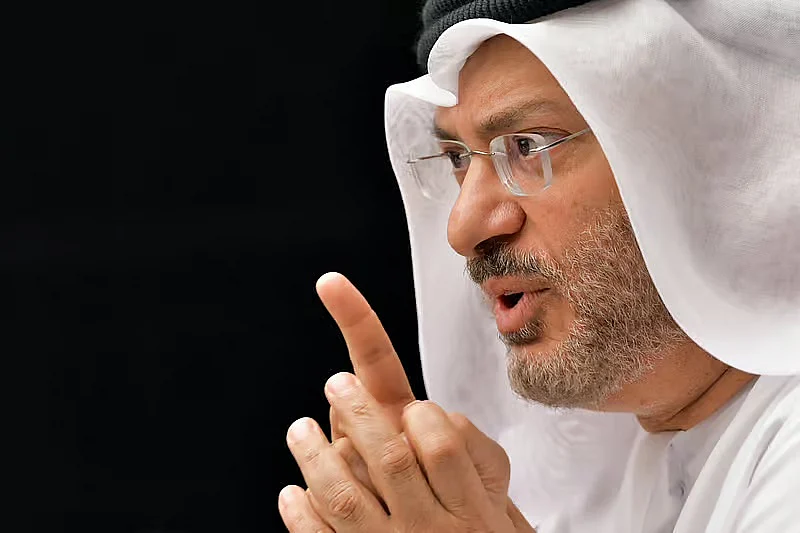
Region's 'Neither War Nor Peace' State: UAE's Gargash Calls For 'Realistic Solutions'


The comments by Gargash, Diplomatic Adviser to the UAE President, came as tensions flared again in the region and the UAE said its Air Force had responded to a drone detected over the country's territorial waters approaching from Iran.
Recommended For You“A state of neither war nor peace cannot be a sustainable solution,” Gargash wrote on X.“What is needed today are realistic and sustainable political solutions that address the political and economic dimensions of the crisis, beginning with moving beyond escalation and restoring navigation in the Strait of Hormuz to normal, and leading to a more realistic approach that moves beyond the memorandum of understanding, which failed to chart a practical and acceptable roadmap.”
On Monday, the Ministry of Defence said the UAE Air Force responded to a UAV detected over the country's territorial waters approaching from Iran. The ministry said the Armed Forces remained on a high state of readiness to address potential threats, while air defence systems continued to monitor and safeguard UAE airspace around the clock.
In a separate statement, the ministry denied media reports that Al Menhad Air Base had been targeted by missiles.
The latest developments came after US forces struck Iranian missile launchers on Larak Island in the Strait of Hormuz on Sunday, the first US military action against Iran in about a month. Iran subsequently launched ballistic missiles at US forces in Jordan.
Gargash's remarks build on a position he outlined last week, when he said Iran's attacks on Gulf countries had“missed their target”, describing them as a strategic miscalculation that had increased Tehran's isolation and weakened its position. He said the way out of the conflict was not through targeting GCC states, but by working with them to create conditions for de-escalation and a political solution.
His call for a political solution also echoes assessments from senior UAE diplomatic and strategic experts interviewed by Khaleej Times as the Iran conflict crossed the six-month mark last week.
'Neither war nor peace' cannot continue
Dr Mohammed Ibrahim Al Dhaheri, Deputy Director-General of the Anwar Gargash Diplomatic Academy, told Khaleej Times in an earlier intervie that the“region cannot remain trapped in a perpetual state of neither war nor peace, where endless talks simply provide time for tactical manoeuvring”.
“Dialogue serves a purpose only when it produces measurable compliance,” he said, adding that“the mistake of the past was to treat the existence of dialogue as progress in itself”.
He said the past six months had also shown that diplomatic assurances alone were no longer sufficient.
“Informal promises offer no protection when missiles are in the air,” Al Dhaheri said. Any lasting security framework, he argued, would have to anchor commitments in“hard, enforceable and audited standards”, backed by independent verification.
His comments also closely mirror Gargash's emphasis on restoring normal navigation through the Strait of Hormuz.
“Freedom of navigation through this waterway remains entirely non-negotiable,” Al Dhaheri said.“The Strait belongs to international trade, and no single state has the right to turn it into a political bargaining chip or position itself as its gatekeeper.”
Al Dhaheri said a meaningful diplomatic reset would require Iran to halt direct and proxy attacks against neighbouring states and commercial shipping, restore unrestricted maritime movement and accept binding, independently audited security arrangements.
'Calculation failed'
Fatmah Alzeyoudi, a researcher in Iranian and Middle East affairs at the Emirates Centre for Strategic Studies and Research, separately told Khaleej Times that Tehran's calculation in targeting the UAE had failed.
“The UAE demonstrated that its strength extends beyond its advanced economy to its growing military capabilities and the strategic, disciplined vision underpinning its defence posture,” Alzeyoudi said.
She said the attacks would not mean the UAE or other Gulf states abandoning engagement with Iran, but argued that diplomacy now needed to be backed by firmer guarantees.
“Diplomatic dialogue will continue as a regional necessity,” she said.“However, dialogue alone is no longer sufficient and must be accompanied by credible security arrangements and tangible guarantees from Iran.”
ALSO READ- UAE-Iran trade suspension: What would it take for ties to resume? UAE detects missile threat: Trade embargo with Iran, impact on flights explained UAE detects 2 missiles targeting maritime navigation, suspends trade with Iran

Legal Disclaimer:
MENAFN provides the
information “as is” without warranty of any kind. We do not accept any
responsibility or liability for the accuracy, content, images, videos,
licenses, completeness, legality, or reliability of the information
contained in this article. If you have any complaints or copyright issues
related to this article, kindly contact the provider above.
Comments
No comment