

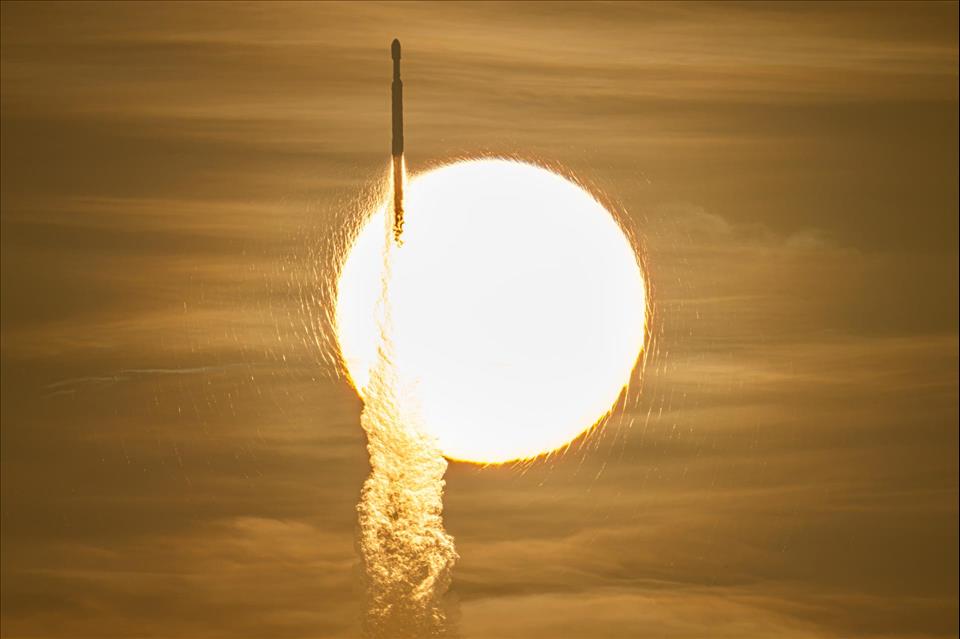
NASA Launches Nancy Grace Roman Space Telescope To Uncover Dark Matter And Thousands Of New Worlds


According to the BBC's English service, the Roman Space Telescope separated from the Falcon Heavy rocket about 30 minutes after launch and has begun a 100-day journey to the Sun-Earth Lagrange Point 2 (L2), approximately 1.6 million kilometers (1 million miles) from Earth. NASA says the location provides an exceptionally stable and cold environment for its highly sensitive infrared instruments.
The Roman Telescope is considered one of NASA's most ambitious astronomy missions since the Hubble Space Telescope and the James Webb Space Telescope. While Webb focuses on observing distant objects in extraordinary detail, Roman is designed to survey enormous areas of the sky, capturing a field of view about 100 times larger than Hubble or Webb in a single image.
NASA says this wide-field capability will allow scientists to map billions of galaxies across the universe, creating the largest and most detailed cosmic surveys ever conducted. Researchers hope these maps will reveal how galaxies have formed and evolved over billions of years under the influence of dark matter and dark energy.
One of the mission's primary scientific goals is to investigate dark matter and dark energy, which scientists estimate make up about 95% of the universe. Dark matter cannot be observed directly but is detected through its gravitational effects on stars and galaxies, while dark energy is believed to be responsible for the accelerating expansion of the universe.
The telescope is also expected to revolutionize the search for exoplanets. NASA's Associate Administrator for Science, Nicky Fox, said Roman could discover tens of thousands, and potentially up to 100,000, planets orbiting stars beyond our Solar System. Scientists hope these discoveries will improve understanding of how planetary systems form and how many distant worlds may have conditions suitable for life.
Beyond exoplanets and cosmology, Roman will study black holes, nearby planets and asteroids, distant galaxies, and other cosmic phenomena. Its observations are expected to complement data collected by both Hubble and James Webb, providing astronomers with a broader picture of the universe.
NASA has planned the telescope's primary mission for five years, but officials hope Roman will continue operating for up to a decade, depending on its performance and fuel reserves.
The telescope is named after Nancy Grace Roman, NASA's first Chief of Astronomy and one of the agency's first female executives. Often called the“Mother of Hubble,” Roman played a crucial role in securing congressional support for the Hubble Space Telescope, helping lay the foundation for modern space astronomy.

Legal Disclaimer:
MENAFN provides the
information “as is” without warranty of any kind. We do not accept any
responsibility or liability for the accuracy, content, images, videos,
licenses, completeness, legality, or reliability of the information
contained in this article. If you have any complaints or copyright issues
related to this article, kindly contact the provider above.
Comments
No comment