

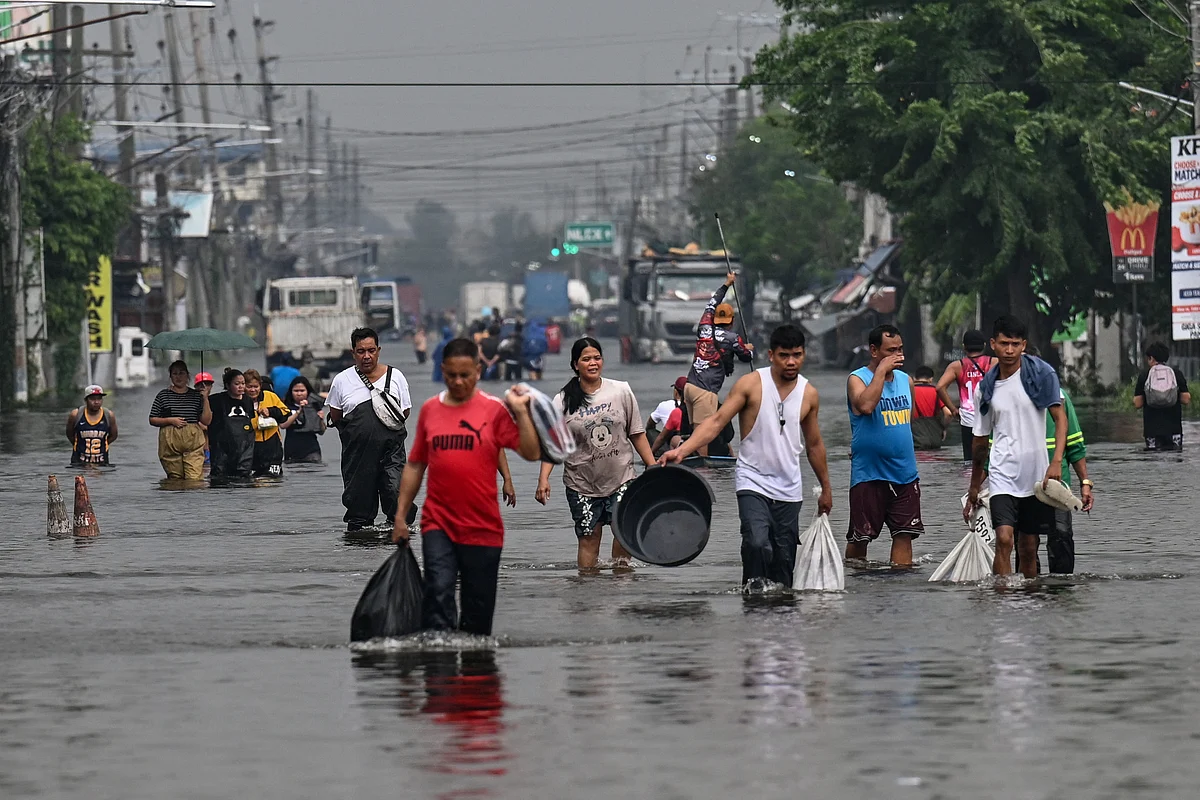
Philippines Floods: 33 Dead, 8 Million Affected As Monsoon Rains Swamp Central Luzon


A total of 33 people have died from the impact of the southwest monsoon, or habagat, while 19 were injured and three remain missing, Gregorio Tomas, director of the Office of Civil Defense (OCD), said at a press conference on Monday.
Recommended For You Etihad Rail sells over 100,000 tickets; Dubai station to see more people use trains dailyThe Department of Social Welfare and Development (DSWD) earlier said around 8 million residents have been affected by the floods. Damage to infrastructure has climbed to P6.11 billion (Dh370 million) and impact on agriculture has reached P2.32 billion (Dh140 million) in August, the OCD added.
Stay up to date with the latest news. Follow KT on WhatsApp Channels.
Two hundred millimeters of rain in 24 hours drenched the region on Saturday even as floodwaters have yet to recede from last week's deluge, submerging more towns and destroying infrastructure and property across several provinces in Central Luzon.
The province of Tarlac declared a state of calamity on Sunday after its main river overflowed its banks, collapsing two bridges and "rendering major thoroughfares impassable" since Saturday.
In Pampanga, Governor Lilia Pineda said her province is the most affected by the recent floods, with 400 families evacuated in the town of San Simon alone.
In Olongapo City, floodwaters inundated the city and coastal municipalities across Zambales Province, grinding regular life to a halt.
The entire region was also hit by massive power outages, the Manila Electric Company reported.
Ilocos, Manila underwaterAside from Central Luzon, the Ilocos Region and Metro Manila were also hit by non-stop rains and flooding.
In President Ferdinand Marcos Jr.'s home province of Ilocos Norte, floodwaters rose along major thoroughfares including the Manila North Road in the town of Bacarra. Knee-to-waist-deep floods also hit Batac City, while sections of Laoag City experienced swollen creeks and rivers.
In Ilocos Sur, Candon City and surrounding towns experienced significant urban and roadside flooding, accompanied by rain-induced landslides blocking municipal roads.
In the regional center of Pangasinan, portions of Dagupan City and Calasiao reported heavy flooding that limited passage to larger vehicles.
In Metro Manila, parts of Las Piñas City, Valenzuela City, Mandaluyong City, Parañaque City, Quezon City, and the City of Manila were again underwater, forcing the government to suspend classes and ordering rescuers to be on standby.
Even the newly completed flood control project, recently inaugurated by Marcos Jr. himself, along Araneta Avenue in Quezon City was overwhelmed by overflows from the nearby San Juan River.
Unprecedented sufferingUniversity of the Philippines professor Roland Tolentino was among the thousands who suffered through traffic jams on his way from Baguio City to Quezon City. Former Department of Agrarian Reform Secretary Hernani Braganza also reported difficulty in navigating flooded highways from Metro Manila to western Pangasinan.
Community development worker Pia Montalban said the entire weekend had been a disaster in Central Luzon.“The worst flooding and damage are happening. There is no town in the region that has not been affected. The fields are completely destroyed. Crops, homes, and people are flooded. Bridges and dikes have given way,” she reported.
“This is the worst damage in the entire history of the region,” Montalban said, adding that those who pocketed millions and caused botched flood control projects must be held accountable.
In Malolos, the city's historic Barasoain Church, which hosted the founding of the First Philippine Republic, was inundated by floods. In the same city, the Kilusang Magbubukid ng Pilipinas (KMP, Farmers' Movement of the Philippines) led a farmers' rally amid floodwaters on Sunday.
“We condemn the government's inaction, anomalous and ineffective flood-control projects, and environmental destruction that have worsened flooding in Bulacan,” KMP chairperson Danilo Ramos said.
Ramos said the Marcos government must stop dismissing the recurring flooding as simply the result of heavy rains and confront its deeper causes, including failed infrastructure, corruption, environmental destruction and the lack of genuine long-term flood-mitigation measures.
ALSO READ- Philippines flood control budget: Marcos seeks 4,200% increase to P107.4 billion for 2027 Philippines flood control scandal: Senators allegedly received up to P1 billion From drought to floods: Filipino farmers face another crop disaster as typhoons swamp fields

Legal Disclaimer:
MENAFN provides the
information “as is” without warranty of any kind. We do not accept any
responsibility or liability for the accuracy, content, images, videos,
licenses, completeness, legality, or reliability of the information
contained in this article. If you have any complaints or copyright issues
related to this article, kindly contact the provider above.
Comments
No comment