

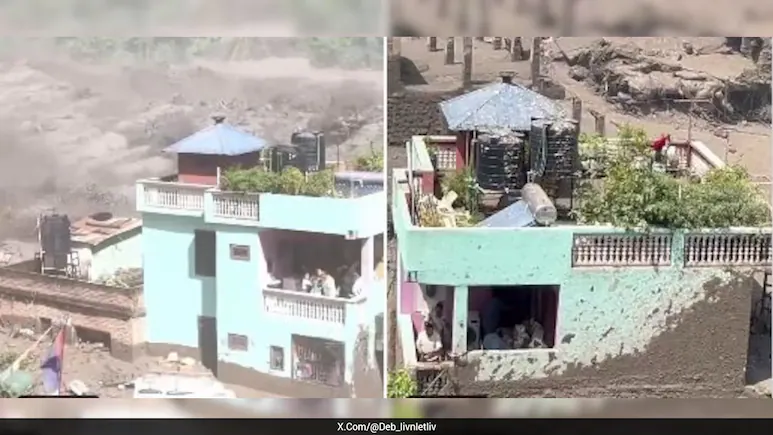
Viral Nepal Flood Video: Why Did This House Stand While Others Fell?


According to Indian Media, the house remained standing as a torrent of water, mud, boulders and uprooted trees surged around it. The family inside reportedly survived and was later rescued safely.
The house's survival appears to have been linked to its reinforced concrete structural frame, rather than luck alone. Unlike many traditional homes in Himalayan valleys that rely heavily on stone masonry, the structure had steel reinforcement connecting its columns, beams and foundation into a rigid framework, NDTV reported.
Structural experts cited in the report explained that such a frame can provide greater resistance to the sideways forces generated when fast-moving floodwater and debris strike a building. The reinforced skeleton helped transfer those forces through the structure and into the ground.
The house's location also appears to have played an important role. It was not directly in the deepest channel of the debris flow and stood on slightly higher ground. This meant that some of the water, mud and debris could split and move around the structure rather than hitting it with the full force of the main flow.
Its compact design may also have helped reduce the pressure exerted by the moving debris. As mud accumulated around the building, it reportedly formed a natural barrier that helped redirect later surges away from the house.
The incident highlights the importance of structural design, reinforcement and site selection in areas vulnerable to flash floods and debris flows. However, the survival of one building does not mean that reinforced concrete structures are immune to extreme flooding. The intensity and direction of the flow, the building's foundation, surrounding terrain and the type of debris involved can all determine whether a structure survives.
The dramatic footage of the green house standing amid widespread destruction has since gone viral on social media, prompting discussion about why some structures withstand extreme natural disasters while neighbouring buildings collapse.
The flash floods have caused a major humanitarian disaster in Nepal, with more than 700 people reported dead and more than 3,000 still missing, according to the reports.

Legal Disclaimer:
MENAFN provides the
information “as is” without warranty of any kind. We do not accept any
responsibility or liability for the accuracy, content, images, videos,
licenses, completeness, legality, or reliability of the information
contained in this article. If you have any complaints or copyright issues
related to this article, kindly contact the provider above.
Comments
No comment