

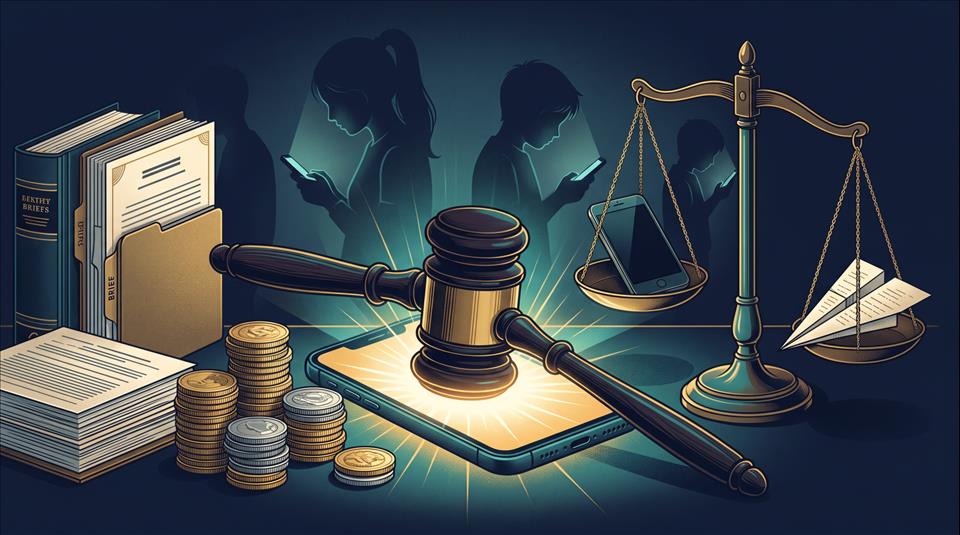
Meta's Teen Safety Settlement Changes Argument For Regulators Everywhere


The genie is out of the bottle, and nobody in Silicon Valley knows how to put it back. For years, governments have struggled to keep pace with social media companies. Regulators wrote rules, launched investigations and demanded stronger safeguards, while children continued to spend hours on platforms designed to keep them scrolling. But now everything has changed.
Meta's landmark agreement in the United States, under which the company could pay up to $17 billion and make sweeping changes to Facebook and Instagram, has given governments another weapon in the fight over children's online safety. More importantly, it has raised a simple but uncomfortable question - if Meta can protect teenagers in the United States, why shouldn't it do the same thing in other countries?
An independent auditor will be looking over Meta's shoulder. Some of these terms must stay in place for at least five years. And yet Meta admitted nothing. The company has denied harming children from day one and continues to deny it. It agreed to pay and to change. Meta had reportedly calculated that losing outright could have run up fines of as much as 1.4 trillion.
Meta's settlement didn't start this fire. It poured fuel on one already burning across four continents. Roughly 40 countries are now debating, drafting or enforcing limits on young people's access to social platforms. Australia introduced the world's first nationwide ban on social media use by children under 16 late last year. A similar proposal is also being considered in Azerbaijan. Under a draft bill, children under 16 would be prohibited from creating accounts on certain social media platforms, while users aged 16 to 18 would require parental consent and face additional safeguards.
Indonesia, which began enforcing its own under-16 rule in March, has spent the months since trying to get major tech firms to actually honor its age-verification mandate. Malaysia, enforcing from June, has hit the same wall. In several cases governments have said plainly that the platforms aren't doing the enforcing.
Here's the wrinkle, though. Some Australian parents backed the ban anyway - not because it works as advertised, but because it gave them something to rely on. "It's the law" ends an argument faster than "because I said so." And a rule that fails to dislodge a 15-year-old who's been scrolling since primary school may still keep a 10-year-old from ever signing up. Prevention and cure are different jobs.
The US settlement could prove to be a turning point.
Meta has agreed to strengthen age verification, expand parental controls and introduce significant restrictions for users under 18. Among the measures are a default two-hour daily limit, a ban on app use between midnight and 6 a.m. without parental permission, and the disabling of notifications during nighttime hours and school lessons. Teenagers would also see fewer visible engagement signals, including likes and reactions. Certain filters would be prohibited, while users would have access to a non-personalized feed. The scale of the legal pressure explains why. Twenty-nine US states had sought penalties and changes to the way Facebook and Instagram operate, arguing that Meta encouraged addictive use among young people.
According to foreign media, Meta has agreed to pay up to $18 billion in compensation over 10 years as part of a settlement with nearly all U.S. states over allegations concerning the impact of its social media platforms on teenagers.
If Meta thinks it has bought peace, Brussels has other plans. European regulation could land heavier than the American deal ever did.
In July 2026 the European Commission preliminarily found that Facebook and Instagram may be breaching the Digital Services Act specifically because of addictive design. The Commission's view is that Meta never seriously assessed or reined in what those mechanics do to users' mental and physical health, minors very much included.
Later, the Commission has preliminarily concluded that Meta doesn't meaningfully enforce its own under-13 ban. Right now a child types in a fake birthday and walks straight through the front door. In April, the Commission made essentially that accusation directly. The Commission has also spelled out what it wants. Its 2025 DSA guidelines call for switching off, by default for minors, the features built to pull people back in.
The European Parliament has gone further, backing the idea of a common European digital age. Under the proposal, children under 13 would not be allowed to use social media, those aged 13 to 16 would need parental consent, and users aged 16 and above could access platforms independently. And that's Europe's chronic problem. The investigations have dragged on for more than two years. Meta has made no substantial changes to its European products and has not been fined a cent. Spanish socialist MEP Laura Ballarín Cereza put her finger on the sore spot, asking the Commission point-blank why Meta is changing its product for Americans while merely negotiating with Europeans about the same issues.
British officials are already asking questions. The UK government has said it expects Meta to apply similar safety measures to British teenagers, warning against a situation in which American children receive "stronger protection."
If Meta can introduce a two-hour limit, shut down overnight access and alter notifications in the United States, European regulators will have a harder time accepting arguments that such measures are technically impossible or excessively burdensome. Thus, the American settlement has effectively created a real-world test case.
UN High Commissioner for Human Rights Volker Türk used the moment to push past the courtroom. Platforms, he argued, should be built with minors' safety baked in from the blueprint stage, and governments should regulate proactively rather than sit on their hands waiting for lawsuits or corporate goodwill to do the work for them.
Social media platforms make money from attention. The longer users stay, the more opportunities there are to show advertising and gather behavioral data. Features such as endless feeds, automatic videos, notifications and personalized recommendations are not random additions. They are part of an economic model built around keeping people engaged. For children, that model presents a particularly difficult problem. A teenager does not necessarily approach a social media feed with the same ability to regulate time, attention and impulses as an adult. Asking children simply to "use social media responsibly" therefore puts much of the burden on the weakest side of the equation.
Meta's settlement does not mean the social media problem has been solved. Besides, it does not prove that bans work, and it certainly does not settle the argument over how much control governments should have over children's online lives.

Legal Disclaimer:
MENAFN provides the
information “as is” without warranty of any kind. We do not accept any
responsibility or liability for the accuracy, content, images, videos,
licenses, completeness, legality, or reliability of the information
contained in this article. If you have any complaints or copyright issues
related to this article, kindly contact the provider above.
Comments
No comment