

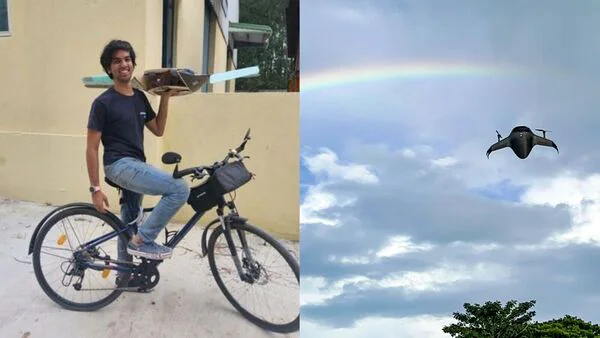
Bengaluru CEO Won $500 Hackathon Prize At 15, Turned Down US College Offer, Now Runs $50 Million Startup


In 2020, Pushp was 15 when the COVID-10 led pandemic shut schools and parks, confining many kids like him to his home. This is when he shifted his focus to something that always intrigued him as a child-making robots. Soon he began experimenting with drones. He called the project Open Drone and entered it in a hackathon, winning $500. He invested the prize money back into the project and used it to build his first prototype. That first drone is said to hang on the wall of Airbound's office.
Also Read | Catch them young: VCs are scouting college campuses for the next big startup Who is Naman PushpBorn in Mumbai, Pushp spent parts of his childhood in Hyderabad and Malaysia before returning to India. He studied at Dhirubhai Ambani International School. His interest in building things reportedly began in Malaysia, where he made simple robots in Class 5 and 6. He also entered robotics competitions and engineering projects.
At 16, Pushp, still a school student, received his first venture cheque from GradCapital. As he was a minor, investors had to speak to his father before investing. He was later admitted to Carnegie Mellon University, which he chose not to attend to focus on the problems around building drones.
Naman Pushp realised that conventional aircraft spend much of their energy carrying their own weight, making the payload, the goods being transported, secondary. This made drone delivery difficult to compete with road transportation in terms of cost. This is where his startup Airbound came into the picture to reverse that equation.
Also Read | Bengaluru hospital's 'musical night' draws online backlash About AirboundAirbound's current TRT aircraft weighs about 1.5 kg and can carry around 1 kg of cargo. It takes off vertically and transitions into horizontal flight. Pushp's company is said to be developing a model to carry a 5 kg payload with further plans to expand manufacturing.
“We want to build towards a world where everything has cost parity with trucking,” Pushp has said in a post he shared on LinkedIn.
Airbound has reportedly completed more than 13,000 autonomous flights across Bengaluru and the Guntur region. These include over 1,000 flights for Narayana Health. Its drones transport samples between a clinic and a hospital, making it faster and more effective than traditional ground transport.
Narayana Health's new Banashankari hospital in Bengaluru was designed without a diagnostic laboratory. It is said that the hospital relies on Airbound's drones to move medical samples between facilities.
For now, the company can provide up to 20 flights a day on one clinic-to-hospital route.
In Andhra Pradesh, Airbound reportedly had plans to connect Amaravati, Vijayawada and Guntur, with a long-term target of 10,000 flights a day. Additionally, the state government is said to be aiding in creating a network of ground observers to support private operators while keeping flights within visual line of sight.
What's next?The next challenge is expected to be manufacturing. Airbound is betting on lightweight carbon-fibre aircraft that can be produced at scale.
“100 aircraft a day will start to feel very small,” Pushp remained optimistic at an event, as reported by India Today.

Legal Disclaimer:
MENAFN provides the
information “as is” without warranty of any kind. We do not accept any
responsibility or liability for the accuracy, content, images, videos,
licenses, completeness, legality, or reliability of the information
contained in this article. If you have any complaints or copyright issues
related to this article, kindly contact the provider above.
Comments
No comment