

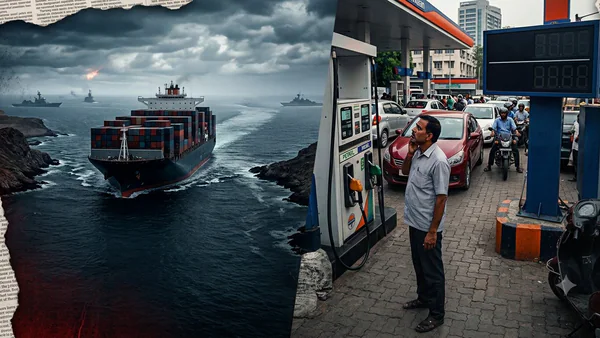
$22 Billion Extra For Fuel: India Among Countries Which Paid The Most In Strait Of Hormuz Price Shock, Reveals Study


The report published on August 26 emphasised the "largest sustained oil price shock" the US–Iran war has caused since the 1990 Gulf War.
"During the conflict's first six months, Asian LNG prices averaged 75% above pre-war expectations, European LNG prices 60% above, diesel 59% above and crude oil 35% above," the analysis by CREA revealed.
The movement in the Strait of Hormuz, a key economic trade route off the Iranian coast, remains restricted as the war between Iran and the US continues.
The study compared actual fossil fuel prices over the past six months with monthly expected prices in the 12 days before the US and Israel first struck Iran.
How much did India and other countries pay extra?According to the CREA report, the highest gross extra costs were incurred by the EU (USD 78 billion), followed by China (USD 35 billion) and India (USD 22 billion).
This means that India suffered a gross additional cost of USD 22 billion in the six months following the strikes on Iran, compared to what pre-war futures curves had expected.
India, the single largest LPG importer, was among Top 20 countries, only second to China, that paid the most for the Hormuz price shock. India's net additional cost across all fuels stood at USD 14.4 billion.
This net extra cost of USD 14.4 billion is equivalent to 0.38% of India's GDP, representing the loss of approximately 1.4 days of national income.
India's LPG, crude oil importsChina paid USD 31.3 billion net for crude oil between March and August 2026, and India paid USD 20.5 billion, together 40% of the USD 131.2 billion crude total.
According to the report, India's imported LPG bill over the six months came to about USD 4.7 billion, of which roughly a fifth was the extra cost caused by the price shock.
That extra cost was paid on volumes that collapsed in March to half the average volumes of the previous two years (2024 and 2025) and had recovered to 86% of that level by June, the report added.
Across the full six months, India's extra LPG import cost is estimated at USD 1.1 billion.
Among importers, the typical low- or middle-income country paid about twice as much relative to the GDP as the typical high-income country, the report revealed.
'India's LPG imports fell 49% in March'The CREA report revealed that India's LPG imports fell 49 percent in March, the first full month of the US-Iran war, compared with the average of the previous two years.
The US share of India's LPG imports rose from 8% in February to 16% in March and to 32% in April, replacing some, but not all, of the lost Gulf volume.
Readily available monthly trade data covers only a minority of importing countries and excludes the largest, China, so any global LPG figure would be based on a biased sample.
India is reported instead because it reports both volumes and cargo origins, the report added.
Clean energy investments helped contain the crisisIn the first five months of the crisis alone, clean power generation added since 2020 saved importing countries an estimated USD 36 billion in avoided coal, gas and oil imports.
This includes USD 22 billion in gas imports, USD 10 billion in coal imports, and USD 5 billion in oil imports.
"In absolute terms, the largest savings were in China (USD 7.9 billion) and Japan (USD 4.9 billion), followed by Spain, France, Italy, the Netherlands, Brazil and India," the CREA report added.
Measured against what each country's fossil fuel import bill would otherwise have been, Brazil avoided 35%, Lithuania 25%, Denmark 24% and Sweden 19% of the total national import value. Outside the EU, Brazil and Colombia saw the largest proportional savings.
According to the IEA, in 2025, global renewable power investments totalled USD 700 billion or USD 58 billion per month.
Global monthly investment in renewable power was just 5.6% higher than the USD 55.3 billion in additional monthly fossil fuel import costs caused by higher seaborne oil and gas prices following the war on Iran.

Legal Disclaimer:
MENAFN provides the
information “as is” without warranty of any kind. We do not accept any
responsibility or liability for the accuracy, content, images, videos,
licenses, completeness, legality, or reliability of the information
contained in this article. If you have any complaints or copyright issues
related to this article, kindly contact the provider above.
Comments
No comment