

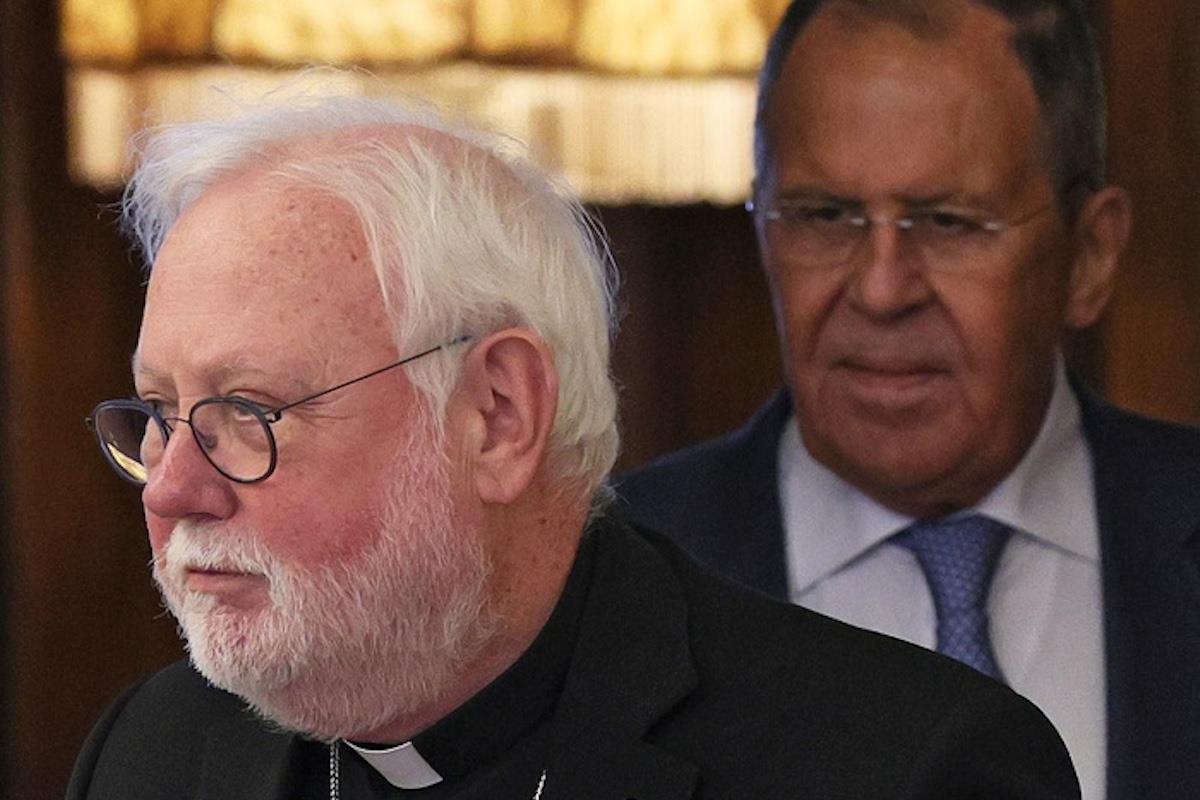
Holy See Seeks A Path To Peace In Moscow


Vatican diplomacy and American intelligence crossed paths in an effort to restore some balance to a chaotic world order and establish dialogue as a basis for viable peace.
On Tuesday, August 25, long-term diplomatic planning and last-minute intelligence briefings came together in the Russian capital. Moscow became the meeting place where the Vatican's diplomatic efforts to promote peace and American global interests in foreign affairs converged.
Russian television transmitted the beginning and end of the meeting between Bishop Gallagher and Minister Lavrov live. The introductory statements at the negotiating table and the final remarks at the press conference were carefully prepared in advance and presumably agreed upon.
Both sides wanted more than just media coverage of the meeting; they wanted to demonstrate that, despite its difficulties, dialogue is still possible. Bishop Gallagher, on behalf of Pope Leo and Cardinal Secretary of State Pietro Parolin, presented the international community with the challenging reality that wars cannot be ended militarily today.
Diplomacy is needed, and it should also be the means by which conflicts are resolved before they reach the point of military intervention or, worse, war.
Latest stories Bangladesh's J-10CE fighter plan stirs China dependence fears The many snags in Erdogan's many strategic wins Nepal glacial disaster and the new geography of climate riskBishop Gallagher said that those involved in the conflict, along with the entire international community, must establish conditions conducive to“serious political and diplomatic work.” The Holy See is prepared to offer diplomatic and ecclesial support to achieve peace in Ukraine.
Lavrov stressed the balance of Vatican diplomacy regarding the situation in Ukraine, acknowledging the Holy See's initiatives to settle the conflict. Lavrov announced that Moscow is ready to resume political consultations at the deputy foreign minister level regarding this conflict and praised the Holy See's diplomatic efforts and its“active involvement in resolving a number of acute humanitarian issues in the Ukrainian conflict.”
Another issue discussed in the meeting was the AI, particularly its use in the military. Ascertaining aligned positions on such topic, the Holy See and the Russian Federation agreed to carry on the dialogue in a substantive way.
As expected, Lavrov brought up the issue of the Russian-speaking population in Ukraine and the Ukrainian government's actions against the Ukrainian Orthodox Church in communion with the Moscow Patriarchate, led by Kirill. Lavrov used precise canonical and theological terminology in the latter case.
Bishop Anthony of Volokolamsk, chairman of the Department for External Church Relations of the Moscow Patriarchate, also addressed the question about“the persecution of the Ukrainian Orthodox Church by the Ukrainian state authorities” during his meeting with Bishop Gallagher.
Although potentially divisive, this issue does not seem significant enough to impede positive developments in Vatican-Russian diplomatic relations, as both Lavrov and Gallagher stated that they expect to achieve progress and further cooperation with their counterparts.
While the Gallagher-Lavrov meeting received widespread public attention, the meeting between Bishop Gallagher and Yuri Ushakov, Putin's advisor for international affairs, was held discreetly and confidentially, as is customary when counterparts wish to take decisive steps forward in their diplomatic relations.
The Holy See announced the meeting's occurrence with a post on the X account of the State Secretariat.
Sometimes a picture speaks volumes. Posting a picture of Gallagher and Ushakov shaking hands after their meeting suggests that the Holy See evaluated the results of the meeting positively – which could become a key to revamping diplomacy on the world stage.
What is certain is that Bishop Gallagher's visit to Moscow on behalf of the Holy See occurred during a dangerous time of international super partes bodies vacuums, both politically and diplomatically. A void is always dangerous because it can be filled by force and violence.
Sign up for one of our free newsletters-
The Daily Report
Start your day right with Asia Times' top stories
AT Weekly Report
A weekly roundup of Asia Times' most-read stories
By filling diplomatically this void, the Holy See is acting vicariously for the international community and the missing super partes agencies. Although acting“on behalf and for the sake of humanity” is grounded in the theological structure of the Holy See's diplomatic efforts, acting in the absence of credible and trustworthy agencies at the international level is not in line with the style and mission of Vatican diplomacy.
For now, our world needs the Holy See to continue this“unnatural” vicarious diplomacy to avoid a global order ruled only by the strong and mighty.
The Moscow occurrence, where the Vatican's genuine desire to govern and settle conflicts through diplomacy met the power of the“strong and mighty” (America and Russia), could be the beginning of a new era of viable and credible super partes agencies where counterparts discuss issues instead of going to war.
Despite current political trends and the failure of the diplomatic bodies we inherited from the post-Cold War order, this is what the Holy See is looking for.
Marcello Neri is senior fellow at Appia Institute (Religion and Politics); professor of ethics and political anthropology at the Higher Institute of Educational Sciences G. Toniolo of Modena; and professor of“religion and public square” at the Faculty of Political Sciences of the Catholic University in Milan.
This article first appeared on Appia Institute and is republished with permission. Read the original here.
Thank you for registering!
-
Share on X (Opens in new window)
Share on LinkedIn (Opens in new window)
LinkedI
Share on Facebook (Opens in new window)
Faceboo
Share on WhatsApp (Opens in new window)
WhatsAp
Share on Reddit (Opens in new window)
Reddi
Email a link to a friend (Opens in new window)
Emai
Print (Opens in new window)
Prin

Legal Disclaimer:
MENAFN provides the
information “as is” without warranty of any kind. We do not accept any
responsibility or liability for the accuracy, content, images, videos,
licenses, completeness, legality, or reliability of the information
contained in this article. If you have any complaints or copyright issues
related to this article, kindly contact the provider above.
Comments
No comment