

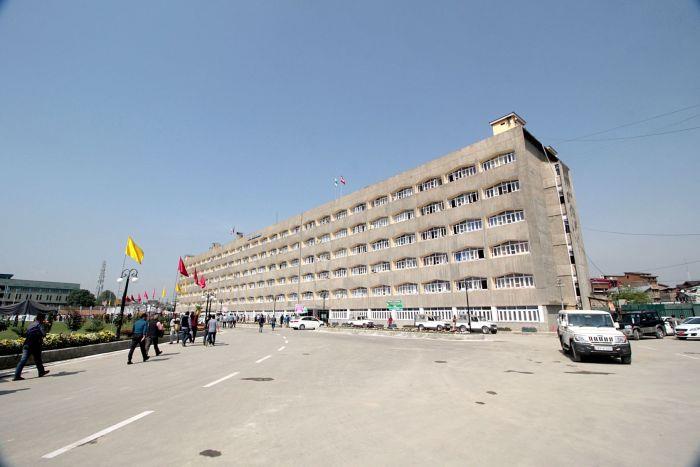
Srinagar Revamp: Civil Secretariat Among 21 Offices Proposed For Relocation


The proposal covers a range of administrative, security and public institutions currently located in densely populated parts of the city. Their existing premises have been earmarked for possible redevelopment as tourism facilities, public spaces, parking areas and other community infrastructure, according to an ETV Bharat report.
ADVERTISEMENTThe Srinagar Master Plan-2035 was prepared by the Town Planning Organisation Kashmir and approved by the then State Administrative Council on February 13, 2019. It was subsequently notified by the Housing and Urban Development Department on March 7, 2019, before the reorganisation of Jammu and Kashmir in August that year.
One of the most significant proposals is the relocation of the Civil Secretariat to Nowgam along the National Highway Bypass, roughly 10 kilometres from its present site. The existing Secretariat premises would continue to function until a final decision is taken on shifting the complex.
ADVERTISEMENTThe proposed relocation plan also includes the Forest Department, Old Assembly Complex, Old Secretariat Complex, offices of the Divisional Commissioner and Deputy Commissioner, the Directorate of School Education Kashmir, and the Agriculture and Horticulture departments currently operating from Lal Mandi.
These offices have been proposed to be housed at a Mini-Secretariat at Batamaloo.
However, the proposed Mini-Secretariat itself remains incomplete. The project, for which the foundation stone was laid in 2018 and which carries an estimated cost of Rs 80.26 crore, has reportedly remained stalled due to lack of funds.
The plan proposes moving the Directorate of Information and the office of DIG Traffic from Polo View to Bemina.
The District Police Lines at Karan Nagar has also been proposed for relocation to Noorbagh in the Eidgah area, while the Veterinary Hospital at Maisuma could be shifted to the same location.
Among the healthcare institutions identified for relocation is the Chest Disease Hospital at Dalgate. It has been proposed to be moved to Zewan on the outskirts of Srinagar, with its existing location earmarked for conversion into a community facility centre.
The Central Jail at Badamwari and the Government Poultry Farm in the area have been proposed for relocation to Khunmoh. Their present sites could subsequently be developed into a Craft Centre and a Disaster Cell, respectively.
The Leper Hospital and Leper Colony at Lalbazar are also proposed to be shifted, with Khimber, Shuhama, Humchi and Saidpora among the locations identified. The existing Lalbazar site has been proposed for tourism-related development.
Another proposal involves relocating the CAPD godowns at Shaheed Gunj to the Dry Port at Budgam. The land currently occupied by the godowns could then be redeveloped as a public park, playground, craft centre and multilevel parking facility.
Read Also What Three CMs Taught Me About Governance in Kashmir Government at the DoorThe Doordarshan office near Srinagar International Airport and some other government establishments have also been identified for relocation.
The government has already shifted the District Court Complex to Tengpora in Batamaloo. Meanwhile, a new complex for the Srinagar wing of the Jammu and Kashmir and Ladakh High Court is under construction at Rakhi-i-Gund in Bemina.
The proposed changes are part of a broader plan to prepare Srinagar for projected urban growth.
According to the Master Plan, the city's built-up area could expand to around 766 square kilometres by 2035, while the population is projected to increase from approximately 1.2 million to three million.
Chief Minister Omar Abdullah has repeatedly stressed the need to tackle congestion and traffic pressure in Srinagar and has said the government would undertake measures aimed at decongesting the city.
The relocation proposals, however, have raised concerns among sections of residents and the business community, particularly over the possible impact on commercial activity in areas that currently benefit from the presence of major government institutions.
KTMEF spokesperson Qazi Tauseef said the government should first assess the economic implications of moving the offices and consult trade bodies before proceeding.
He said traders, transporters and restaurant operators could be affected if institutions that currently draw large numbers of employees and visitors are moved away from established commercial centres.
Residents, meanwhile, have called for the decongestion plan to be accompanied by adequate public infrastructure, including parking facilities, playgrounds and community spaces.
The proposed relocation of the institutions, if implemented, could significantly alter Srinagar's administrative geography and free up several strategically located parcels of land for other public and economic uses.
Legal Disclaimer:
MENAFN provides the
information “as is” without warranty of any kind. We do not accept any
responsibility or liability for the accuracy, content, images, videos,
licenses, completeness, legality, or reliability of the information
contained in this article. If you have any complaints or copyright issues
related to this article, kindly contact the provider above.
Comments
No comment