

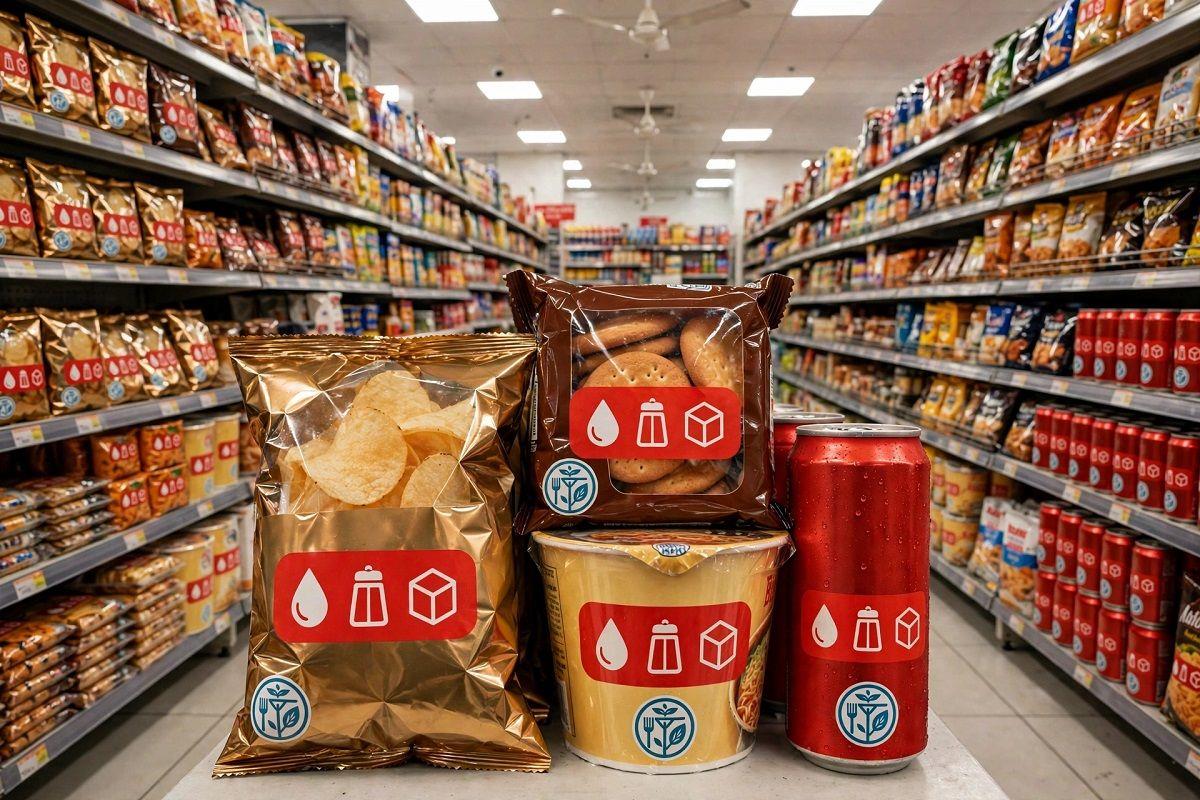
High Sugar, Salt, Fat Foods May Get Red Warning Labels


In a compliance affidavit filed before the apex court, the food regulator said it has proposed a red-coloured hexagonal warning label for products that are high in any two or more of the three specified nutrients of concern, based on thresholds prescribed under the Dietary Guidelines for Indians, 2024, issued by the Indian Council of Medical Research-National Institute of Nutrition (ICMR-NIN).
ADVERTISEMENTThe proposed warning would carry declarations such as“High Fat”,“High Sugar”,“High Salt” and, where applicable,“Highly Sweetened Beverage”, allowing consumers to identify such products at a glance.
The FSSAI said the proposed front-of-pack warning is intended to provide a“simple, prominent and easily comprehensible” indication of products containing high levels of specified nutrients of concern.
ADVERTISEMENTThe affidavit was filed in compliance with an August 13 order of the Supreme Court, which was hearing a plea filed by public charitable trust 3S and Our Health Society seeking mandatory front-of-package warning labels on packaged foods.
The petitioner, represented by advocate Rajiv Shankar Dvivedi, has sought directions to the Centre, states and Union territories for implementation of mandatory front-of-package warning labels (FOPL).
During the August 13 hearing, a bench of Justices J B Pardiwala and K Vinod Chandran had criticised the FSSAI over the delay in introducing warning labels and questioned whether the government“does not want its people to be healthy”.
In its latest affidavit, the FSSAI said it had prepared a proposal for displaying information relating to added sugar, added fat and salt in pictorial form on the front of food packages.
The warning label, it said, would be displayed in a font size one point larger than the font used in the nutrition information table on the back of the package.
Read Also Ladakh Launches Crackdown on Food Safety Violations J&K Eateries Told To Specify Meat TypeThe regulator has proposed a phased implementation of front-of-pack nutrition labelling (FoPNL), saying this would facilitate consumer acceptability and give the food industry adequate time for reformulation.
Under the proposed Phase I, the warning would apply to products high in any two or more of added fat, added sugar and salt, along with specified sweetened beverages.
Phase II would expand the requirement to products high in any one of the three specified nutrients.
The FSSAI has also proposed exemptions for certain categories of products.
These include single-ingredient food products and foods that are inherently rich in fat, sugar or salt, such as ghee, edible oil, salt, sugar, jaggery and honey, subject to other applicable requirements under food safety and labelling regulations.
The affidavit said a food product would be classified as high in fat, sugar and/or salt based on nutrient thresholds specified in the Dietary Guidelines for Indians, 2024.
The proposed system is intended to particularly assist children and other vulnerable groups in making informed food choices, the FSSAI said.
The authority said the proposed information would be presented in a red hexagon on the front of the package in a prescribed format.
However, the regulator clarified that the proposal is yet to become a notified requirement.
“It is pertinent to mention that the same will be notified by way of an amendment in the respective regulations by following prescribed procedure,” the affidavit said.
The proposed warning-label system is aimed at making key nutritional information more visible at the point of purchase rather than requiring consumers to rely solely on detailed nutrition tables printed on the back of packaged food products. (with PTI inputs)

Legal Disclaimer:
MENAFN provides the
information “as is” without warranty of any kind. We do not accept any
responsibility or liability for the accuracy, content, images, videos,
licenses, completeness, legality, or reliability of the information
contained in this article. If you have any complaints or copyright issues
related to this article, kindly contact the provider above.
Comments
No comment