

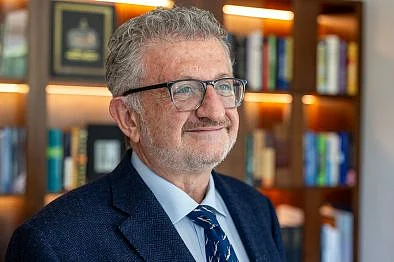
Meet The Geneticist Who Spent 16 Years Helping Build NYU Abu Dhabi From The Ground Up


The first thing Fabio wanted to talk about was my failure to properly appreciate what he was wearing. He was dressed in a tan linen suit, lighter than the darker ones I have seen him in before. His angular face was softened by an almost permanent smile. He spoke with enthusiasm, but what stood out more was the way he listened.
Recommended For YouWhen I asked whether this is how he usually dresses, he said a T-shirt would probably be more representative outside work. Then he stopped.“Actually, don't you like my tie?” He laughed and got to his feet before the interview has properly begun.
Stay up to date with the latest news. Follow KT on WhatsApp Channels.
Almost everything in his office, he told me, was connected in some way to NYU Abu Dhabi.
There is an early sketch of the Saadiyat campus by architect Rafael Viñoly. Books written by NYUAD faculty sit alongside student work. There are reminders of the university's links to the UAE's space programme. And then there is a piece of glass whose story began with seven different colours of sand from the seven emirates. The sand was taken to Venice, where an Italian artist transformed it into a sculpture before it returned to Abu Dhabi as a gift.
It took only a few minutes to walk around the office, but nearly every object points to a much longer story - one that stretches back almost two decades.
Before NYU Abu Dhabi existedBefore there were students, lecture halls or a campus on Saadiyat Island, NYU Abu Dhabi was an ambitious idea taking shape between New York and Abu Dhabi.
One of the pivotal moments came in 2006, when NYU's then-president John Sexton was invited to a majlis with Sheikh Mohamed bin Zayed Al Nahyan, then Crown Prince of Abu Dhabi. The meeting was expected to last around 15 minutes, but it lasted considerably longer.
Khaldoon Al Mubarak later recalled that, at a crucial stage, the two men needed to sit together and understand whether they truly shared the same vision.
What followed was not meant to be another overseas study centre carrying the name of an American university. By October 2007, NYU and Abu Dhabi had announced plans to establish a full residential research university, with its first students expected in 2010.
Sexton's words at the time now seem particularly significant. NYU, he said, would remain rooted in New York but also needed to become“in and of the world”. More importantly, he said the university was coming to Abu Dhabi not simply to educate, but with the expectation of being“educated and changed in turn”.
Who is Fabio Piano?At the time, Fabio was still primarily known as a molecular biologist.
The Italian-born scientist had spent much of his own academic life at NYU, where he eventually earned four degrees. His career unfolded during a period of rapid change in molecular biology, developmental biology and genomics, as advances such as the Human Genome Project transformed how scientists studied life.
He later helped establish NYU's Center for Genomics and Systems Biology in New York. His research was concerned not simply with individual genes, but with the networks and mechanisms through which genes interact and living systems function.
Then the Abu Dhabi project caught his attention.
Fabio became involved in early conversations about what the new university could become. Some people, he recalled in NYUAD's oral history, arrived with assumptions about what was and was not possible in the region.
The offer he misunderstoodIn January 2010, he organised a genomics conference in Abu Dhabi. A couple of weeks after returning to New York, founding Vice Chancellor Alfred Bloom asked to see him. Fabio prepared to report back on the conference.
Bloom had something else in mind.
“We're looking for a provost, and I would love for you to be that candidate,” Bloom told him, according to NYUAD's oral history.
Fabio initially misunderstood the proposal, thinking Bloom was asking him to join the committee that would choose the university's provost. Bloom clarified: he wanted Fabio himself.
The decision was far from easy. Piano had helped build a genomics centre in New York, whose new building had just been completed. His laboratory, research, and life were all based there, and he had strong reasons to stay.
But after months of conversations - including one with NYU President John Sexton that appealed to his sense of responsibility to the university - Fabio eventually agreed to make the move to Abu Dhabi in the summer of 2010.
“I thought I would do it for one year,” Piano recalled later.“Of course, I was totally hooked once it got started.”
Fabio saw Saadiyat Island developWhat Fabio thought would be a one-year assignment stretched into ten. And over those years, he watched Abu Dhabi, and especially Saadiyat Island, transform around him.
“When I first arrived, there was no bridge to Saadiyat Island, let alone Saadiyat Island,” he told me.
In those early days, reaching the site where NYU Abu Dhabi's permanent campus would eventually stand meant taking a boat. The university's first undergraduate students had begun their studies in 2010 at its temporary Downtown Campus in Abu Dhabi. Several years later, the Saadiyat campus opened.
Fabio remembers both versions of the university - the smaller operation taking shape in the city and the much larger institution that eventually emerged on the island. He watched Saadiyat grow alongside it, as homes, museums, cultural institutions, and entire neighbourhoods appeared around the campus.
Today, Piano lives there.“I've been here for 16 years now. It's been one of my joys to be here.”
'Felt like coming home'He grew up partly in Singapore and London but remains emphatically Italian. Yet Abu Dhabi, he says, produced a feeling he did not entirely expect.
“Coming to this part of the world felt like coming home.”
He talks about the familiarity he found in hospitality and human relationships, and about what he sees as Abu Dhabi's ability to move quickly towards new industries and technologies without entirely surrendering the traditions beneath them.
Even while helping build the university, however, Fabio never stopped being a scientist. During NYUAD's development, its Public Health Research Center created the UAE Healthy Future Study, a long-term effort to understand how lifestyle, environment and genetics affect the health of Emiratis. The first phase eventually recruited nearly 15,000 UAE nationals, building one of the country's most significant population-health research resources. NYUAD says the work contributed to the establishment of the Emirati Genome Program.
Fabio remembers the connection more specifically. He said researchers at NYUAD had begun thinking about sequencing Emirati participants before the national genome programme was established, and that when the programme emerged they connected with G42.
“We, in some sense, gave the first 5,000 samples for the Emirati Genome Project,” Piano said.
The university's published record independently confirms the Healthy Future Study's broader contribution to establishing the national programme, although it does not publicly specify Fabio's 5,000-sample account.
There is another, much more personal genomic story Piano likes to tell. He has had his own ancestry examined.
“I do cluster with Emiratis, apparently,” he said, before refining the claim. He meant the Arab world more broadly. He suspected his southern Italian ancestry may explain the connection.“That's what the genome says.”
A few minutes earlier, he had told me Abu Dhabi somehow felt like home. Piano made no attempt to connect the two observations. Neither did I.
'We are an Abu Dhabi product'Piano has an unusual way of handling interviews: he often answers a question with one of his own.
When I asked what NYU Abu Dhabi has changed about the city, he did not immediately talk about the university. Instead, he asked whether I grew up in Abu Dhabi.
I did.
So he asked what I have seen change.
For a moment, the conversation became less about NYUAD and more about Abu Dhabi itself - the city as it was, the city it has become, and where a university like NYUAD belongs in that story.
That instinct to look outward becomes particularly interesting when the subject turned to the criticism that NYU Abu Dhabi is, in effect,“American land” in the UAE.“I don't like it,” he said immediately.
Piano acknowledged the American roots of the institution. He argued that one of the strengths of American higher education is an intellectual culture in which students are expected to question what they are told, including accepted ideas and propositions. For knowledge to advance, he said, people must be able to demonstrate that something long believed to be true is wrong.
But an American educational tradition, in his mind, is different from an American institution simply transplanted abroad. The old international model, he argued, often involved universities establishing sites overseas that largely represented the culture and practices of the home institution. What NYUAD became, he said, is more complicated.
It carries an American style of education. Its students and faculty come from across the world. But the institution itself exists because Abu Dhabi invited it, built around it and allowed it to develop here.
“Talent does not have nationality. Talent is talent," he said.
Then he reached the formulation that seemed to matter most to him.“We are a UAE product. We are an Abu Dhabi product.”
It is a striking statement given where the story began 2007, Sexton publicly promised that NYU did not expect to come to Abu Dhabi unchanged. Nearly two decades later, Piano is arguing that the institution that emerged is evidence that it did not.
He described students from around the world who took a chance on a university that barely existed; Emirati students able to receive a highly international education without first leaving their country; faculty recruited into fields relevant to the UAE; and artistic, scientific and cultural work that gradually became part of Abu Dhabi itself.
Fabio's journey with NYUADHis own relationship with NYUAD has never been entirely linear. Piano stepped down as provost in 2020 and returned more fully to biology and genomics. When Mariët Westermann left the vice chancellorship in 2024, he was asked back into leadership, first on an interim basis. On August 6 this year, NYU made the appointment permanent, naming him Vice Chancellor and Chief Executive.
Calling it a return is too neat. Piano never really left the institution, just as the institution seems never to have entirely left him.
Near the end of our conversation, the glass sculpture from the beginning of the office tour came back into view. Seven shades of Emirati sand were taken to Venice and transformed by an Italian artist before returning to Abu Dhabi.
Fabio likes what it represents: the seven emirates together, but also an openness towards the world.
The facts carry enough of their own symmetry: Emirati material, shaped in Italy, brought back to Abu Dhabi and kept by an Italian scientist who once agreed to come here for what he imagined might be one year.
Sixteen years later, he lives on an island he once had to reach by boat, now leading the university he helped build there.
ALSO READ- How NYU Abu Dhabi plans to retain talent in UAE, develop country's knowledge base Ministry of Industry and Advanced Technology and New York University Abu Dhabi sign Mo Abu Dhabi researchers develop nanotechnology for better cancer detection, treatment

Legal Disclaimer:
MENAFN provides the
information “as is” without warranty of any kind. We do not accept any
responsibility or liability for the accuracy, content, images, videos,
licenses, completeness, legality, or reliability of the information
contained in this article. If you have any complaints or copyright issues
related to this article, kindly contact the provider above.
Comments
No comment