

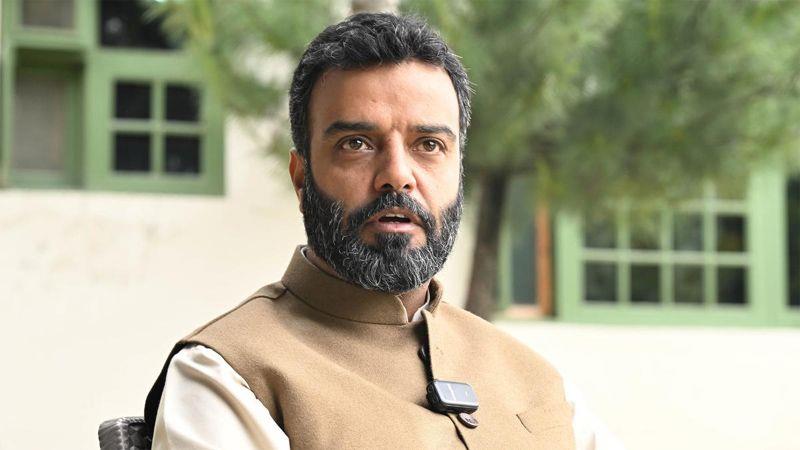
'Want No Share In This Lie': Ruhullah Questions NC's 370 Stand


In a strongly worded two-page letter to NC president Farooq Abdullah, Mehdi questioned the party's decision to treat restoration of statehood as the“outer limit” of its political horizon, while pointing to its 2024 Assembly election promise to restore Articles 370 and 35A.
ADVERTISEMENTHe also challenged Abdullah over his public demand that he resign as an MP and seek a fresh mandate, turning the dispute into a wider debate over what the National Conference now stands for.
Mehdi said his resignation would come“even without you asking” but made clear that he wanted accountability before taking the final step.
ADVERTISEMENTThe letter came after Abdullah had publicly challenged him to resign from Parliament if he believed his 2024 Lok Sabha victory was based on his personal support rather than the National Conference organisation.
The NC president had said that Mehdi should return to the people and seek a fresh mandate.
In an earlier statement, Mehdi confirmed that he would resign from both Parliament and the National Conference.
“Yes, I am resigning from the party and as Srinagar MP,” he said.
He said he was likely to formally tender his resignation to the Lok Sabha Speaker and Farooq Abdullah on November 3, the 26th death anniversary of his father, Aga Syed Mehdi.
Mehdi said he had a few commitments to fulfil before formally submitting his resignation, including the disbursal of funds under the Members of Parliament Local Area Development Scheme.
“I have a few commitments before I formally submit my resignation,” he said.
Read Also The Srinagar Test Aga Ruhullah to Quit NC, Resign as Srinagar MP on Nov 3He also said he had invited several MPs to Srinagar for a conference as part of his efforts to seek restoration of Jammu and Kashmir's constitutional rights.
In his letter, Mehdi took particular exception to the criticism that he was seeking restoration of Article 370 while“begging from Delhi”.
He argued that the National Conference itself was not“begging” for Article 370 but was seeking restoration of statehood from the Centre.
Mehdi said statehood was a right recognised by the Supreme Court but argued that accepting it as the“outer limit” of Jammu and Kashmir's political aspirations risked legitimising and normalising the constitutional changes made in August 2019.
He also questioned why the NC had promised restoration of Articles 370 and 35A in its 2024 Assembly election manifesto if it did not intend to pursue the commitment.
“Why did we include the restoration of Article 370 in our manifesto?” he asked.
“Were we making promises we knew we could not keep or perhaps never truly intended to keep?”
Mehdi argued that the BJP was in power at the Centre when the NC framed its 2024 manifesto, and therefore the party could not simply use the Centre's position as an explanation for abandoning its earlier commitment.
He questioned whether the NC had invoked the“wound” inflicted on the people of Jammu and Kashmir in August 2019 merely for political mileage before forgetting its promises after forming the government.
Mehdi said that if this was the case, it was not merely a political misjudgment but a“sin” and a“brazen moral failure” of deliberately misleading a population that had already endured decades of suffering and voted for the party with“hope, trust and the expectation” that it would honour its word.
“Personally, I want no share in this lie,” he said.
Mehdi said the issue went beyond the restoration of Article 370 and involved wider concerns about the future of Jammu and Kashmir.
He pointed to unemployment, pressure on land and resources, and concerns over religious rights, traditions and language.
“Our land is up for grabs. Our resources benefit everybody but us. Our religious rights, traditions, and language face constant pressure. Our environment is being ravaged by illegal deforestation, mining, and construction in ecologically fragile zones,” he said.
He said elected representatives had a responsibility to resist what he described as the“constant degradation and dehumanisation” of Jammu and Kashmir rather than reduce the aspirations of its people to what the BJP was willing to concede.
“Our job as elected representatives is to fight this constant degradation and dehumanisation,” Mehdi said.
He added that the political responsibility was also to ensure that the events of August 2019 did not become the“new political normal”.
“It is to ensure that the extraordinary and deeply consequential events of August 2019 do not become the new political normal and to recognise that restoration of statehood cannot be treated as an adequate substitute for what was taken away,” he said.
Mehdi further questioned why his political position should be considered objectionable by anyone from Jammu and Kashmir,“let alone a member of the JKNC”.
He reminded Abdullah of the National Conference's own past position, recalling that the Jammu and Kashmir Assembly had passed the Autonomy Resolution when Abdullah was chief minister.
“I do not ask these questions out of disrespect. I ask them because I remember that you were the hon'ble chief minister of the very Assembly that passed the Autonomy Resolution. That, too, must have required courage,” he said.
“Why, then, has the mere mention of constitutional guarantees for Jammu and Kashmir now become so offensive that you felt compelled to publicly demand my resignation?” he asked.
Mehdi said the central question was what had changed, the aspirations of the people or the willingness of the National Conference to stand up for them.
“What has changed, the aspiration of our people, or the JKNC's willingness to stand up for them?” he asked.
He said he had more questions but would await Abdullah's response, adding that the people of Jammu and Kashmir also had a right to know what the National Conference truly stood for.
The letter also addressed the personal dimension of the dispute.
Mehdi said he had never sought membership of the National Conference and had instead been personally invited by Farooq Abdullah to join the party.
“Not many know this, Doctor Sahab. But you do,” he wrote.
He described himself as“the inheritor of a long tradition of martyrdom” and“the proud son of a martyr”.
On the question of his resignation, Mehdi reiterated that the decision would be taken regardless of Abdullah's public demand.
“The resignation will come. It would have come even without you asking, but before that must come accountability,” he said.
The developments mark a sharp escalation in the differences between Mehdi and the NC leadership, with the dispute now extending beyond his proposed resignation to fundamental questions over the party's political position on Article 370, restoration of statehood and its commitments to the people of Jammu and Kashmir.
Legal Disclaimer:
MENAFN provides the
information “as is” without warranty of any kind. We do not accept any
responsibility or liability for the accuracy, content, images, videos,
licenses, completeness, legality, or reliability of the information
contained in this article. If you have any complaints or copyright issues
related to this article, kindly contact the provider above.
Comments
No comment