

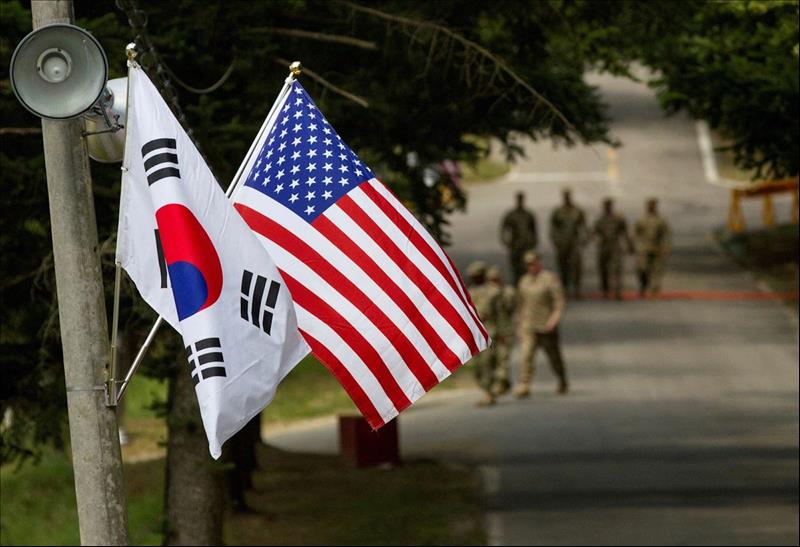
The Geopolitical Imperative For A Self-Reliant South Korea


The unilateral announcement, posted to social media mere hours before the large-scale maneuvers involving 18,000 South Korean troops were set to launch, was justified by Washington on grounds of cost efficiency, claims of a close personal rapport with North Korean leader Kim Jong Un and executive frustration over South Korean President Lee Jae-myung's refusal to commit Seoul's military to denuclearization operations against Iran.
This transactional and unilateral maneuver directly fractures the foundation of the US-led extended deterrence doctrine, which has served as the bedrock of stability on the Korean Peninsula for over seven decades.
When a nation's security guarantees can be summarily revoked to accommodate Washington's domestic political calculus, absolute reliance on the American defense umbrella ceases to be a protective asset. Instead, it becomes an existential vulnerability threatening national survival.
This new geostrategic reality compels South Korea to face an unavoidable historical crossroads. Discourse surrounding strategic autonomy has shifted radically: transitioning from a progressive academic debate into an urgent geopolitical imperative to safeguard national sovereignty against the erratic behavior of its principal ally.
The American dilemmaWashington's unilateral decree demands an accelerated transfer of Wartime Operational Control (OPCON) to the South Korean military. Although evaluations for Full Operational Capability (FOC) are slated for completion in 2026, severe systemic gaps in intelligence, surveillance, and reconnaissance (ISR) integration continue to cast a long shadow over Seoul.
Limitations in independent satellite monitoring to track North Korea's highly mobile missile launchers and subterranean installations leave South Korea heavily dependent on Washington's early-warning satellite network.

Legal Disclaimer:
MENAFN provides the
information “as is” without warranty of any kind. We do not accept any
responsibility or liability for the accuracy, content, images, videos,
licenses, completeness, legality, or reliability of the information
contained in this article. If you have any complaints or copyright issues
related to this article, kindly contact the provider above.
Comments
No comment