

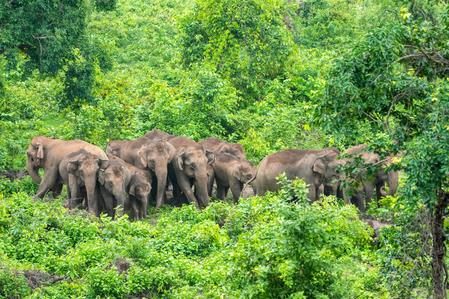
TN Notifies 3 Elephant Corridors For Safe Movement Between Hosur Forest Division, Karnataka


The corridors recognised under the notification are Jawalagiri–Ulibanda–Thaggatti, Jawalagiri–Panai–Anchetty and Billikkal–Jawalagiri.
The order was issued by Kakarla Usha, Additional Chief Secretary of the Environment, Climate Change and Forests Department.
Together, the three corridors cover more than 10,300 hectares of reserve forests and wildlife sanctuary land.
Jawalagiri–Panai–Anchetty, the largest of the three, extends for 20.90 km and encompasses 6,881.47 hectares.
The Jawalagiri–Ulibanda–Thaggatti corridor covers 3,241.53 hectares along an 18.50-km stretch.
The Billikkal–Jawalagiri corridor, the smallest, runs for 2.20 km and covers nearly 196 hectares.
The gazette notification follows interim directions issued by the Madras High Court and recommendations from committees appointed to identify elephant corridors and address obstacles affecting their conservation.
A report submitted to the state government by the Principal Chief Conservator of Forests and Chief Wildlife Warden identified the three routes as crucial for the seasonal movement of elephants.
The corridors form important ecological links across the Tamil Nadu–Karnataka border. Elephant herds regularly move between the two states in response to monsoon patterns, changes in water and fodder availability, breeding requirements and other habitat conditions.
Protecting these traditional routes is, therefore, considered essential for maintaining viable elephant populations and reducing pressure on fragmented habitats.
Since all three corridors lie within existing reserve forests or protected sanctuary areas, the notification will not change the legal classification of the land.
It will also not introduce additional restrictions on local residents, as the landscapes are already governed by reserve forest or wildlife protection provisions.
Formal recognition, however, is expected to give the corridors greater conservation priority, improve coordination between forest authorities and help prevent future development or habitat disruption from blocking elephant movement.
It may also support long-term landscape planning, wildlife monitoring and measures aimed at reducing human-elephant conflict in settlements near migration routes and guide targeted restoration of degraded patches along the routes.
The notification will be published in the Tamil Nadu Government Gazette as well as the Krishnagiri district gazette, completing the formal recognition process.

Legal Disclaimer:
MENAFN provides the
information “as is” without warranty of any kind. We do not accept any
responsibility or liability for the accuracy, content, images, videos,
licenses, completeness, legality, or reliability of the information
contained in this article. If you have any complaints or copyright issues
related to this article, kindly contact the provider above.
Comments
No comment