

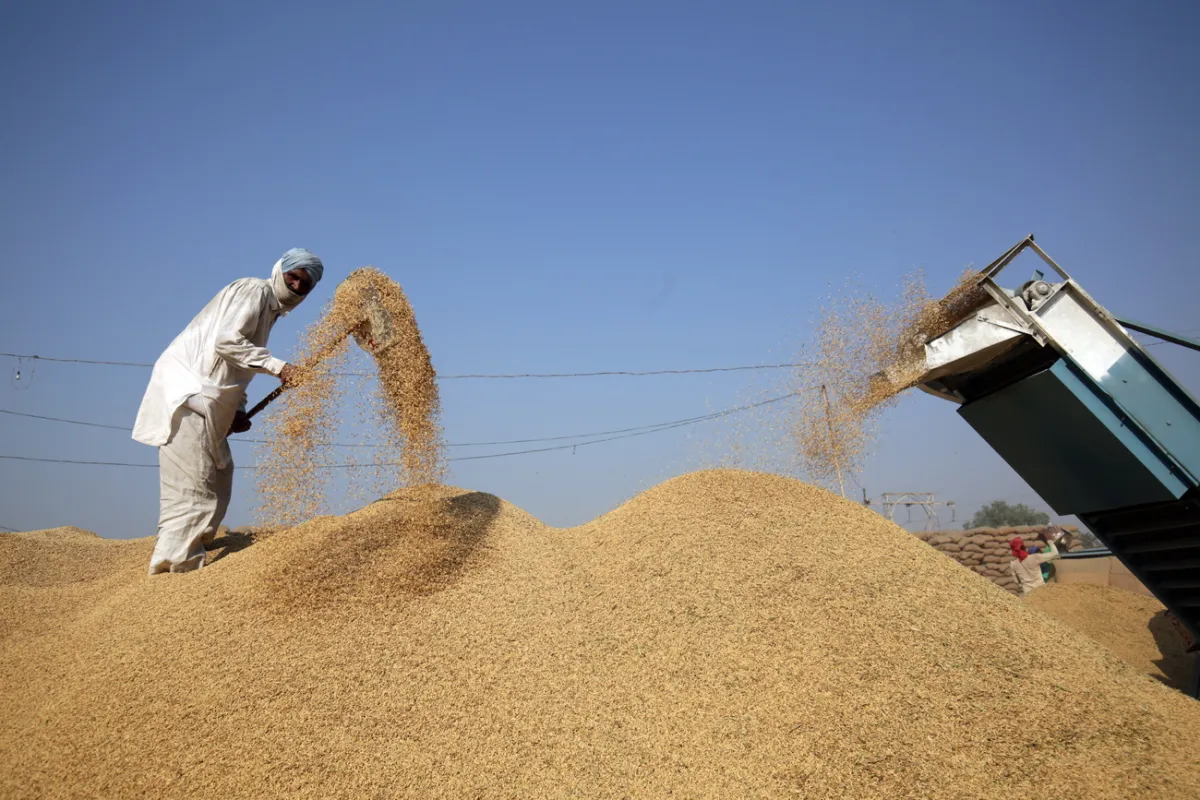
BRICS Have The World's Largest Grain Traders In Their Sights


I cover food and agribusiness and have special interests in sustainable supply chains, food safety and quality, as well as covering the emerging players and trends in the food industry. A background in forestry and conservation biology brought me down the path of environmental advocacy. Journalism and Switzerland have made me a neutral observer holding companies accountable for their actions.
-
More from this aut
English Departm
On July 9, competition authorities from the BRICS group met at a closed meeting in Geneva at the UN Trade and Development (UNCTAD) headquarters. The objective of the meeting was to tackle the market dominance of the biggest players in the global grain trade: ADM, Bunge, COFCO, Cargill and LDC (known collectively as ABCD+). The issue is of strategic importance for the BRICS countries as they account for around 44% of global grain production and 25% of grain consumption.
BRICS are a loose grouping of 11 emerging markets comprising Brazil, China, Egypt, Ethiopia, India, Indonesia, Iran, Russia, Saudi Arabia, South Africa, and the United Arab Emirates. Together they make up half of the world's population and a quarter of the global economy. It was established in 2006 on the margins of the United Nations General Assembly in New York. The first BRICS summit was held in 2009 in Yekaterinburg, Russia.
BRICS aim to act as counterweight to the influence of Western powers in global institutions like the UN Security Council or the World Bank and is seen by some as an alternative to the G7 group of countries. It also seeks to reduce reliance on the dollar as a global currency and promote more Global South cooperation in economic policy and trade.
In 2025, ten partner countries joined BRICS, including Belarus, Bolivia, Cuba, Kazakhstan, Malaysia, Nigeria, Thailand, Uganda, Uzbekistan, and Vietnam. They are not members but can participate in BRICS summits.
The outcome of the meeting in Geneva was the creation of a BRICS project task force that will prepare the first joint sector inquiry into the global grain trade. The task force will be co-chaired by the heads of the competition authorities of Brazil and Egypt. The inquiry is a first for the BRICS and the first multilateral cooperation of its kind to challenge market dominance in the commodities sector.
The inquiry's findings are expected to be presented at the next BRICS International Competition Conference, scheduled to take place in Brazil in September 2027. The goal is to improve cooperation between competition authorities across BRICS and flag any moves by grain traders that could give them an unfair advantage. Depending on the outcome of the inquiry, BRICS members could also coordinate anti-trust action against grain traders.
“A small number of firms dominate both specific points on a supply chain, such as buying grain, and own businesses at multiple stages of that supply chain. To put it simply: they buy the grain, produce the flour or feed, and also own the bakery or the feedlot that buys the processed commodity,” says Sophia Murphy, CEO of the Institute for Agriculture Trade & Policy (IATP), an international NGO that promotes sustainable food, farm, and trade systems.
Various estimates indicate that ABCD+ control between 70%–90% of the global grain trade. Switzerland is an important hub of this trade: it is estimated that 35%–50% of the world's grains are traded out of offices based in or around Geneva and the city of Zug, in central Switzerland. These companies act as intermediaries between major BRICS grain exporters like Russia (wheat), Brazil (corn) or India (rice) and top BRICS importers like Egypt (wheat), China (rice) and Indonesia (wheat).
While their margins are typically low (between 1% and 3%), the big grain traders make up for it in sheer scale of operations. According to a recent reportExternal link by the research collective ETC, the grain storage capacity of ADM, Bunge and COFCO alone is equivalent to the combined annual wheat consumption of the United States, Britain and Turkey. The big profits are made during times of volatility, like during the Russian invasion of Ukraine in 2022.
External Content“We face a paradoxical situation in which farmers in countries such as Brazil and Russia receive insufficient returns for their work, while consumers in Egypt pay excessively high prices for bread. Where does the margin accumulate, and who captures disproportionate profits along global grain value chains? These are the questions our sector inquiry should answer,” Mahmoud Momtaz, chair of the Egyptian Competition Authority (ECA), is quoted as saying during the BRICS meeting in Geneva.
Increased consolidationOne of the reasons why regulatory authorities find it difficult to keep track of grain traders is the complexity and opacity of their corporate structures. Most of them have several subsidiaries in different parts of the globe to take advantage of lower tax rates, favourable currency exchange rates or lower tariffs. According to a 2023 report by UN trade body UNCTAD, just three traders – Cargill, ADM and COFCO – own a total of 2,339 subsidiaries.
“This fragmentation enables traders to exploit regulatory blind spots, consolidating their control over critical infrastructure like shipping, storage, and data,” states a report External link prepared by the BRICS Competition Law and Policy Centre, a Russia-backed research institution supported by other BRICS antitrust agencies.
This consolidation is turbo-charged when two large traders join forces. Last July, Swiss incorporated grain trader Bunge merged with Netherlands-based trader Viterra to create the largest-ever global agricultural merger.
Approval from China's competition authority was the last hurdle before the deal could go ahead. China's merger-control rules apply not just to Chinese companies, but also to foreign mergers that could affect competition in Chinese markets. China's State Administration for Market Regulation (SAMR) said that the merger could potentially reduce competition in the Chinese market for imported soy, rapeseed and barley. They placed conditions for the merger, including guaranteeing a reliable supply to the Chinese market even during grain shortages and reporting quarterly sales volumes to Chinese customers.
Digital platformsOne area where BRICS see the benefits of collective scrutiny is digital platforms like Geneva-based Covantis, which was created and funded jointly by grain traders. Covantis was created in 2020 by ADM, Bunge, Cargill, COFCO International, LDC, and Viterra to sell soy and corn out of Brazil. It is now a global digital trading platform with more than 945 million metric tonnes in transactional volume in 2025, capturing 63% of global grains, oilseeds and vegetable oil volumes. The BRICS Competition Law and Policy Centre report is critical of such digital platforms because they increase the forecasting and surveillance power of the traders. ETC's report Grain Traders, Greed and Oligopoly Power also flags such digital platforms.
“Using AI-driven analytics and blockchain platforms like Covantis, they monitor supply chains in real time and anticipate market shifts long before competitors or regulators. This exclusive commercial intelligence – inaccessible to governments or multilateral bodies – gives traders a decisive advantage to shape markets while remaining largely outside public scrutiny,” the report states.
More More Agribusiness How the war in Iran is affecting the Swiss food industryThis content was published on Apr 9, 2026 From chocolate sales at airports to fertiliser trade bottlenecks – the Swiss food and commodity industry is already feeling the impact of the war in the Middle East.
Read more: How the war in Iran is affecting the Swiss food ind
Legal Disclaimer:
MENAFN provides the
information “as is” without warranty of any kind. We do not accept any
responsibility or liability for the accuracy, content, images, videos,
licenses, completeness, legality, or reliability of the information
contained in this article. If you have any complaints or copyright issues
related to this article, kindly contact the provider above.
Comments
No comment