


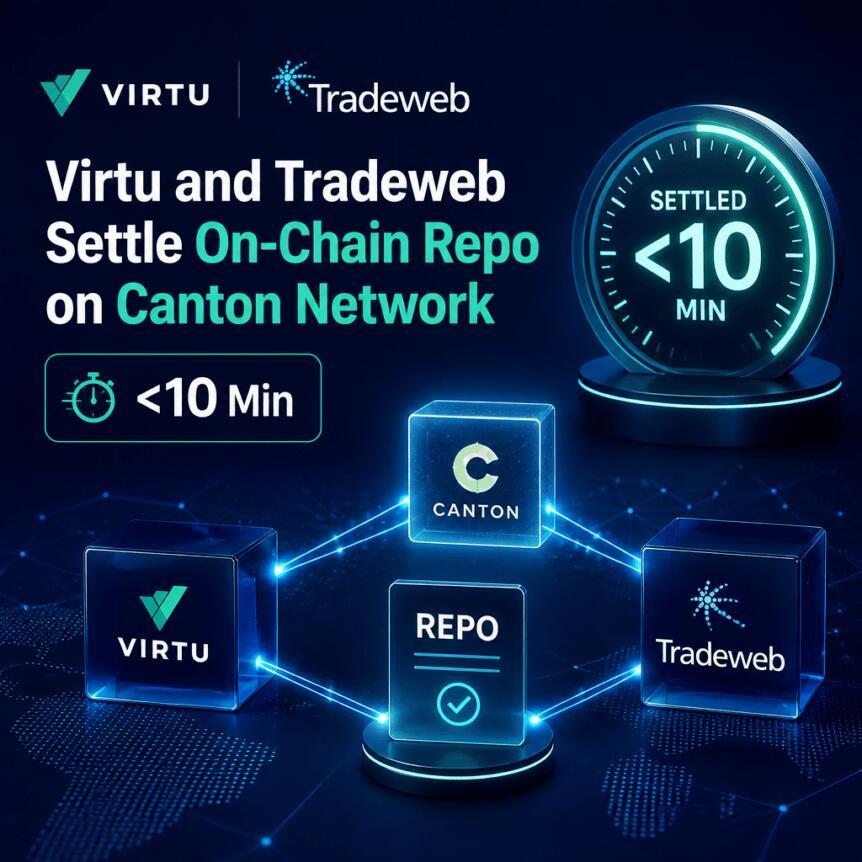
Virtu And Tradeweb Settle On-Chain Repo On Canton Network In <10 Min


The collateral in question is USDM1, a US dollar-denominated sovereign bond issued onchain by the Republic of the Marshall Islands. The bond is described as being backed 1:1 by short-term US Treasurys and pays a coupon while it is posted as collateral. It is also structured under New York law as a fully collateralized sovereign obligation.
Key takeaways- Repo settlement moved fully onchain: the full repo and repurchase cycle completed using atomic settlement on Canton, in under 10 minutes. USDM1 is deployed as collateral, not just a tokenized asset: the bond is used to support an institutional financing flow. Deal executed between regulated counterparties: the transaction ran through Tradeweb and was completed between established financial firms. USDM1 availability ties to institutional rails: Tradeweb provides access, while custody is supported by Anchorage Digital, BitGo and tZERO, per the release.
Repos are a core part of institutional liquidity management, allowing one party to sell securities and agree to repurchase them later, typically with collateral underpinning the transaction. In this case, the participating firms structured the repo around USDM1-an onchain sovereign bond whose design is meant to keep dollar exposure tied to underlying US Treasurys.
According to the release, the transaction used USDM1 as collateral throughout the lifecycle of the repurchase agreement. This matters because it extends tokenized sovereign debt beyond initial issuance and secondary trading narratives, positioning it for use directly inside financing structures where collateral efficiency and settlement speed are often pivotal.
The companies involved also said the transaction was the first repo to combine natively issued sovereign collateral with fully onchain atomic settlement. While that claim signals a meaningful technical milestone, the report also emphasizes that this remains an early-stage example and does not confirm broad adoption across institutional repo markets.
Canton's institutional focus shows up in the transaction designCanton is presented as a blockchain network tailored for institutional finance, with permissioning and privacy features intended to support regulated transactions and tokenized assets. The repo executed this week follows a broader pattern of Canton-related activity in recent months, where major market infrastructure and financial firms have used the network to move tokenized instruments in settlement workflows.
Earlier coverage highlighted that Tradeweb facilitated a July transaction transferring a tokenized US Treasury from Franklin Templeton to Virtu Financial on Canton. That transaction settled against USDCx, illustrating that Canton has been used to connect tokenized assets with stablecoin settlement mechanisms.
In the latest repo, settlement is framed as“fully onchain atomic,” meaning the transaction's logic and settlement completion happen within the network workflow rather than being partly dependent on traditional post-trade processes. The report states the entire cycle-repo and repurchase-was completed in under 10 minutes between regulated counterparties via Tradeweb.
Momentum on Canton: cross-chain swaps, stablecoins and planned public-benefits pilotsThe repo is only one thread in a wider wave of institutional experimentation on Canton. The report notes several developments across August and prior months.
In August, FalconX and Interstice launched a cross-chain swap engine connecting Canton with Ethereum, Solana and Robinhood Chain. The same period also saw World Liberty Financial launch its USD1 stablecoin natively on Canton. Taken together, these moves reflect a push to make Canton interoperable with broader token ecosystems rather than limiting activity to a closed network.
Beyond purely financial market plumbing, the report also references plans announced this month by Digital Asset and the American Idea Foundation-founded by former US House Speaker Paul Ryan-for a 2027 pilot using Canton to distribute state-administered benefits across three US states. While that initiative is different from repo settlement, it signals that developers and institutional backers are looking at Canton as infrastructure for regulated, high-stakes workflows where auditability, access control and privacy matter.
For investors and market participants, this mix of activities raises an important question: whether Canton's institutional use cases will expand from discrete pilots and isolated transactions into repeatable market processes. Each new transaction type-such as repo collateralization-adds another potential building block, but adoption in core markets depends on operational readiness, counterparties' comfort with risk controls, and whether tokenized settlement can integrate smoothly with existing institutional infrastructures.
Where USDM1 fits into institutional custody and tradingAccording to the release cited in the report, USDM1 is available through Tradeweb, while institutional custody is provided by Anchorage Digital, BitGo and tZERO. This structure is relevant because custody and access are often gating factors for tokenized collateral in traditional finance. If collateral remains usable across multiple participants without forcing bespoke custody arrangements, tokenized sovereign debt may be more practical for institutional balance sheets and financing desks.
The reporting also frames USDM1 as a bond that pays a coupon while being used as collateral-an important design point for financing applications. In many collateralized transactions, the issuer of the tokenized asset and the economic rights attached to it can determine whether the collateral is attractive for borrowers and lenders alike.
Still, the report leaves open the extent to which the model will generalize beyond this transaction. Even if the settlement workflow was completed quickly and end-to-end onchain, broader uptake would likely require more counterparties, more standardized collateral handling, and evidence that operational and legal requirements can be met consistently across venues.
Going forward, the key signal for the market will be whether additional repo deals follow using similar collateral structures and whether other institutional networks or trading venues can reproduce the same kind of atomic settlement without requiring significant bespoke setup. Watch for more examples that connect tokenized sovereign assets directly into financing cycles-because that is where adoption could become more than an experimental proof of concept.
Risk & affiliate notice: Crypto assets are volatile and capital is at risk. This article may contain affiliate links.
Legal Disclaimer:
MENAFN provides the
information “as is” without warranty of any kind. We do not accept
any responsibility or liability for the accuracy, content, images,
videos, licenses, completeness, legality, or reliability of the information
contained in this article. If you have any complaints or copyright
issues related to this article, kindly contact the provider above.


Comments
No comment