

Friday Essay: Don Watson's Book On Paul Keating Ended Their Friendship Is It Our Best Ever Political Memoir?


In 2010, Hawke's wife Blanche d'Alpuget published a book about him – her second Hawke biography – which Keating felt painted him in a poor light.“If I get around to writing a book,” he told the media in response,“I will be telling the truth; the whole truth.”
Publishers were reportedly“licking their lips” at the thought of publishing whatever that“truth” might look like, but it turned out to be a hollow threat.
When journalists asked why Keating had been so content to let others do all the writing about his contribution to Australian politics, he would quip that“anyone who's any good never wrote about themselves”. For anyone who remembered the controversial and somewhat self-aggrandising Hawke Memoirs (1994), Keating's meaning was probably clear.
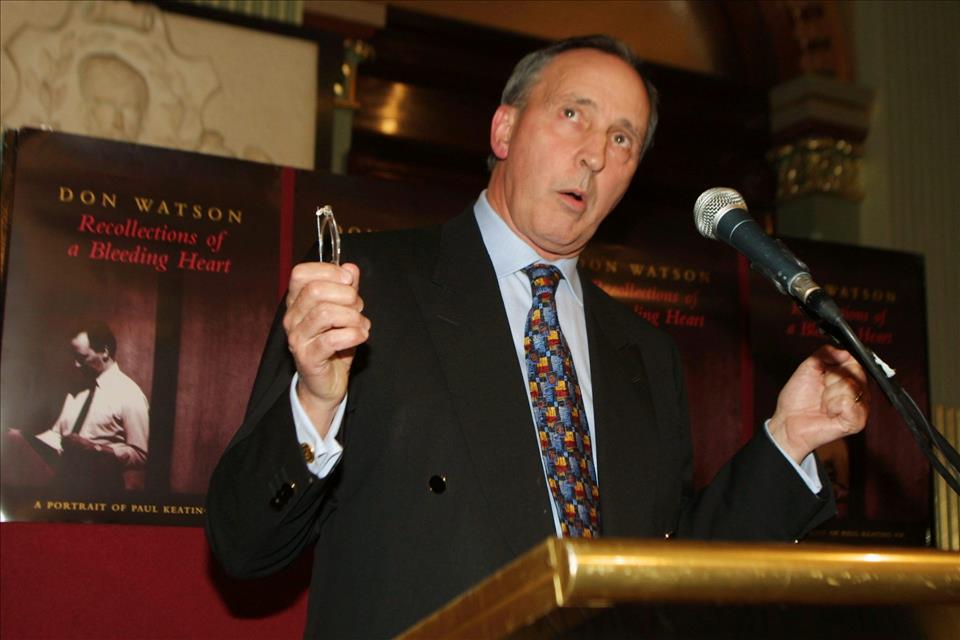
In the absence of a sole-authored memoir, Keating's historical performances were mediated by others, chiefly former advisers, journalists and television producers. The most successful, Recollections of a Bleeding Heart: A Portrait of Paul Keating PM, came from Keating's former speechwriter Don Watson.
The book, described by leading Australian biography scholar Melanie Nolan as a“cutting-edge” work of political life writing by a“staffer”, was an instant bestseller on publication in 2002. Yet Keating was famously enraged by it.
Tales from within the tentHawke's former speechwriter Stephen Mills once wrote that a speechwriter's job was to“write the speeches that the Prime Minister would have written himself, if he had the time”. Speechwriting could generate a“long and intimate” relationship, as happened with Graham Freudenberg and Gough Whitlam, or it could be an“enormously laborious” and painful experience, as many found in their engagement with Malcolm Fraser.
A degree of loyalty and discretion was expected on the part of ministerial advisers, many of whom wanted to work at the coalface of power and then“get on with their careers”, as former Keating adviser John Edwards put it to me. But they enjoyed greater freedom than most public servants to speak and write about their experiences later on.
Freudenberg's biography of Whitlam broke new ground when it was published in 1977. But far from serving a public fetish for insider gossip, A Certain Grandeur offered a high-level account of“the powerful political and economic forces” that had besieged“an idealistic administration”. Freudenberg kept faith with the“traditional speechwriter's code” insofar as it“kept the writer out of the picture and betrayed no confidences”.
A more novel pattern of personal and emotional revelation was on display in the United States, where speechwriters were comprehensively illuminating the characters of their employers. In an article for the Atlantic in 1979, speechwriter James Fallows described his erstwhile boss, president Jimmy Carter, as a“good man” lacking“sophistication” and“passion”. He published the piece knowing that Carter and his staff considered it politically“wrong” to do so.
Stephen Mills, Hawke speechwriter and“fringe participant” in the leadership battles of 1991, decided he had a“responsibility” to record what he saw. Advisers, he reasoned, could“sometimes see the politicians better than the politicians can see themselves”. Launching his book The Hawke Years at the National Press Club in 1993, Mills emphasised that it carried no“authorisation” from Hawke, and was both“informed” and“candid” in manner.
'Get a book out of it'When he became prime minister, Keating had need of a full-time speechwriter. Mark Ryan, his political adviser, approached Watson, a former colleague with whom he had worked for Victorian premier John Cain Jr.
Just weeks earlier, Watson had decided to abandon“all speechwriting, satire writing, bullshit writing”, and was getting ready to coauthor“with Stuart Macintyre a history of Australia since the war”.
When Ryan called him, Watson was holidaying at Mogg's Creek in Victoria, and did not hesitate in rejecting the offer. His family protested, arguing that working for Keating would be a“fabulous experience” and, if opinion polls were to be believed, likely“all over in a year”.
Watson was persuaded to visit Keating and discuss the offer.“I was impressed by a lot of things [...] including this strange melancholic sense”, Watson told me in an interview. The prospect of writing for a politician renowned for his“extraordinary use of language” was also enticing.
In the end, the writer joined Keating's team with a view to helping Labor win the next election. Watson commenced work in January 1992 and, to the surprise of nobody more than himself, was still there when Labor lost office in March 1996.
Watson was eminently qualified to craft words for Keating, and well prepared for the ideological battles within the prime minister's office. Born in rural Gippsland and trained in Melbourne and Canberra as a historian, his doctorate was an intellectual study of Australian civil libertarian, Marxist and historian Brian Fitzpatrick.
In the 1980s, while the Hawke government was reshaping Australia's economic policy settings, Watson was writing satirical pieces for comedian Max Gillies, who regularly impersonated Hawke and Keating. Later in the decade, Watson found himself working for Cain, whose relations with federal Labor were highly strained.
While his literary abilities and command of Australian historical themes were a prized asset, Watson's personal politics placed him at odds with other advisers in Keating's prime ministerial office, where the contest was between the economists or“pointy heads” on one hand and“bleeding hearts” like himself on the other. It probably mattered, too, that Watson was a rural Victorian in an office dominated by economic rationalists from Sydney.
As advisers of longer standing departed and forged new careers, Watson acquired new influence on the Keating agenda. Some considered the 1994 Creative Nation statement on culture, information policy and the arts (and the $250 million-odd additional funding that came with it) as a Watson win in the contest between rationalists and bleeding hearts.
By 1995, some journalists claimed Keating's“real emotional and intellectual sustenance” derived solely from his wife Annita, and from Watson. Such influence was overstated, but historian James Curran rightly concluded that Watson became“a significant intellectual influence on Keating's prime ministerial persona”.
Though respectful of the traditional“gentleman's agreement” Freudenberg described of the standard speechwriter's relationship, Watson was more comfortable with pushing boundaries and retaining a degree of his own voice alongside that of his political master.
On the night of Labor's astonishing fifth consecutive election victory, no less an observer than the Liberal Party's Victorian president, Michael Kroger, remarked that“Don Watson's probably an asset in Mr Keating's office”. It was recognition from a surprising source that Watson had a unique place in, and authority to speak about, the prime minister's office.
If anyone was surprised that Watson hoped to produce an account of his time there, they ought not to have been. His then-partner was the renowned Australian feminist and publisher Hilary McPhee, who told Watson at the outset he ought to“get a book out of it”.
Within the first month, he had started recording a personal diary, which he thought was“a good discipline” and would help him cope with“the frustration” of a workplace that was simultaneously frantic and“becalmed”. He regularly told Keating about this diary, and the book it would help furnish, but the prime minister responded only with vague words and empty looks. Perhaps it was only that Keating could scarcely keep up with all the would-be authors in his office.
Watson had a professional identity and education guiding his work with, and writing about, the prime minister.“I was an historian,” he explained, and as such he did not expect to write anything about Keating that“a hardened politician couldn't handle”.
Following the 1993 election, Watson signed a contract with Transworld to write a compelling account of Keating's first year in office. Transworld publicists claimed the book would be“strangely friendly, amusing, affectionate and accessible”.
Announcing its acquisition in book trade magazines, Transworld celebrated Watson's authority as“a distinguished historian, scriptwriter, reviewer and political satirist”. Moreover, it trumpeted the fact that Watson's“vantage point” was that of someone“inside the Prime Minister's office”.
Historian, insider or both?Watson left Canberra in March 1996 and retreated to the inner suburbs of Melbourne, where he reckoned with Labor's loss and the intensity of his recent working life. He took a room at the Standard Hotel in Fitzroy, and 25 years later he could still recall the“strange smell” in the carpets and the“smell of the schnitzels” during the lunchtime rush.
Ostensibly there to write his book, Watson procrastinated by writing film scripts, including The Man Who Sued God (which became a box-office success starring Scottish comedian Billy Connolly), and one about Ned Kelly that was ultimately aborted. Still struggling to work through his own emotions, Watson geared up to search through Keating's mind.
“We write political history as though we know nothing of psychology,” he told Tony Stephens at the Sydney Morning Herald.“Shakespeare without psychology is unbelievable. History without psychology is not possible.” To write his psychologically perceptive and at times piercing account of Keating, Watson first needed to be psychologically restored himself.
When he was up to it, Watson had to make stark choices about the book's style, length and commercial characteristics. For a start, there was the issue of voice and perspective.“I think that was the hardest thing, to cope with the voice,” he explained to me. He spent two months revisiting his original diaries, striving for a manuscript that was detached, omnipresent and magisterial.“Who was speaking,” he asked himself,“a historian, an insider, or both?”
In early 1999, academic Iain McCalman invited Watson to visit the Humanities Research Centre at the Australian National University and begin writing in earnest. Scholars such as Barry Smith, respected social and medical historian of Britain, listened to Watson's presentations and advised that the book needed less majesty and more grit.“[Smith] would not read the book I was proposing,” he said,“but a diary was a different matter.”
At dinner with another Keating biographer, Michael Gordon, and journalist Jim Middleton that evening, Watson considered the conundrum. He decided he would write the book from the perspective of a roving camera rather than a“camera on the wall”. Freudenberg's A Certain Grandeur was not a model that would suit this kind of book.“I couldn't pretend, in the way that Graham did, that I was this sort of amanuensis sitting in a corner observing.”
A new publishing house would be required to give this project the backing it needed. When Transworld's Judith Curr departed for a new role in the United States, Watson felt that Transworld lost interest in this project. McPhee advised Watson to have his agent, Rose Creswell, shop the book around once again.“Well, it happened that Rose was in New York at the time, with Jane Palfreyman, who was the publisher at Random [House Australia]. They were actually going to meet Sonny Mehta [...] who was the overall international managing director of Random House, and he bought it at once,” Watson recalled.
Watson greatly appreciated their support, particularly Palfreyman's:“Jane was a person of incredibly ferocious loyalty [...] if you were her author, she would stick by you.” A steadfast publisher was a good asset to have when the stakes seemed so high.
Their appetite for risk mattered because Watson decided – consequentially, it turned out – not to share draft material with Keating. If he sought Keating's approval, one journalist remarked to the speechwriter, Watson would“never get it published”.
In a reflective afterword for the tenth-anniversary edition, he suggested that allowing Keating to interfere with the manuscript would have fundamentally compromised the work's value and breached faith with himself as well as“history – the bit I saw at least”.
In our interview, Watson explained that he perceived some level of intervention on Keating's part in the Edwards book. Published in 1996 shortly after Keating had lost office, Edwards' Keating: The Inside Story offered a largely favourable account of Keating's role as treasurer and prime minister. Edwards recalled very little in the way of interference from Keating, yet they disagreed on matters including Hawke's role in the floating of the Australian dollar in 1983 and Keating's culpability in creating the recession of the early 1990s.
In deciding not to show Keating his own manuscript, the“Edwards book sort of came back to me”. Rightly or wrongly, Watson's decision would make a very different kind of performance possible.
In the manuscript that made it to publication, Watson's impression of Keating was refracted through his own emotions – enthusiasm, frustration and, ultimately, despair.
Gentle, savage and addicted to politicsThe book that became Recollections of a Bleeding Heart begins with pen portraits of Keating as well as Watson himself – two men from different geographic and class backgrounds who ultimately shared an egalitarian, postmodern patriotism. Watson evoked at length the“rabbit burrow” that constituted the political geography of the prime minister's office and the“battle lines” of ideological conflict inside it under Keating.
He recorded in detail the lively and spirited debates Keating engendered over the symbols of Australia's national identity, namely the Australian flag and the proposal for a republic, all set against the backdrop of the“economic mire” of the early 1990s.
He described working on the Redfern speech, an important oration on the history of white oppression of First Nations people in 1992 and certainly one of Keating's finest speeches, as“one of those moments when to write for him was an unqualified privilege”.
But it was ultimately a book written in tragic mode, not least because this mirrored what Watson felt was the prevailing“despair on the left”.
For all the moving storytelling about“progress” in delivering a Native Title Act that gave some First Nations the prospect of reclaiming their traditional lands, or the“historic” initiative of the first ever APEC leaders' summit in Seattle, he devoted dozens more pages to the mundane challenges of political life and the more substantial problem of the government's unpopularity following John Dawkins's difficult 1993 budget.
Leaning heavily on a form of psychobiography, Watson described Keating in the book as a“paradoxical” man,“gentle in one environment, savage in another”, addicted to the practice of politics but no longer elevated by it“until the stakes were very high”.
The final 150 pages seemed only to foreshadow Keating's 1996 election defeat and the setback to his modernising style of politics. Watson wrote much of the book at great pace as the final deadline approached. In his interview with me, he wondered“what another six months of reflection and consideration would have done” for the kind of story he told.
In a cultural landscape increasingly inclined towards revelation and testimony, Watson determined to write himself into the Keating story, more extensively than Edwards had.
Seething, slicing and betrayalRecollections would include elements of the personal and less of the economic. There was, for one thing, the Keatings' marriage. It had seemed massively strained during the life of the government, and came to an end in 1998.
Annita Keating worried over how Watson might depict her and the marriage. Watson recalled several long meetings with her lawyers, who eventually realised Watson would be writing the book in his own name, rather than creating a ghostwritten product for Keating.“So, literally, they slid back their chairs and we all stood up and walked out,” Watson recalled.
Much more was at stake for her ex-husband. In mid-2002, Watson and Random House gave Keating the final pages of the manuscript for review ahead of the book launch in Sydney. Watson recalled that Keating read it on a homebound flight from the United Kingdom and was irate by the time he landed.
A series of“hideous faxes” denouncing the book began to arrive with him and Palfreyman, Watson recalled. I have not seen these documents, and until Watson's personal papers at the National Library of Australia are opened, nobody will. But the general nature of Keating's grievances remained vivid in Watson's memory decades later.
First, there were the speeches, which mattered for the“big picture” legacy Keating hoped to own. In describing his work as a speechwriter, Watson had broken the“deal” of speechwriting, in his former employer's view.
Second, the book contained just a bit too much of Watson himself for Keating's taste.“The trouble for Paul,” former ACTU secretary Bill Kelty told Watson,“is that it's about you and not him.” The book's title, Recollections of a Bleeding Heart, was chosen by Watson somewhere along the journey because it signalled this was not a biography and would be written unambiguously from his own viewpoint.
Third, Keating was uncomfortable with the psychoanalysis to which Watson had subjected him. Watson's Keating was a highly emotional figure, probably a man with depression. This was not the magisterial Churchillian portrait that Keating had hoped for, although plenty of Winston's“black dog” appeared in its pages.
Fourth, Keating felt betrayed; Watson had enjoyed unconditional access to Keating's Sydney office and its resources in making the book. Tellingly, the former prime minister imagined Palfreyman and Random House to be in on the betrayal.
The launch of Recollections in May 2002 encapsulated the contested authority of the type of book Watson had produced. Rather than withdrawing from the high-profile event at Sydney Town Hall, Keating maximised his leverage by delivering a calculated speech in person.
Noel Pearson, First Nations academic, lawyer and advocate who had been at the forefront of the effort to secure native title laws under Keating, gave a very lengthy address first. Watson and Keating stood beside him, the latter“just seething”. When it was his turn, the former prime minister delivered a“mesmerising black performance” in which he likened the book to a“black-box recorder in an airplane”.
Keating argued that the book's psychoanalytical themes revealed less about him and more about Watson.“Don has the inclinations of a fruit bat,” he remarked:“he always heads back to the darkness”. Concluding the event, Watson defended the book and asserted that“people of great passion and conviction” like Keating were naturally“prone to melancholy”.
Most of the audience were none the wiser about the deep anger playing out in front of them. They enjoyed a quintessential Keating performance and queued in large numbers to buy their copy. But Pearson, who knew what was happening, later said it was“like watching a sea hawk pin its kill with its talons on the perch and slice live fish into still-quivering sashimi”. The metaphor, if slightly overdone, certainly caught the depth of feeling on Keating's part.
A definitive, seductive Australian classicMuch to Keating's chagrin, Recollections became one of the most significant political books ever published in Australia. Reportedly selling between 75,000 and 100,000 copies, it remains one of the most widely circulated political (auto)biographies in this country. Critics from a range of political perspectives have called it an“intelligent and seductive” account,“a classic”.
If it was“a touch too long” in Les Carlyon's view,“the quality of the writing” redeemed it. Struggling to classify the book, reviewers described it variously as“tragedy” and“legend”, a piece of“political anthropology” and“memoir” from a“historian who is activist”. Historian Geoffrey Bolton saw it as“neither quite autobiography nor quite biography”, while political scientist Rod Rhodes perhaps came closest in describing it as an“accidental ethnography of 'being there'”.
All agreed that Watson's emotional subjectivity gave the book its quality. In Adelaide's Advertiser, Tony Baker rejoiced that readers could see and hear Keating“through a door hitherto locked and bolted, now slightly ajar”. Recollections jointly won the National Biography Award for 2003 (alongside a family memoir, The Rose Boys, by poet and editor Peter Rose), was awarded Book of the Year by The Age and Courier Mail newspapers, and won a smattering of other awards.
By his own account, Watson spent“12 months” visiting nearly“every bloody Labor branch in the country” to promote the book and Keating's political legacy along with it. Keating's ministerial colleagues, some of whom were initially shocked, came to appreciate it over time.
Former health minister Carmen Lawrence, who initially dismissed Recollections as a very“lopsided” account, later wrote a foreword for the tenth-anniversary edition praising“the value” of what Watson had published.
Neal Blewett, a senior minister in the Hawke and Keating governments, gave the book high praise in saying Watson's portrait revealed“the Keating I knew, but had never been able to capture in words”. This“Australian classic”, as academic and public servant Glyn Davis described it, became“the most cited work on the Keating years”.
Watson's portrait of Keating also seeped into other facets of Australian culture. Melbourne musician and comedian Casey Bennetto credited Recollections, along with the“disappointing” re-election of the Howard government in October 2004, as twin sources of inspiration for what became Keating! The Musical.
Debuting as a short set at the 2005 Melbourne International Comedy Festival (under the name The Country Soul Opera We Had to Have), Keating! was quickly picked up by director Neil Armfield and expanded into a full two-act musical. The press reported that box-office sales at Belvoir Street Theatre in Sydney netted in the order of half a million dollars. Keating! won the Helpmann Award for Best Musical along with prizes for Best Actor in a Supporting Role and Director in 2007.
Hundreds of thousands of readers and pundits accepted the insider authority of the speechwriter, but Keating never did. Watson's later efforts to repair the relationship came to nothing, and the former prime minister was at pains to defend his ownership of speeches Watson had drafted, above all the Redfern Park speech.
When the National Film and Sound Archive held an event to celebrate its acquisition of the original recording, Keating was angered at the media's interest in Watson's role in its creation.“Watson was not the author of the speech,” he wrote in a sharp op-ed.“The sentiments of the speech [...] were mine.”
Notwithstanding the unseemliness of two white Australians bickering over the ownership of these words of historic racial reckoning, Keating claimed that speechwriting only became a problem“when the speechwriter steps from anonymity to claim particular speeches or words”.
Watson addressed these criticisms in his tenth-anniversary edition of Recollections, sporting a new afterword that upheld the traditional notion of a“contract” of anonymity:“I don't recall Paul Keating ever uttering a word that he did not want to utter. Under the 'contract' all of [the speeches] are his and he is welcome to them.”
Despite the emotional contours and reverent tone of the initial book, Watson's afterword reflected the breakdown in their association, and the enduring animosity Keating felt. In a fashion, Keating's complaints were futile. The reading public had already decided Recollections of a Bleeding Heart was a definitive work, on Keating and on Australian politics more broadly.
This is an edited extract from Performance Politics: Australian politicians and the stories they tell by Joshua Black (New South), published September 1.


Legal Disclaimer:
MENAFN provides the
information “as is” without warranty of any kind. We do not accept any
responsibility or liability for the accuracy, content, images, videos,
licenses, completeness, legality, or reliability of the information
contained in this article. If you have any complaints or copyright issues
related to this article, kindly contact the provider above.
Comments
No comment