

Pakistan's Girls Fight For Their Place In The Boxing Ring


Soomro, 21, made national headlines last year after winning an international bout in Bangkok in a rare feat for a young woman from Pakistan, where patriarchal and cultural norms dictate that girls and women belong at home, not at gyms or sports clubs.
Recommended For YouWomen boxers recently captured the nation's attention again when Fatima Zahra, 22, became Pakistan's first female Commonwealth Games boxing medallist, winning bronze in the 60kg category in Glasgow in late July.
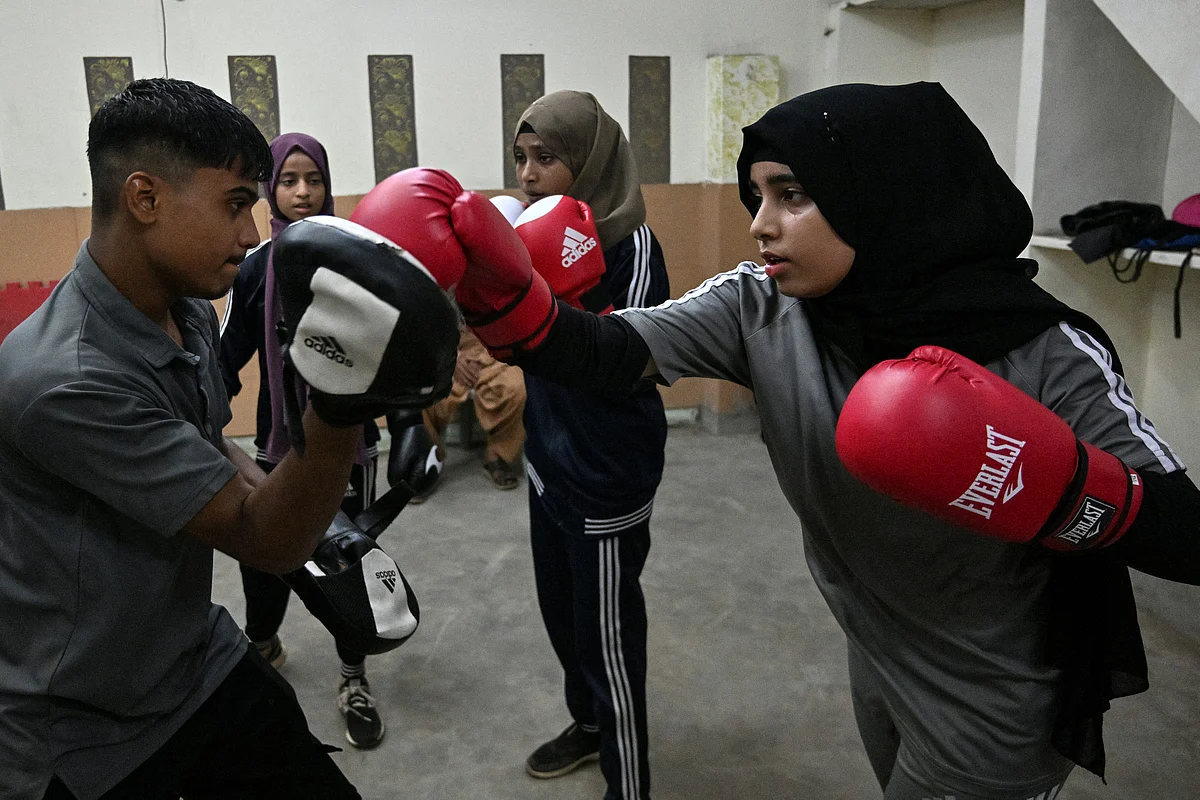
Thirteen-year-old Zahra, like Soomro, hails from the sports-mad Lyari neighbourhood in the port city of Karachi, a gritty community once haunted by gang violence and poverty.
And like her idol, she is undeterred by the societal backlash.
"They (society) think it (boxing) is not for girls. They also think girls should not even go outside, because girls are not safe outside," the teen told AFP as she adjusted her black hijab.
"But it is not possible to live without going outside, you have to go out."
Around her, other girls get ready for the class, peeling off their outer layers but remaining covered from head to toe in scarves, long-sleeve shirts and trousers.
Their session is held in a modest room in a rundown Lyari building, with worn walls and loud, whirring fans that bring relief from the summer heat when power becomes available in the late afternoon.
Supervising them is coach Ustad Younis Qambrani, a grizzled 56-year-old who has trained dozens of young fighters since he opened up his boxing gym to girls more than a decade ago.
"I believed women's boxing was very important for girls," Qambrani told AFP.
"My two daughters were the first ones to begin women's boxing. The girls who train with us go outside with great confidence. They show great courage and are not afraid of anything."
Battle to leave home
The girls' struggle to leave their homes and find safe spaces to play sport is reflected in Lyari's own journey over the past few decades.
Lyari was once considered one of Pakistan's most dangerous neighbourhoods, hit by an influx of weapons and drugs when Karachi was a major transport hub during the Afghan war against the Soviets.
A heavy-handed operation by paramilitary forces against the gangs began in 2013, with religious parties then filling the political vacuum.
Those parties won the 2018 elections, and girls' activities were further restricted. Girls were not even allowed to ride bicycles in some areas.
However, sport has continued to thrive within the deeply conservative community, with Lyari renowned for producing athletes, including iron-chinned girl boxers.
Some local parents, such as Zahra's and Soomro's, strongly back their daughters' determination to put on boxing gloves.
Soomro, who hopes to build on her win in Thailand last year, believes girls have as much right as boys to take up sport.
"Our society regards girls as very weak. People think girls are weak and cannot do anything," she told AFP at a mixed-gender boxing arena down the road.
"But I believe girls can do everything, sometimes even more than men."
ALSO READ- Boxing: Moscow likely to host epic Bivol vs Beterbiev decider Boxing: Wilder calls out Joshua after win over Chisora

Legal Disclaimer:
MENAFN provides the
information “as is” without warranty of any kind. We do not accept any
responsibility or liability for the accuracy, content, images, videos,
licenses, completeness, legality, or reliability of the information
contained in this article. If you have any complaints or copyright issues
related to this article, kindly contact the provider above.
Comments
No comment