

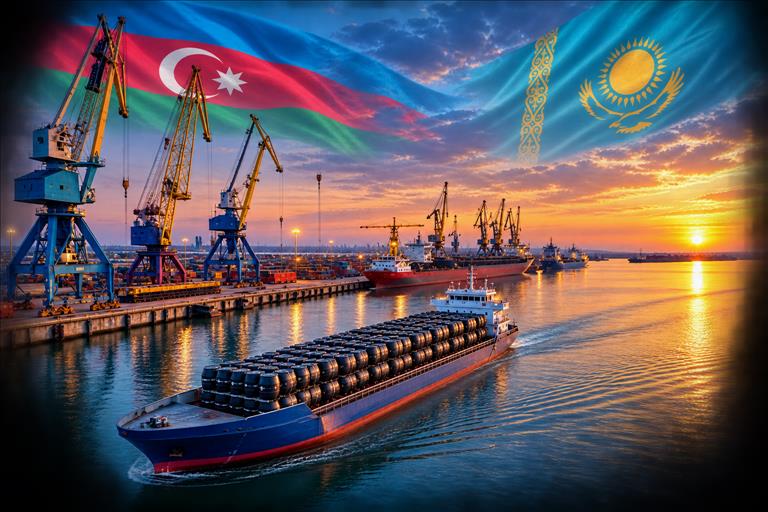
Kazakhstan's Uranium Dilemma Puts Azerbaijan At Center Of Europe's Energy Security


| St. Petersburg (Northern Corridor) | Still the majority route for Western deliveries; no current restrictions on uranium | Risk is high - Western sanctions expanding; uranium exemptions are a political decision, not a structural guarantee | Transit dependency Entirely Russian-controlled; disruption requires no Western decision, only a Russian one |
| Middle Corridor (Trans-Caspian through Azerbaijan) | 48% of Western deliveries in 2025; sometimes 60–65% per CEO; operational since 2018 | LOW RISK - bypasses Russia entirely; no Western sanctions exposure; Caspian states not party to the Russia-Ukraine conflict | Kazakh rail → Aktau port → Caspian ferry → Alat Port (Azerbaijan) → Georgian rail → Poti → onward maritime |
| Swap mechanism (foreign inventories) | Available as a supplementary option; limited volume | Risk exposure is none, as it requires no physical transit | Depends on inventory positions held in Western storage; not scalable for full supply replacement |
In that sense, however, the "Fitch framing" – "no current limitations, but sanctions could cause disruption" – fails to recognize the operational risk on one specific count: disruption need not be caused by a sanctions decision from Western governments. The precedent is there with regard to multiple commodities. Since 2022, Russia has engaged in export restrictions, transit restrictions, and infrastructure restrictions as means of geopolitical pressure. At the moment, uranium has been outside the ambit of such measures; however, this is a political matter and not an intrinsic quality. Speaking to MINING in June 2026, Kazatomprom CEO Meirzhan Yussupov laid out the rationale for diversification clearly: "We have a diversified portfolio of sales, and, as any other business, which doesn't want to keep all its eggs in one basket, we have diversified routes." The diversification of routes is not a preventive move; it is a strategic move.
Why Astana needs Baku, and vice-versa
Kazakhstan's position in the uranium transit equation is more constrained than its production dominance might suggest. Astana has three options to ship the uranium to the West: through Russia (safe, cheap, but vulnerable to sanctions), through Azerbaijan and Georgia (tried and tested route, no sanctions but difficult logistics-wise) or through swaps based on foreign stocks (available in limited quantities and cannot be scaled up). Only the middle option allows satisfying the risk management needs of the Western utilities, reducing the dependence on Russia and shipping at the required volumes. According to the chief commercial officer of Kazatomprom in 2023, 58% of all the uranium shipments from Kazakhstan to the West took place through the Trans-Caspian route in the first half of the year, with an objective to reach 71% by the end of the year. The fluctuations in the percentages described by the CEO in June 2026 from 48% to 65% are due to customer preference and optimization efforts, not because of the route's unreliability.
The structural dependency runs in both directions. Kazatomprom needs Alat Port to remain accessible, reliable, and certified for uranium handling. Azerbaijan needs Kazakhstan to keep routing Western deliveries through the Middle Corridor, both for the transit revenue and for the geopolitical weight that uranium transit confers on its role as a regional hub. The Caspian Green Energy Corridor, the Trans-Caspian fibre-optic cable, the joint investment fund, and the Treaty on Eternal Friendship signed in Tashkent last week are all superstructure built on a foundation that includes, quietly but consequentially, the physical movement of uranium fuel across the Caspian Sea to keep European nuclear reactors running. That is the relationship's deepest layer, and it is the one that makes every other layer more durable.
The Fitch credit note was, in one way, routine, a rating agency identifying a transit concentration risk for an issuer with a BBB rating. In another way, it was the briefest description of how the geopolitics of energy security have shifted positions after 2022. The Middle Corridor via the port of Alat was a fallback option for decades due to its logistical complexity and commercial insignificance. This is still true; however, the strategic importance of this route has acquired significance that cannot be achieved by any effort to promote investments in the Middle Corridor as efficiently as the behavior of Russia ever since the war in Ukraine. The country did not invent this scenario. It is only, as it has been during most of the past four-year crises, an indispensable geography for this scenario.

Legal Disclaimer:
MENAFN provides the
information “as is” without warranty of any kind. We do not accept any
responsibility or liability for the accuracy, content, images, videos,
licenses, completeness, legality, or reliability of the information
contained in this article. If you have any complaints or copyright issues
related to this article, kindly contact the provider above.
Comments
No comment