

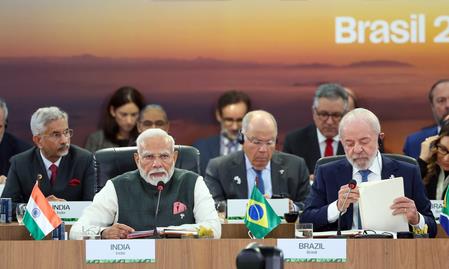
India To Host Two-Day BRICS Summit In Delhi From September 12


India's BRICS Chairship is guided by the theme:“Building for Resilience, Innovation, Cooperation and Sustainability”, reflecting Prime Minister Narendra Modi's vision of a people-centric approach rooted in the spirit of "Humanity First," according to the statement released by the Ministry of External Affairs (MEA).
Apart from these areas, the leaders will discuss strengthening intra-BRICS cooperation on common priorities and share perspectives on global and regional matters of mutual importance.
Under India's Chairship this year, more than 350 meetings and high-level engagements have been held in over 25 cities across India to further strengthen the BRICS strategic partnership across three fundamental pillars: political and security, economic and financial, and cultural and people-to-people exchanges.
Through these meetings and business-to-business and people-to-people initiatives, India's BRICS Chairship has contributed to advancing BRICS cooperation through practical and development-oriented outcomes.
"India is a founding member of BRICS and has previously held its Chairship three times in 2012, 2016 and 2021. India assumed its fourth BRICS Chairship on 1 January 2026. The year 2026 also marks a significant milestone as BRICS completes twenty years since its establishment," the MEA said in a statement.
The BRICS logo for India's Chairship blends tradition with modernity. The petals radiate the vibrant colours of BRICS member countries, highlighting their collective strength and unity. At the centre, the“Namaste” gesture captures India's spirit of warmth, respect, and harmonious collaboration, according to the official statement.
BRICS comprises Brazil, China, Egypt, Ethiopia, India, Indonesia, Iran, Russia, Saudi Arabia, South Africa, United Arab Emirates. BRICS partner countries are: Belarus, Cuba, Bolivia, Kazakhstan, Malaysia, Nigeria, Thailand, Uganda, Uzbekistan and Vietnam.
BRICS cooperation continues to broaden its scope across various global issues, including the fight against terrorism, climate change, food and energy security, the international economic and financial situation, telecommunications, agriculture, labour and employment, international financial architecture, trade, and the World Trade Organisation (WTO).

Legal Disclaimer:
MENAFN provides the
information “as is” without warranty of any kind. We do not accept any
responsibility or liability for the accuracy, content, images, videos,
licenses, completeness, legality, or reliability of the information
contained in this article. If you have any complaints or copyright issues
related to this article, kindly contact the provider above.
Comments
No comment