

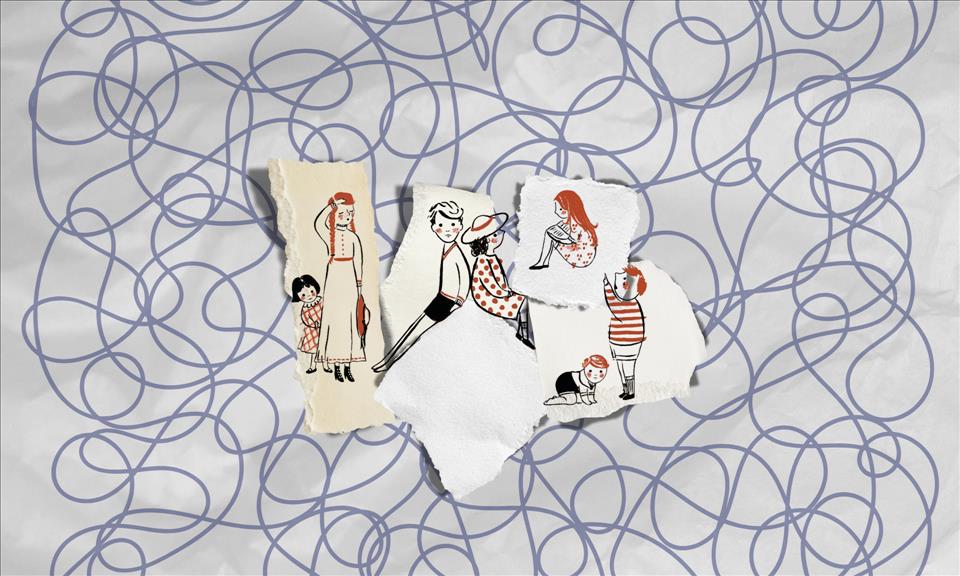
Australian Children's Classics: Seven Little Australians Is Our Own Little Women But Naughty, Not Earnest


Judy, 13, is cutting the grass in an effort to please her father, who watches with growing trepidation from the side verandah of the family home. Appeasing Father is a regular activity for Judy and her siblings. In this instance, it comes after Judy has led the children in an invasion of an adult dinner party, seeking roast fowl instead of their unsatisfactory tea of bread and butter.
Judy has unconventional ideas about fathers and parenting for an 19th-century girl – and a habit of embarrassing her father, the stern“military man” Captain Woolcot. She is generally always sorry for it, with varying degrees of sincerity and self-interest.
The seven children range in age from the eldest, 16-year-old Meg, to The General, baby of the other children's impossibly young stepmother, Esther. (“Seven of you, and I'm only twenty!” she says at one point.)
Seven Little Australians, a bestseller on publication, would sell over 2 million copies, be translated into at least 11 languages, and be adapted for the stage, film and television. It has never been out of print.
The books we read as children can shape us forever – as readers and people.
In this series, we ask experts to reflect on some of Australia's most beloved children's classics, spanning the 19th century to the new millennium.
Like many Australians of my generation, I was introduced to the book when the ABC broadcast its television adaptation in 1973, with a faithful script by Eleanor Witcombe.
My mother found me a copy of the book, beginning my lifelong devotion to Judy and the rest of the Woolcots. My website and social media profiles are all variations of“Misrule”, the nickname given to the chaotic home of the Woolcot children and their long-suffering parents. I wanted to be Judy; instead, I have spent a lifetime thinking about her.
An homage – with 'fair warning'Turner openly modelled her novel on Little Women (1868). This is reflected even in character names: Meg is also the eldest Little Woman, and there's an apparent homage to author Louisa May Alcott in the Woolcot family name.
Judy is often compared to Alcott's Jo - both girls are independently minded and kicking hard against the expectations placed on them as middle-class girls in a strictly patriarchal society - but in other respects, there is little resemblance to Alcott's novel.
In place of Christian virtue and service, the Woolcot children pursue rather more paganistic pleasures: picnics and pantomimes, fun fairs and fowl dinners. Turner gives her reader“fair warning” about the children at the start of the novel:“Not one of the seven is really good, for the very excellent reason that Australian children never are.” She puts this down to the“miasmas of naughtiness” that comes from growing up in the“sunny brilliance” of the Australian environment.
This famous line from the novel has left its mark on Australian children's literature over the more than 100 years since its publication.
Australia's first urban family children's bookSeven Little Australians was not the first Australian children's book, nor the first novel to portray Australian childhood. But it was the first to reflect an urban Australia on the cusp of nationhood, far from the bush mythos and immigrant adventure stories of earlier, family-oriented fiction.
These early books were idealised stories of“jolly life” on bush backblocks and goldfields, with intrepid men and boys (of course) fighting floods and fires, fearsome bushrangers and deadly fauna. Some were“undisguised tract[s] designed to attract immigrants from Britain to Australia”. Fear of and contempt for First Nations Australians was ubiquitous in these books, many of them written by authors who had never set foot on Australia.
Turner was a city girl. Her stories depicted urban Australian life in the years before and after Federation – and into the excitement and progress of the 20th century.
English-born, she arrived in Australian aged around ten, with her single (perhaps widowed, perhaps unmarried) mother and an assortment of sisters. A series of unsatisfactory father figures may explain Turner - and Judy's - shrewd appraisal of Captain Woolcot's failings. (“What's the use of fathers in the world, I'd like to know!” Judy declares early in the novel.)
Turner was determined to make her mark in the literary scene from a young age, beginning with a literary journal she established while a schoolgirl at Sydney Girls High School. Post-school, Ethel wrote for a variety of journals, magazines and newspapers, including the Bulletin, Town and Country Journal, and the Tasmanian Mail. She earned a comfortable income from her writing and as the editor of the children's pages of the Illustrated Sydney News.
Although her ambitions were always to be considered a serious literary writer of fiction for adult readers, it is this children's novel, written when she was only 22, that secured Turner's lasting place in the Australian literary canon.
There are many things to say about this remarkable, enduring novel. But despite its title, there is really only one of the Seven that captures our full attention: Judy Woolcot, born Helen (“which in no way accounts for Judy”), also known as Fizz.
Judy, whose death scene will reduce generations of Australians of all ages to tears: not because it is the sentimental death of a saintly Victorian heroine, but because of its stark depiction of the reluctance of this most alive of literary girls to go into the“gathering shadows” that attend her death.
The scene that was cutOne scene that appeared in early editions of Seven Little Australians disappeared from about the fifth edition, in 1896 – as did 15-year-old Pip's swearing-adjacent“My oath!”.
The children are treated to a picnic in the country while staying on Yarrahappini, the outback New South Wales cattle property owned by Esther's pastoralist family. It's on this picnic that Judy will lose her young life, breaking her back saving The General from a falling ringbarked gumtree - that most striking symbol of colonial Australia.
On the way to the picnic, station manager Mr Gillet tells the children a“Koori” dreaming story about the origins of the kookaburra's laugh. He ascribes the story's ownership to Tettawonga, a revered Aboriginal man who worked for Esther's family for decades. The story is remarkable in its acknowledgement of the damage done by colonisation to First Nations people:
It seems little wonder that the London publisher excised this story in the uncertain social and political environment leading up to Australia's federation. Unknown until restored in the novel's 1994 centenary edition, it has been included in every official edition since, along with Pip's near-profanity.
No heroine like JudyKerry White, Australian children's literature scholar and bibliographer, says of Judy:“I can't think of any other heroine in our fiction quite like [her]... nobody copied Judy, not even Turner herself.”
I suspect she is probably right, though I think we can see traces of the vibrant, quick-witted, social-mores-smashing Judy in some of the more memorable fictional young women of Australian literature: Sybylla Melvyn (My Brilliant Career, 1901), Josie Alibrandi (Looking for Alibrandi, 1992), Ellie Linton (Tomorrow, When the War Began, 1993).
Many of Judy's fans over the years have come to the same conclusion I have: Judy had to die, because there was nowhere and no one for Judy to grow up into in a modern Australia that still hadn't found a place for unconventional women.
Because of Judy, Sybylla and Josie and Ellie could live. And in our hearts and imaginations, Judy also lives on, swinging her scythe in her shabby pink frock. Funny, naughty, clever, loving and reckless Judy. Our first real (white) Australian girl.


Legal Disclaimer:
MENAFN provides the
information “as is” without warranty of any kind. We do not accept any
responsibility or liability for the accuracy, content, images, videos,
licenses, completeness, legality, or reliability of the information
contained in this article. If you have any complaints or copyright issues
related to this article, kindly contact the provider above.
Comments
No comment