

403
Sorry!!
Error! We're sorry, but the page you were looking for doesn't exist.
Islamic Civilization: A New Perspective, New Discoveries — Uzbekistan Brings Global Media Together Around a Shared Heritage


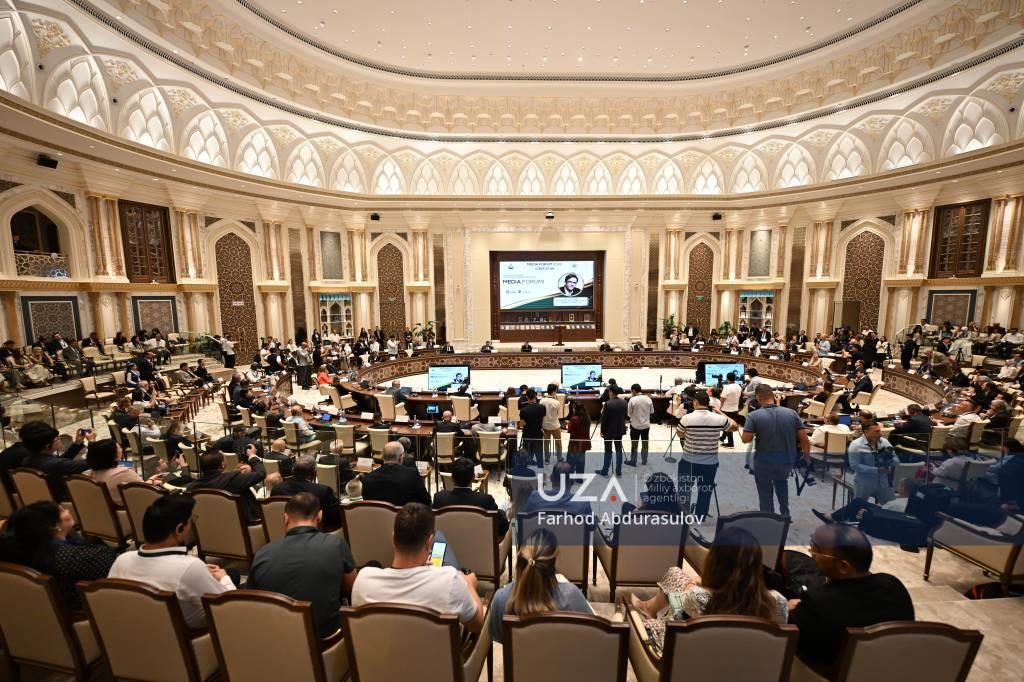
(MENAFN- National News Agency of Uzbekistan) From 24 to 27 August 2026, Tashkent and Samarkand are hosting the International Media Forum “Islamic Civilization: A New Perspective — New Discoveries.” Bringing together representatives of the global media industry, filmmakers, scholars, publishers, digital technology specialists and creative professionals, the forum is emerging as one of Uzbekistan’s most significant international media and cultural diplomacy initiatives of 2026. Official information from the Center for Islamic Civilization in Uzbekistan indicates that the wider forum programme runs from 24 to 28 August, with Samarkand forming a major field component on 27 August.
The scale of the event is particularly notable. Around 300 representatives from nearly 50 countries are participating, including executives of leading media companies, news agencies and television channels, journalists, international publications and digital platforms, documentary filmmakers, producers, scholars and specialists in creative industries and artificial intelligence. The forum is organized by the Center for Islamic Civilization in Uzbekistan together with the Center for Media Content Production under the Presidential Administration, the National Television and Radio Company of Uzbekistan and other partner organizations.
The composition of the participants demonstrates that the forum is much more than a conventional journalistic conference. Its agenda connects several rapidly developing areas — international journalism, documentary filmmaking, publishing, historical memory, digital media, artificial intelligence, cultural diplomacy and tourism. In this sense, the event can be viewed as a platform where Uzbekistan’s historical heritage is being discussed not only as a subject of scholarship, but also as a potential source of contemporary global media content.
A particularly important dimension of the forum is the participation of internationally recognized media organizations. CNN and Euronews have been designated as the forum’s main media partners. Euronews CEO and Editorial Director Claus Strunz is scheduled to deliver a special address on connecting Europe and Central Asia through culture, media and ideas. CNN representative Paula Hancocks is participating as a moderator, while CNN International Commercial Regional Representative Imran Ahmad is presenting “CNN Discovers Uzbekistan: When the Heritage of Islamic Civilization Takes Center Stage.” CNN International Commercial Executive Vice President Phil Nelson is also expected to contribute through a special video address.
The presence of such organizations gives the forum an important international-media dimension. For Uzbekistan, cooperation with global broadcasters creates an opportunity to move beyond simply promoting the country through official information channels. It opens the possibility of developing documentaries, television programmes, special reports and digital projects that can present Uzbekistan’s historical and cultural heritage to audiences in different parts of the world.
The central question of the forum is therefore not simply how to preserve the legacy of Islamic civilization, but how to tell its story to the twenty-first-century audience.
This is especially relevant at a time when the consumption of historical and cultural information is rapidly changing. Younger audiences increasingly encounter history through documentaries, streaming services, social networks, interactive museums, virtual reality, short-form video and artificial intelligence rather than through traditional books and television alone. The forum’s emphasis on modern technologies reflects this transformation.
The programme includes discussions on documentary filmmaking and historical memory, publishing initiatives, new media formats and international media cooperation. According to the organizers, the forum also includes more than 50 presentations and speeches, covering subjects ranging from the intellectual heritage of Islamic civilization to contemporary media technologies.
One of the strongest themes is the contribution of major scholars and thinkers of the Islamic world to global civilization. Figures such as Muhammad al-Khwarizmi, Abu Ali ibn Sina, Abu Rayhan al-Biruni, Imam al-Bukhari, Abu Mansur al-Maturidi and Mirzo Ulugbek represent not only the religious or cultural history of Central Asia but also its contribution to mathematics, medicine, astronomy, philosophy, education and scientific thought.
Presenting these figures through modern media is strategically important. The challenge for cultural diplomacy today is not merely to state that a particular country produced great scholars centuries ago. The challenge is to demonstrate, through credible scholarship and compelling storytelling, why their ideas still matter today.
The forum’s programme reflects this approach through projects devoted to manuscripts, Qur’anic heritage, historical figures, publishing and digital storytelling. Among the initiatives are the “114 Qurans” project, the “Katta Langar Quran: Truth and Legends” project and an initiative focused on the use of artificial intelligence as a digital tool for reading and studying ancient manuscripts.
The proposed international calligraphy project, “Quran of the World: From the Tradition of Calligraphy to the Heritage of the Future,” is another example. The initiative seeks to bring together traditions from different international schools of calligraphy in the creation of a unique manuscript. It demonstrates how an ancient art form can be transformed into an international cultural project with contemporary relevance.
Artificial intelligence occupies a particularly interesting place in the forum’s agenda. Technologies capable of assisting researchers in reading, reconstructing and interpreting historical manuscripts could significantly change the way cultural heritage is studied and presented. For Uzbekistan, which possesses an exceptionally rich collection of Islamic manuscripts and scientific heritage, the combination of historical scholarship and digital technology offers considerable potential.
The forum therefore represents an important shift from the traditional concept of heritage preservation towards heritage digitization, visualization and global storytelling.
Another important feature is the educational dimension of the event. Before and during the forum, masterclasses and meetings have been organized for students of Uzbekistan with the participation of international media professionals. Representatives of leading media companies, international publications, television channels and digital platforms have shared their experience in journalism, media production and international communication with young Uzbek journalists.
This component may prove particularly valuable in the long term. International media cooperation cannot depend solely on high-level meetings between executives. It also requires a new generation of journalists, producers, editors and digital storytellers who understand international standards and know how to communicate national heritage to global audiences.
In this respect, the forum creates a bridge between Uzbekistan’s historical heritage and the future of its media industry.
The choice of venues is equally significant. The principal events are being held at the Center for Islamic Civilization in Uzbekistan, an institution designed to combine research, education, museum collections and modern technologies. Holding the forum there gives foreign journalists direct access to manuscripts, historical artefacts and multimedia presentations rather than limiting their experience to conference-room discussions.
The Center consequently becomes more than a venue. It functions as a potential international content hub.
A journalist can see an artefact, speak to a scholar, examine a manuscript, experience a digital reconstruction and then develop a television report, documentary, article or social-media story based on first-hand observation. This model is much more powerful for international communication than conventional promotional material because it gives visiting media professionals the opportunity to independently interpret what they see.
The Samarkand component on 27 August adds another important dimension. Forum participants are scheduled to travel to Samarkand and visit the newly developed Imam al-Bukhari complex, the International Scientific Research Center for Hadith Studies and the Imam al-Bukhari Innovative Museum, followed by visits to major historical monuments of the city.
The Imam al-Bukhari complex itself illustrates the scale of Uzbekistan’s efforts to develop new cultural and religious heritage infrastructure. The complex covers approximately 45 hectares, includes a mosque capable of accommodating 10,000 worshippers, a colonnaded terrace with 154 columns, 14 domes and four minarets rising to 75 meters. Following reconstruction, its daily visitor capacity increased from approximately 12,000 to 65,000 people.
The complex also includes the Imam Bukhari Innovation Museum, consisting of nine pavilions dedicated to the scholar’s life, the history of hadith studies and his intellectual legacy. An international scientific research center operates nearby, focusing on Islamic scholarly and manuscript heritage and international academic cooperation.
For international journalists, this creates a unique opportunity to combine historical reporting with visual storytelling. Samarkand itself provides another powerful layer of content. The Registan, Bibi-Khanum Mosque, Shah-i-Zinda and Gur-e-Amir are among the city’s major architectural landmarks, and UNESCO recognizes Samarkand as a World Heritage site under the title “Samarkand — Crossroad of Cultures.”
The Tashkent-Samarkand structure of the forum is therefore strategically effective. Tashkent provides the discussion, institutional and technological environment; Samarkand provides the historical landscape in which that discussion can be visually experienced.
The forum also includes several initiatives that demonstrate the organizers’ intention to extend its impact beyond traditional media coverage. A global calligraphy competition, projects devoted to Qur’anic manuscripts, discussions about artificial intelligence and historical sources, and multimedia presentations all contribute to a broader cultural programme.
Another notable element is the international publishing dimension. The programme includes a presentation of the book “Shavkat Mirziyoyev — An Enlightened Leader,” authored by Mahmud Erol Kılıç, Director General of the Research Centre for Islamic History, Art and Culture (IRCICA). The presentation represents another channel through which Uzbekistan’s contemporary reforms and international initiatives are being introduced to an international professional audience.
From the perspective of Uzbekistan’s international image, the forum has several potential long-term effects.
First, it strengthens media diplomacy. Bringing together journalists and executives from dozens of countries creates direct professional networks that can continue beyond the event itself.
Second, it strengthens cultural diplomacy. Rather than presenting Islamic civilization exclusively through religious narratives, Uzbekistan is emphasizing its scientific, intellectual, artistic and educational dimensions.
Third, it supports tourism diplomacy. International journalists visiting Tashkent, the Center for Islamic Civilization, Samarkand and the Imam al-Bukhari complex gain first-hand experience that can later be transformed into travel features, documentaries and international television content.
Fourth, it contributes to Uzbekistan’s intellectual image. The country is presented not merely as a destination with ancient monuments, but as a historical center associated with mathematics, astronomy, medicine, philosophy, theology, literature and scholarship.
Perhaps the most important question, however, is what happens after the forum.
The number of participants — approximately 300 people from nearly 50 countries — is impressive, but the real impact of the event should ultimately be measured by the quantity and quality of international content generated afterwards. If the participating media organizations produce documentaries, television reports, articles, podcasts, books, digital projects and social-media content about Uzbekistan’s Islamic and scientific heritage, the forum’s influence could continue for months or even years.
This is where the event’s strategic significance becomes particularly clear. A traditional conference ends when the delegates leave. A successful media forum continues through the stories, films, publications and digital products created by those delegates after they return home.
The 2026 International Media Forum “Islamic Civilization: A New Perspective — New Discoveries” therefore represents an attempt to transform Uzbekistan’s historical heritage into a living international media narrative.
Its significance lies not only in bringing global media professionals to Tashkent and Samarkand, but also in creating a new communication model in which history, scholarship, journalism, technology, cinema and cultural diplomacy reinforce one another.
For Uzbekistan, the central opportunity is to move from simply preserving the memory of Islamic civilization to actively shaping how that civilization is understood by global audiences.
In this sense, the forum’s title — “A New Perspective, New Discoveries” — is more than a slogan. It describes a broader strategy: to rediscover the intellectual and cultural legacy of the region through contemporary media, to connect historical scholarship with artificial intelligence and digital technologies, and to make Uzbekistan’s centuries-old contribution to world civilization relevant to audiences of the twenty-first century.
The gathering of hundreds of media professionals from nearly 50 countries, the involvement of global media brands such as CNN and Euronews, the participation of scholars and creative-industry specialists, the Tashkent programme and the Samarkand media tour together make the forum one of the most ambitious international media initiatives centered on Islamic civilization to be held in Uzbekistan.
Its ultimate success, however, will not be determined by the number of delegates or sessions. It will be determined by whether the stories told in Tashkent and Samarkand continue travelling around the world after the forum ends.
The scale of the event is particularly notable. Around 300 representatives from nearly 50 countries are participating, including executives of leading media companies, news agencies and television channels, journalists, international publications and digital platforms, documentary filmmakers, producers, scholars and specialists in creative industries and artificial intelligence. The forum is organized by the Center for Islamic Civilization in Uzbekistan together with the Center for Media Content Production under the Presidential Administration, the National Television and Radio Company of Uzbekistan and other partner organizations.
The composition of the participants demonstrates that the forum is much more than a conventional journalistic conference. Its agenda connects several rapidly developing areas — international journalism, documentary filmmaking, publishing, historical memory, digital media, artificial intelligence, cultural diplomacy and tourism. In this sense, the event can be viewed as a platform where Uzbekistan’s historical heritage is being discussed not only as a subject of scholarship, but also as a potential source of contemporary global media content.
A particularly important dimension of the forum is the participation of internationally recognized media organizations. CNN and Euronews have been designated as the forum’s main media partners. Euronews CEO and Editorial Director Claus Strunz is scheduled to deliver a special address on connecting Europe and Central Asia through culture, media and ideas. CNN representative Paula Hancocks is participating as a moderator, while CNN International Commercial Regional Representative Imran Ahmad is presenting “CNN Discovers Uzbekistan: When the Heritage of Islamic Civilization Takes Center Stage.” CNN International Commercial Executive Vice President Phil Nelson is also expected to contribute through a special video address.
The presence of such organizations gives the forum an important international-media dimension. For Uzbekistan, cooperation with global broadcasters creates an opportunity to move beyond simply promoting the country through official information channels. It opens the possibility of developing documentaries, television programmes, special reports and digital projects that can present Uzbekistan’s historical and cultural heritage to audiences in different parts of the world.
The central question of the forum is therefore not simply how to preserve the legacy of Islamic civilization, but how to tell its story to the twenty-first-century audience.
This is especially relevant at a time when the consumption of historical and cultural information is rapidly changing. Younger audiences increasingly encounter history through documentaries, streaming services, social networks, interactive museums, virtual reality, short-form video and artificial intelligence rather than through traditional books and television alone. The forum’s emphasis on modern technologies reflects this transformation.
The programme includes discussions on documentary filmmaking and historical memory, publishing initiatives, new media formats and international media cooperation. According to the organizers, the forum also includes more than 50 presentations and speeches, covering subjects ranging from the intellectual heritage of Islamic civilization to contemporary media technologies.
One of the strongest themes is the contribution of major scholars and thinkers of the Islamic world to global civilization. Figures such as Muhammad al-Khwarizmi, Abu Ali ibn Sina, Abu Rayhan al-Biruni, Imam al-Bukhari, Abu Mansur al-Maturidi and Mirzo Ulugbek represent not only the religious or cultural history of Central Asia but also its contribution to mathematics, medicine, astronomy, philosophy, education and scientific thought.
Presenting these figures through modern media is strategically important. The challenge for cultural diplomacy today is not merely to state that a particular country produced great scholars centuries ago. The challenge is to demonstrate, through credible scholarship and compelling storytelling, why their ideas still matter today.
The forum’s programme reflects this approach through projects devoted to manuscripts, Qur’anic heritage, historical figures, publishing and digital storytelling. Among the initiatives are the “114 Qurans” project, the “Katta Langar Quran: Truth and Legends” project and an initiative focused on the use of artificial intelligence as a digital tool for reading and studying ancient manuscripts.
The proposed international calligraphy project, “Quran of the World: From the Tradition of Calligraphy to the Heritage of the Future,” is another example. The initiative seeks to bring together traditions from different international schools of calligraphy in the creation of a unique manuscript. It demonstrates how an ancient art form can be transformed into an international cultural project with contemporary relevance.
Artificial intelligence occupies a particularly interesting place in the forum’s agenda. Technologies capable of assisting researchers in reading, reconstructing and interpreting historical manuscripts could significantly change the way cultural heritage is studied and presented. For Uzbekistan, which possesses an exceptionally rich collection of Islamic manuscripts and scientific heritage, the combination of historical scholarship and digital technology offers considerable potential.
The forum therefore represents an important shift from the traditional concept of heritage preservation towards heritage digitization, visualization and global storytelling.
Another important feature is the educational dimension of the event. Before and during the forum, masterclasses and meetings have been organized for students of Uzbekistan with the participation of international media professionals. Representatives of leading media companies, international publications, television channels and digital platforms have shared their experience in journalism, media production and international communication with young Uzbek journalists.
This component may prove particularly valuable in the long term. International media cooperation cannot depend solely on high-level meetings between executives. It also requires a new generation of journalists, producers, editors and digital storytellers who understand international standards and know how to communicate national heritage to global audiences.
In this respect, the forum creates a bridge between Uzbekistan’s historical heritage and the future of its media industry.
The choice of venues is equally significant. The principal events are being held at the Center for Islamic Civilization in Uzbekistan, an institution designed to combine research, education, museum collections and modern technologies. Holding the forum there gives foreign journalists direct access to manuscripts, historical artefacts and multimedia presentations rather than limiting their experience to conference-room discussions.
The Center consequently becomes more than a venue. It functions as a potential international content hub.
A journalist can see an artefact, speak to a scholar, examine a manuscript, experience a digital reconstruction and then develop a television report, documentary, article or social-media story based on first-hand observation. This model is much more powerful for international communication than conventional promotional material because it gives visiting media professionals the opportunity to independently interpret what they see.
The Samarkand component on 27 August adds another important dimension. Forum participants are scheduled to travel to Samarkand and visit the newly developed Imam al-Bukhari complex, the International Scientific Research Center for Hadith Studies and the Imam al-Bukhari Innovative Museum, followed by visits to major historical monuments of the city.
The Imam al-Bukhari complex itself illustrates the scale of Uzbekistan’s efforts to develop new cultural and religious heritage infrastructure. The complex covers approximately 45 hectares, includes a mosque capable of accommodating 10,000 worshippers, a colonnaded terrace with 154 columns, 14 domes and four minarets rising to 75 meters. Following reconstruction, its daily visitor capacity increased from approximately 12,000 to 65,000 people.
The complex also includes the Imam Bukhari Innovation Museum, consisting of nine pavilions dedicated to the scholar’s life, the history of hadith studies and his intellectual legacy. An international scientific research center operates nearby, focusing on Islamic scholarly and manuscript heritage and international academic cooperation.
For international journalists, this creates a unique opportunity to combine historical reporting with visual storytelling. Samarkand itself provides another powerful layer of content. The Registan, Bibi-Khanum Mosque, Shah-i-Zinda and Gur-e-Amir are among the city’s major architectural landmarks, and UNESCO recognizes Samarkand as a World Heritage site under the title “Samarkand — Crossroad of Cultures.”
The Tashkent-Samarkand structure of the forum is therefore strategically effective. Tashkent provides the discussion, institutional and technological environment; Samarkand provides the historical landscape in which that discussion can be visually experienced.
The forum also includes several initiatives that demonstrate the organizers’ intention to extend its impact beyond traditional media coverage. A global calligraphy competition, projects devoted to Qur’anic manuscripts, discussions about artificial intelligence and historical sources, and multimedia presentations all contribute to a broader cultural programme.
Another notable element is the international publishing dimension. The programme includes a presentation of the book “Shavkat Mirziyoyev — An Enlightened Leader,” authored by Mahmud Erol Kılıç, Director General of the Research Centre for Islamic History, Art and Culture (IRCICA). The presentation represents another channel through which Uzbekistan’s contemporary reforms and international initiatives are being introduced to an international professional audience.
From the perspective of Uzbekistan’s international image, the forum has several potential long-term effects.
First, it strengthens media diplomacy. Bringing together journalists and executives from dozens of countries creates direct professional networks that can continue beyond the event itself.
Second, it strengthens cultural diplomacy. Rather than presenting Islamic civilization exclusively through religious narratives, Uzbekistan is emphasizing its scientific, intellectual, artistic and educational dimensions.
Third, it supports tourism diplomacy. International journalists visiting Tashkent, the Center for Islamic Civilization, Samarkand and the Imam al-Bukhari complex gain first-hand experience that can later be transformed into travel features, documentaries and international television content.
Fourth, it contributes to Uzbekistan’s intellectual image. The country is presented not merely as a destination with ancient monuments, but as a historical center associated with mathematics, astronomy, medicine, philosophy, theology, literature and scholarship.
Perhaps the most important question, however, is what happens after the forum.
The number of participants — approximately 300 people from nearly 50 countries — is impressive, but the real impact of the event should ultimately be measured by the quantity and quality of international content generated afterwards. If the participating media organizations produce documentaries, television reports, articles, podcasts, books, digital projects and social-media content about Uzbekistan’s Islamic and scientific heritage, the forum’s influence could continue for months or even years.
This is where the event’s strategic significance becomes particularly clear. A traditional conference ends when the delegates leave. A successful media forum continues through the stories, films, publications and digital products created by those delegates after they return home.
The 2026 International Media Forum “Islamic Civilization: A New Perspective — New Discoveries” therefore represents an attempt to transform Uzbekistan’s historical heritage into a living international media narrative.
Its significance lies not only in bringing global media professionals to Tashkent and Samarkand, but also in creating a new communication model in which history, scholarship, journalism, technology, cinema and cultural diplomacy reinforce one another.
For Uzbekistan, the central opportunity is to move from simply preserving the memory of Islamic civilization to actively shaping how that civilization is understood by global audiences.
In this sense, the forum’s title — “A New Perspective, New Discoveries” — is more than a slogan. It describes a broader strategy: to rediscover the intellectual and cultural legacy of the region through contemporary media, to connect historical scholarship with artificial intelligence and digital technologies, and to make Uzbekistan’s centuries-old contribution to world civilization relevant to audiences of the twenty-first century.
The gathering of hundreds of media professionals from nearly 50 countries, the involvement of global media brands such as CNN and Euronews, the participation of scholars and creative-industry specialists, the Tashkent programme and the Samarkand media tour together make the forum one of the most ambitious international media initiatives centered on Islamic civilization to be held in Uzbekistan.
Its ultimate success, however, will not be determined by the number of delegates or sessions. It will be determined by whether the stories told in Tashkent and Samarkand continue travelling around the world after the forum ends.

Legal Disclaimer:
MENAFN provides the
information “as is” without warranty of any kind. We do not accept any
responsibility or liability for the accuracy, content, images, videos,
licenses, completeness, legality, or reliability of the information
contained in this article. If you have any complaints or copyright issues
related to this article, kindly contact the provider above.
Comments
No comment