

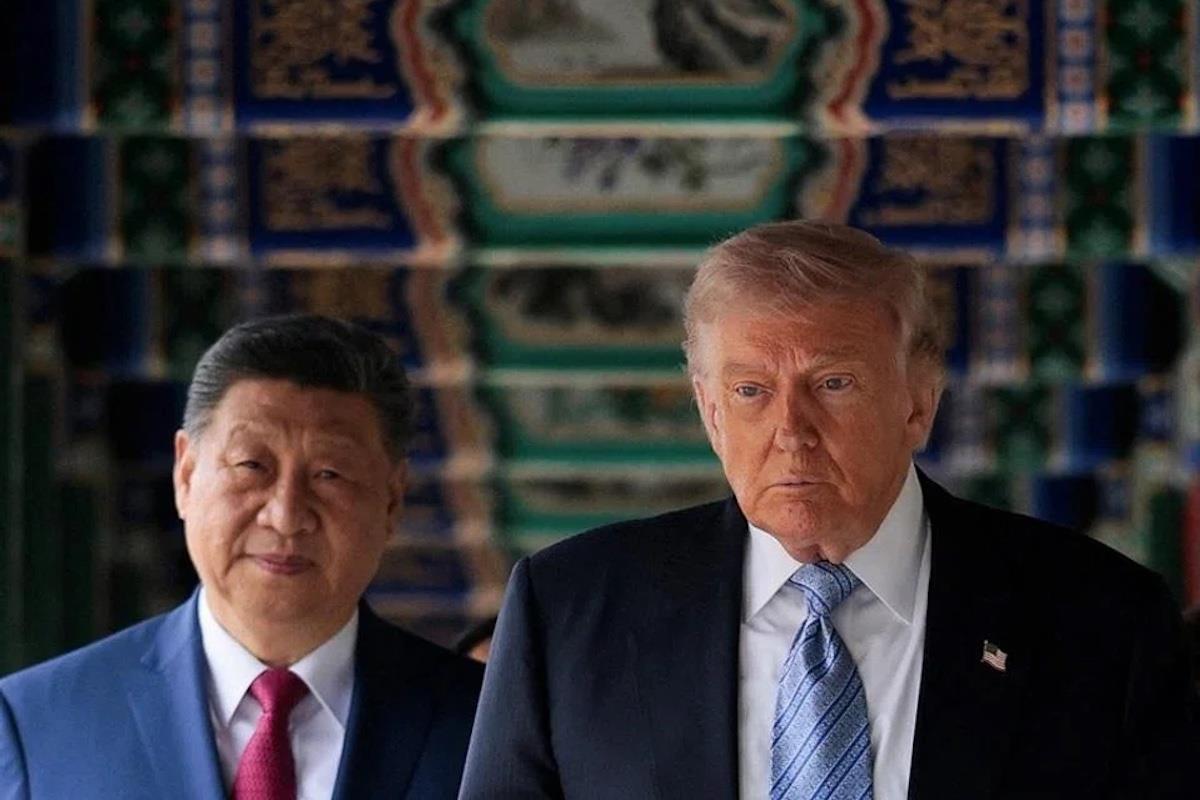
Trump 2.0 And The Unraveling Global Order


Allies might occasionally foster frustrations surrounding US unilateralism but stayed close to Washington because the alternative, a world without a clear anchor, seemed riskier. That assumption is now being tested in real time, and the evidence suggests it may not survive Donald Trump's second term.
Three developments illustrate a building shift: a sweeping new round of US tariffs, a landmark Pew Research Center survey showing China now edging out the US in global favorability and a European Union caught between American pressure and Chinese economic weight.
Layered together, they point to something beyond routine diplomatic friction. They point to a fundamental global realignment that may be difficult, if not impossible, to reverse.
New tariff shock, familiar patternOn July 24, the Trump administration imposed tariffs of 10% to 12.5% on goods from 60 trading partners, covering roughly 99% of all US imports. The administration framed the move as an enforcement action against countries that have failed to adequately prohibit the import of goods made with forced labor, using authority under Section 301 of the Trade Act of 1974.
The new duties replaced a temporary 10% global tariff that had been in place since February, when the Supreme Court ruled that Trump exceeded his authority by imposing tariffs unilaterally under a declared national emergency.
The specific legal justification matters less than the pattern it represents. This is now the second major tariff regime of Trump's second term, arriving within months of the nation's highest court striking down the first.
For trading partners from Canada to India to the European Union, this sends a message questioning the reliability of the United States as an economic partner. A government that reissues sweeping trade barriers under a new legal theory each time the old one fails in court is not a government whose commitments can be planned around.
Pew survey shows global confidence flipThat unpredictability appears to be showing up directly in global public opinion. A Pew Research Center report published July 15, 2026, based on surveys of more than 42,000 adults across 36 countries between February and May 2026, found that people in most of those countries now view China more favorably than the United States.
Confidence in Chinese President Xi Jinping has also overtaken confidence in Trump globally, according to the same Pew report.
Latest stories The politics roiling Japan's $2 trillion national pension fund Sanctions without exit strategies are fracturing the global economy China-Indonesia deals raise eyebrows over hidden costsWhat makes the finding notable is its breadth. This is not confined to the Global South or to countries with longstanding grievances against Washington. Pew's data shows Canadians and Mexicans, the closest US neighbors, now view China more positively than the US. In Germany, Greece, Italy, the Netherlands, Spain, Sweden, and the United Kingdom, Xi outpolls Trump by double digits.
This is a recent reversal, driven by the twin trend of improving views of China and worsening views of the US since Trump's second term began. A year ago, most surveyed countries still favored the US; that is no longer true.
As Council on Foreign Relations senior fellow Yanzhong Zhong states,“China now outranks the United States in global favorability for the first time in nearly two decades, but the real story isn't a Chinese soft-power surge-it's American decline. China's median favorability has barely moved over the past decade; the crossover occurred largely because US ratings collapsed.”
As Maria Repnikova has observed,“China is passively gaining stature from America's soft-power retreat and now looks to many like the more accessible and reliable partner. Beijing has yet to turn that relative advantage into a decisive transfer of affection or a coherent alternative model.”
The Pew report also found that people in middle-income countries across Latin America, Africa, the Middle East and Asia are now more likely to describe China as a reliable partner and less likely to see it as prone to foreign interference, compared with the US.
That is a direct inversion of the roles the two powers have played in global public opinion for most of the post-Cold War era.
South Korea: a treaty ally hedgesPerhaps the clearest illustration of this shift among formal US allies is playing out in Seoul, though not in the direction one might expect. Trump said on August 16 that he spoke with South Korean President Lee Jae Myung and asked if he would give the US“a little hand” with Iran.
When President Lee refused, Trump directed the Pentagon to“substantially reduce” joint military exercises. Known as Ulchi Freedom Shield, they began August 17 and are expected to run until August 27.
Lee's progressive government has been pursuing what it calls“pragmatic diplomacy” and greater strategic autonomy, prioritizing national interest over rigid alignment with Washington.
The shift has been pronounced enough that South Korea's conservative opposition has accused Lee's administration of drifting from the alliance, with American conservative commentators making similar arguments in a Wall Street Journal op-ed cited by both Seoul Economic Daily and Asia Times.
The specifics of Korean domestic politics represent a broader signal. Even a treaty ally with US troops still stationed on its soil is recalibrating how tightly to bind its foreign policy to Washington.
That recalibration is happening under a government that came to power promising hard-nosed pragmatism rather than ideological alignment with either superpower, a telling sign of where the center of gravity in Korean politics has moved.
Europe's bindHowever, South Korea is not the only nation in this position vis-à-vis the US. Nowhere is the tension more acute than in Europe, which finds itself squeezed from two directions at once.
European policymakers are increasingly alarmed by Chinese industrial overcapacity, particularly in electric vehicles, which is accelerating deindustrialization in Germany at a rate of roughly 10,000 lost industrial jobs a month. That alarm has produced plenty of tough rhetoric from Brussels and Berlin about the need to de-risk from Chinese supply chains.
But as James Curran recently detailed in the East Asia Forum, that rhetoric has not translated into coherent policy. The EU wants to raise the economic cost of dependence on China without inflicting pain on itself, and it lacks internal consensus on how to do so.
Compounding the paralysis is the simultaneous pressure of Trump's tariffs, which fall on the EU alongside 59 other economies. European officials are effectively fighting a two-front economic battle: managing exposure to Chinese overcapacity while absorbing new American trade barriers.
The result, for now, is stalemate rather than a clear pivot in either direction. But the pressure isn't going away, and Europe's eventual answer may end up looking far less like coordination with Washington than it once did.
Sign up for one of our free newsletters-
The Daily Report
Start your day right with Asia Times' top stories
AT Weekly Report
A weekly roundup of Asia Times' most-read stories
At the beginning of this year, Canadian Prime Minister Mark Carney gave voice to what the data now shows.
In a January 20, 2026 address at the World Economic Forum in Davos, delivered a day before Trump's own appearance, Carney declared that the world is in the midst of“a rupture, not a transition.”
He argued that the rules-based order underwritten by American power, open sea lanes, financial stability and dispute-resolution frameworks is not coming back, and that middle powers like Canada need to build strategic autonomy rather than wait for a return to the old arrangement.
Carney has repeated variations of that message since, including ahead of the G7 summit in June 2026. What began as one leader's diagnosis is now backed by hard data. And it points toward a world reordering itself well beyond any single election cycle.
None of these threads – tariffs, polling, Korean hedging, European paralysis – is decisive on its own. Together, they collectively describe a system in which trust and credibility, once broken, are not regained overnight.
Public opinion, built over a generation, is then eroded within a few years. Words spoken from the Oval Office should matter; however Allies are quietly building hedges rather than waiting for reassurance.
Trading partners are treating American commitments as transactional rather than binding. Even if US policy shifts again, whether under this administration or a future one, bilateral and/or multilateral relations being recalibrated elsewhere right now may not simply reset.
That is what makes this moment less a rough patch in US foreign policy and more a structural turn in how the rest of the world positions itself vis-à-vis the US.
Georgia Pollard is a research analyst at CJPA Global Advisors. Earl A. Carr Jr. is the founder and CEO of CJPA Global Advisors and an adjunct professor at New York University.
Sign up here to comment on Asia Times stories OrThank you for registering!
-
Share on X (Opens in new window)
Share on LinkedIn (Opens in new window)
LinkedI
Share on Facebook (Opens in new window)
Faceboo
Share on WhatsApp (Opens in new window)
WhatsAp
Share on Reddit (Opens in new window)
Reddi
Print (Opens in new window)
Prin

Legal Disclaimer:
MENAFN provides the
information “as is” without warranty of any kind. We do not accept any
responsibility or liability for the accuracy, content, images, videos,
licenses, completeness, legality, or reliability of the information
contained in this article. If you have any complaints or copyright issues
related to this article, kindly contact the provider above.
Comments
No comment