

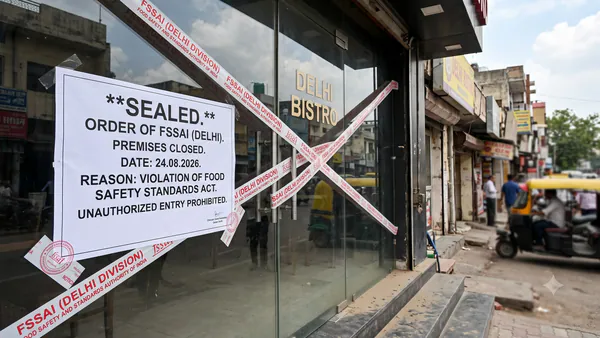
What Happens When FSSAI Suspends An Eatery's License? Rules And Penalties Explained


The suspension triggers a strict regulatory protocol, primarily governed by the Food Safety and Standards Act, 2006 and the Food Safety and Standards (Licensing and Registration of Food Businesses) Regulations, 2011.
"Not all FSSAI violations or the consequences that follow are alike. The action depends on what has actually happened and the seriousness of the breach," Rishi Agrawal, Co-founder & CEO, TeamLease RegTech, told LiveMint.
Agrawal noted that the law takes a graded approach.“A hygiene lapse, misbranding, adulteration and unsafe food are not treated in the same way,” he said.“The consequence depends on the nature of the violation and, in more serious cases, the harm caused.”
For food businesses, Agrawal said, understanding these requirements and having the right controls in place every day ultimately prevents a food safety lapse from becoming a much larger business problem.
Also Read | 'You don't want people to remain healthy?' SC pulls up FSSAI Check immediate consequencesAgrawal said a licence suspension is a regulatory action and can follow when a business fails to comply with an Improvement Notice, or can be imposed immediately in the interest of public health.
“For an eatery, the impact is immediate; operations can stop, revenue is affected, employees and suppliers are disrupted, and customer trust can take a hit,” Agrawal said.
According to the FSSAI Licensing and Registration Regulations (2011), the Food Business Operator (FBO) must immediately cease all food manufacturing, cooking, and selling activities.
Agrawal said that businesses need to keep in mind that food safety cannot be treated as a periodic compliance exercise or the responsibility of one team.
“Hygiene and food handling, storage, kitchen practices and vendor management are all part of the same chain. A lapse at any point can have regulatory and business consequences,” he said.
Under the enforcement powers granted by Section 38 of the FSS Act, 2006, Food Safety Officers (FSOs) are authorised to seize, keep in safe custody, or destroy unsafe food articles found on the premises.
Regulatory enforcement often requires the establishment to publicly display a notice from the food authority indicating its operational suspension. Operating during a suspension is a punishable offence under the Food Safety and Standards Act, 2006.
Also Read | FSSAI gives liquor makers 90 days to comply with whisky, rum labelling rules Rectification processThe FSSAI regulations mandate that the Designated Officer (DO) formally issue a written“Improvement Notice” detailing the specific reasons for the suspension.
As per the regulatory framework, the eatery is granted a specific compliance window to rectify the hygiene, structural, or operational deficiencies.
Once corrective measures are applied, the FBO is required by FSSAI protocols to submit a compliance report and request a fresh inspection of the premises.
What happens next?If the FSO's re-inspection report confirms that the eatery now complies with the mandated food safety standards, the Designated Officer will formally revoke the suspension order.
As outlined in the Licensing and Registration Regulations (2011), if the FBO fails to rectify the issues within the allotted time, the Designated Officer has the authority to permanently cancel the license after issuing a show-cause notice.
According to FSSAI rules, an operator whose licence is cancelled must wait for a mandatory cooling-off period of at least three months from the date of cancellation before applying for a new license.
Here is a streamlined, easily scannable rewrite that clearly outlines the violations, penalties, and practical examples without adding outside information:
Major FSSAI violationsAgrawal said that under Section 50, selling food that is not of the nature, substance, or quality demanded can attract a penalty of up to ₹5 lakh; Section 51 provides a penalty of up to ₹5 lakh for sub-standard food, and Section 52 provides a penalty of up to ₹3 lakh for misbranded food.
“More serious offences can attract both fines and imprisonment. Section 59, for instance, provides for imprisonment and fines in cases involving unsafe food, with the punishment increasing where the violation results in injury or death,” he said.
Also Read | FSSAI suspends license of Marche Retail; restrains SDP Industries from selling ghee Substandard Food (Section 51)This occurs when a product falls short of prescribed quality benchmarks for its category, even if it is not inherently unsafe for consumption.
Penalty: Up to ₹5 lakh.
Example: A batch of spices that contains a lower percentage of a key ingredient than mandated by regulations.
Misbranded Food (Section 52)Misbranding happens when a product's labelling is false, misleading, or non-compliant. This includes incorrect nutritional information, false origin claims, or hidden ingredients.
Penalty: Up to ₹3 lakh.
Example: Labelling a product as "100% Pure Honey" when it contains added sugar, or failing to declare a key allergen on the packaging.
Extraneous Matter (Section 53)This refers to the presence of unwanted foreign substances-such as hair, insects, or other contaminants-that should not be in the food, even if they are not harmful enough to be strictly classified as "unsafe."
Penalty: Up to ₹1 lakh.
Example: Finding a small insect in a packaged snack due to inadequate pest control at the manufacturing unit.
Misleading Advertisement (Section 53)The FSSAI strictly scrutinises how food products are marketed. Making false, exaggerated, or unsubstantiated claims about a product's quality, nutritional value, or health benefits is a major violation.
Penalty: Up to ₹10 lakh.
Example: Marketing a product as having specific health benefits without any scientific backing.
Unsafe Food (Section 59)This is the most serious offence. Unsafe food poses a direct risk to public health due to contamination by harmful bacteria, toxins, or dangerous substances.
Penalty: Up to ₹10 lakh and/or imprisonment. The exact punishment scales are based on the severity of the injury or death caused by consuming the food.
Example: Selling milk contaminated with harmful bacteria that results in widespread food poisoning in a community.

Legal Disclaimer:
MENAFN provides the
information “as is” without warranty of any kind. We do not accept any
responsibility or liability for the accuracy, content, images, videos,
licenses, completeness, legality, or reliability of the information
contained in this article. If you have any complaints or copyright issues
related to this article, kindly contact the provider above.
Comments
No comment