


Vande Mataram Row Explained: BJP Protests, Sonia-Rahul Police Complaint, Congress History And The New Law


While the Bharatiya Janata Party (BJP) led by Union Home Minister Amit Shah has escalated its attack through demonstrations and legal actions, the Congress hit back, rejecting the charges and accusing the ruling party of weaponising patriotism for political gains.
Also Read | Complaints against Sonia Gandhi in Delhi, Karnataka over 'Vande Mataram' rowUnion Home Minister Amit Shah led the BJP's charge accusing the Congress of 'shamelessness'. Shah alleged that party leader Sonia Gandhi attempted to halt the rendition of Vande Mataram midway during the Indpendence Day event.
“Look at their (Congress') shamelessness. The anthem Vande Mataram was being sung at the Congress Party headquarters. During the anthem, Congress leader Sonia Gandhi told the Congress President to stop singing. We all just kept watching on TV,” Shah said on Sunday.
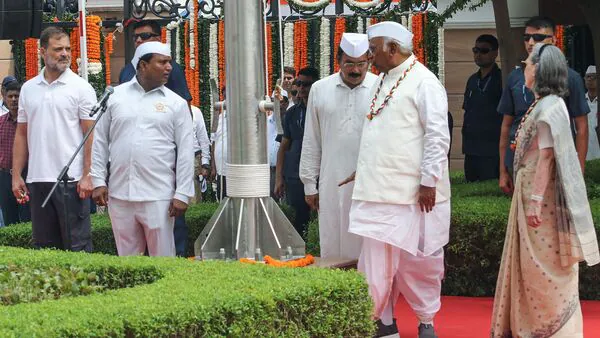
Police complaint against Sonia, RahulA police complaint was lodged with the Delhi Police seeking registration of an FIR against Sonia Gandhi and Rahul Gandhi over alleged disruption during the rendition of the National Song "Vande Mataram" at an Independence Day function at the AICC headquarters here on August 15.
The complaint seeks an FIR after the police ascertain the applicability and legal status of the Prevention of Insults to National Honour (Amendment) Bill, 2026, and thereafter conduct a fair, impartial and time-bound probe into the alleged conduct of the two Congress leaders.
The controversy erupted after visuals from the Independence Day programme at the Congress headquarters showed senior party leaders speaking among themselves while Vande Mataram was being recited. BJP leaders have criticised their conduct, alleging that it amounted to disrespect towards the National Song.
BJP protest in SrinagarThe BJP held a protest outside the Congress office in Srinagar on Sunday over the alleged disrespect towards Vande Mataram by Congress leaders in New Delhi.
Jammu and Kashmir BJP spokesperson Altaf Thakur alleged that Congress leaders Rahul Gandhi, Sonia Gandhi, and Mallikarjun Kharge showed disrespect towards the national song during the party's Independence Day programme.
Accusing top opposition figures of undermining the sanctity of national celebrations during the AICC programme, Altaf Thakur said, "As the Congress was preparing to hoist the Tricolour on Independence Day, the National Song was played, yet Rahul Gandhi, Sonia Gandhi, and Mallikarjun Kharge showed disrespect towards it."
In West Bengal, BJP MLA and Bankim Chandra Chattopadhyay's direct descendant Sumitro Chatterjee wrote an open letter demanding an unconditional apology from Sonia Gandhi over the row.
Congress responds: 'A communication issue'The Congress responded to the row asserting that Sonia Gandhi's actions had nothing to do with the national song played at the venue. The party maintained that she was merely trying to ensure that the correct arrangements for Vande Mataram were sung properly in the event.
Also Read | Vande Mataram Plays At Red Fort For 1st Time On Independence Day CelebrationsCongress General Secretary KC Venugopal rejected the allegations and asserted that his party deeply respects Vande Mataram and accused the BJP of using the national song and freedom struggle as political weapons.
Venugopal maintained it was merely a communication issue and said that Congress has respect for Vande Mataram.
"For the BJP, everything is political. For us, it is emotional. What happened at the AICC headquarters was a communication issue. We are people who respect Vande Mataram. The Congress has a clear stand on Vande Mataram, and you will understand it in due course," Venugopal said.
All you need to know about Vande Mataram?Composed by Bankim Chandra Chatterjee, 'Vande Mataram' was first published in the literary journal Bangadarshan on 7 November 1875. Later, Bankim Chandra Chatterjee incorporated the hymn in his novel 'Anandamath' which was published in 1882.
In the Constituent Assembly, there was unanimity in adopting both Jana Gana Mana and Vande Mataram as National symbols, with no debate on the issue. On 24 January 1950, Dr Rajendra Prasad addressed the Constituent Assembly, stating that Vande Mataram, due to its significant role in the freedom movement, should have the same status as the National Anthem, Jana Gana Mana, and be honoured equally.
Since then the song has become an integral part of the nation's civilizational, political and cultural consciousness.
November 7, 2025, marked the 150th anniversary of Vande Mataram.
The controversy beyond the first two stanzasVande Mataram has also been controversial because its later stanzas.
Only the first two of the six stanzas of Vande Mataram were used historically because the later stanzas contain explicit religious imagery and references to Hindu goddesses (like Durga and Lakshmi).
To avoid religious division and ensure the song could unite all communities during the freedom struggle, national leaders adopted only the first two universal, secular verses celebrating the physical beauty of the motherland.
The latter four stanzas invoke specific Hindu deities, which caused theological objections and discomfort among Muslim members during the freedom movement.
In October 1937, the Congress Working Committee (CWC) resolved to adopt only the first two stanzas of Bankim Chandra Chattopadhyay's Vande Mataram for national and public gatherings. This decision followed advice from Rabindranath Tagor and Mahatma Gandhi and Jawaharlal Nehru, aimed at avoiding alienating non-Hindu communities over religious imagery in later verses.
Also Read | How Independence Day celebrations will be different this yearThese stanzas focus on the motherland and patriotism, not religious symbolism, it was resolved.
While the truncated two-stanza version remained the norm for decades, recent official guidelines for the song's 150th anniversary have encouraged rendering all six stanzas at select state events
The new lawEarlier this month, President Droupadi Murmu gave assent to a Bill that criminalises intentional disruption or prevention of the singing of the national song 'Vande Mataram' at government functions. The law gives the national song the same legal protection currently accorded to the national anthem, a government statement said
With the president's assent, The Prevention of Insults to National Honour (Amendment) Bill, 2026, has become a law.
Earlier, the Prevention of Insults to National Honour Act prohibited intentionally preventing the singing of the national anthem (Jana Gana Mana) or causing disturbance to any assembly engaged in such singing.
These offences were punishable with up to three years of imprisonment, a fine or both, while a second and every subsequent conviction attracted a minimum of one year's imprisonment.
The legislation comes amid a broader push by the Centre to promote Vande Mataram as a symbol of national pride and to commemorate its historic legacy.
Vande Mataram has become an integral part of the nation's civilizational, political and cultural consciousness.The move follows a Union Ministry of Home Affairs (MHA) directive requiring states to play Vande Mataram before Jana Gana Mana during official government functions.
(With agency inputs)

Legal Disclaimer:
MENAFN provides the
information “as is” without warranty of any kind. We do not accept
any responsibility or liability for the accuracy, content, images,
videos, licenses, completeness, legality, or reliability of the information
contained in this article. If you have any complaints or copyright
issues related to this article, kindly contact the provider above.


Comments
No comment