

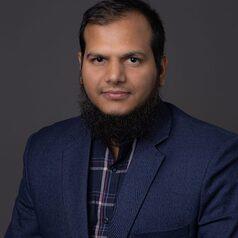
Md Alamgir Hossain


- Senior Lecturer, Electrical and Electronic Engineering, University of Southern Queensland
Dr Md Alamgir Hossain (SMIEEE) is a Senior Lecturer in Electrical and Electronic Engineering at the University of Southern Queensland. He has made significant contributions to renewable energy and power systems through extensive national and international collaborations involving more than 200 researchers and 10 industry partners.
A major highlight of his research career is the establishment of Australia's first hydrogen DC microgrid laboratory at Griffith University, funded by the Blue Economy Cooperative Research Centre. This unique facility enables advanced experimental studies on transient response, voltage stability, power sharing, and economic operation under real-time Internet-of-Things (IoT) control. Developed collaboratively with the University of Tasmania, Optimal Group, and Pitt & Sherry, the lab serves as a national platform for hydrogen microgrid research and industry engagement.
Before joining UniSQ, Dr Hossain served as a Senior Research Fellow at Griffith University's Queensland Micro- and Nano-Technology Centre, and as a Postdoctoral Research Associate at the University of New South Wales (UNSW), where he developed machine-learning-based models for renewable energy forecasting. Earlier in his career, he was an Assistant Professor in Electrical and Electronic Engineering at Dhaka University of Engineering & Technology (DUET), Bangladesh.
Dr Hossain earned both his PhD (2019) and Master of Engineering (2016) from UNSW, Australia, supported by multiple competitive scholarships, including the University International Postgraduate Award, UCPRS Top-Up, and the UNSW Tuition Fee Scholarship. He completed his BSc Engg (EEE) at DUET with First Class (1st Honours).
His research focuses on hydrogen DC microgrids, renewable energy integration, artificial intelligence, optimisation algorithms, and energy management systems. He has authored over 120 journal and conference papers in leading IEEE and Elsevier journals, attracting more than 5,200 citations (H-index = 36, FWCI = 2.47). Notably, 45 percent of his publications appear in the world's top 10 percent of journals, and 36 percent rank among the top 10 percent most cited globally. His research has been referenced in international policy frameworks, including the OECD Education Working Paper“No. 297: Agency in the Anthropocene,” highlighting its broader societal impact.
Dr Hossain's excellence has been recognised through multiple honours, including the High Impact Publication Awards, listing among the World's Top 2% Scientists, the Prime Minister and President Gold Medals, UNSW Research Day Awards, and distinctions such as Top Peer Reviewer 2019 and Outstanding Reviewer (Elsevier).
He has co-supervised eight higher-degree research students to completion and currently supervises six others. In 2023, he was elevated to Senior Member of IEEE in recognition of his leadership and professional contributions.
Dr Hossain continues to advance the frontier of renewable-hydrogen energy systems through cross-disciplinary research and education, fostering collaborations between academia, industry, and government to accelerate Australia's clean-energy transition.
Experience- –present Senior Lecturer, University of Southern Queensland
- 2020 UNSW, Electrical Engineering


Legal Disclaimer:
MENAFN provides the
information “as is” without warranty of any kind. We do not accept any
responsibility or liability for the accuracy, content, images, videos,
licenses, completeness, legality, or reliability of the information
contained in this article. If you have any complaints or copyright issues
related to this article, kindly contact the provider above.
Comments
No comment