


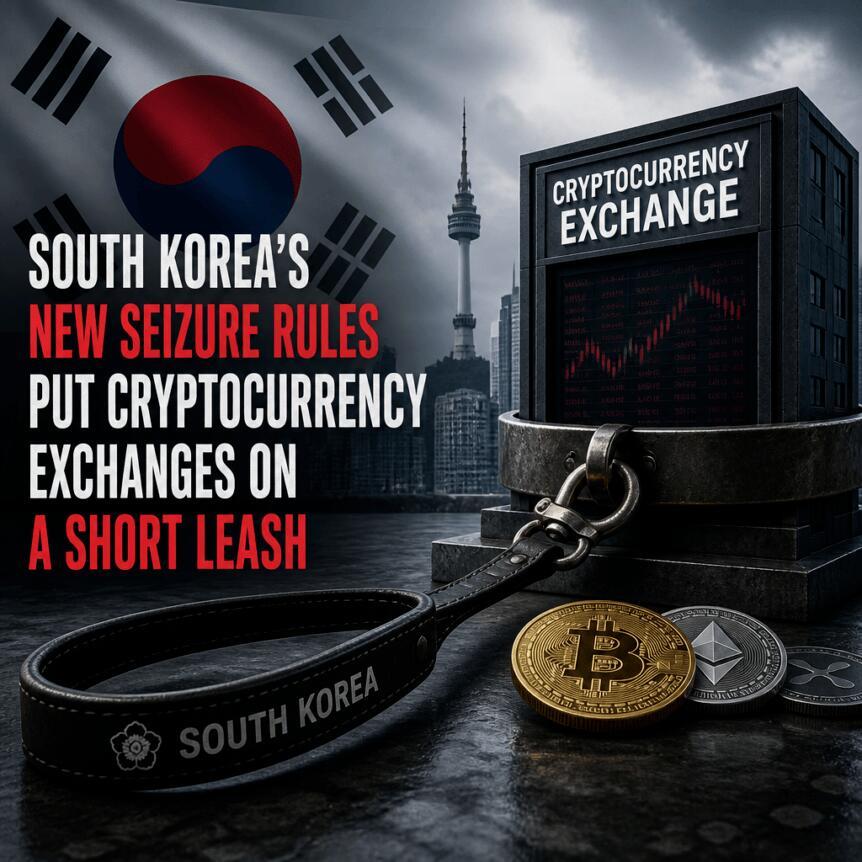
South Korea's New Seizure Rules Put Cryptocurrency Exchanges On A Short Leash


The deadline for public comments on the proposed amendments is August 11. Under the new amendments, cryptocurrency exchanges will have only seven days to disclose customer holdings if they are served with a court order.
South Korea's New Crypto Seizure RulesThe proposed amendments to the Civil Execution Rules create a standardized process for creditors to freeze, identify, and liquidate debtor crypto holdings. If finalized, the rules will take effect from October 1. Once finalized, cryptocurrency exchanges will have a seven-week window to prepare to play a role in civil debt enforcement.
Simply put, a court could freeze the debtor's access to assets held with a custodian. It can also prohibit the custodian from transferring the frozen assets to the debtor. Additionally, the debtor will also lose their right to dispose of the claim. Creditors can then petition the court to ask the custodian to disclose its holdings. The new rules will give the custodian one week to recognize the debtor's claim, identify the asset and the quantity, and disclose any competing seizures, priority rights, or provisional orders.
Broad Implications For South Korean Crypto MarketThe proposed amendments to the Civil Execution Rules could have far-reaching implications in South Korea's retail-heavy cryptocurrency market. The country reached a significant milestone in February 2025, as data from Upbit, Bithumb, Coinone, Korbit, and Gopax revealed over 16 million users held a cryptocurrency account with one of the major exchanges, up from 14 million a year earlier.
Once debtor assets are identified and frozen, the courts could order their liquidation or assign them to creditors. The sale can be executed by a virtual asset service provider (VASP), or the assets could be transferred to an enforcement officer. The court could also order their conversion to more liquid assets before their disbursal.
However, things could get complicated when the crypto is held by the debtor directly, as private key controls come into the picture. In such a situation, while the court could prohibit disposal and direct the debtor to transfer the crypto to an enforcement officer, the actual seizure would only occur once the officer receives the assets.
The proposal is part of South Korea's efforts to build rules for a market meshed with its mainstream financial ecosystem. Lawmakers have introduced several statutory protections for users, and also plan to tighten exchange registration and anti-money laundering (AML) requirements.
Lawmaker Proposes Postponing Crypto TaxSeparately, a South Korean opposition lawmaker has proposed postponing a planned 22% tax on crypto profits to 2030. The South Korean government had announced plans to impose a 22% tax on crypto profits starting in 2027. People Power Party Representative Jeong Seong-guk put forward the proposal, and also outlined plans to amend the Income Tax Act, keeping the proposed 22% tax, but changing the effective date from January 1, 2027 to January 1, 2030. Jeong stated that lawmakers and tax authorities needed more time to review the virtual asset tax framework, strengthen existing investor protections, and build systems to tax crypto fairly.
Finance Minister Koo Yun-cheol reiterated the government's stance in a July 19 meeting, stating,
“At this point, we are proceeding with taxation starting next year as scheduled.”
Disclaimer: This article is provided for informational purposes only. It is not offered or intended to be used as legal, tax, investment, financial, or other advice.
Risk & affiliate notice: Crypto assets are volatile and capital is at risk. This article may contain affiliate links.
Legal Disclaimer:
MENAFN provides the
information “as is” without warranty of any kind. We do not accept
any responsibility or liability for the accuracy, content, images,
videos, licenses, completeness, legality, or reliability of the information
contained in this article. If you have any complaints or copyright
issues related to this article, kindly contact the provider above.


Comments
No comment