

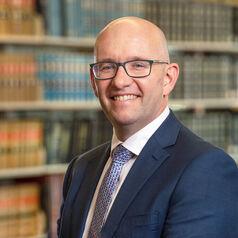
Ben White


- Distinguished Professor, Professor of End-of-Life Law and Regulation, Australian Centre for Health Law Research, Queensland University of Technology
Distinguished Professor Ben White is Professor of End-of-Life Law and Regulation in the Australian Centre for Health Law Research at the Faculty of Business & Law, Queensland University of Technology. His area of research is end-of-life decision-making with a particular focus on voluntary assisted dying.
Ben graduated with first class Honours and a University Medal in Law from the Queensland University of Technology. He was awarded a Rhodes Scholarship to complete a DPhil at Oxford University, where his doctoral thesis investigated the role that consultation plays in the law reform process. Before joining the Law School, he worked as an Associate at the Supreme Court of Queensland and at Legal Aid Queensland. Between 2005 and 2007, Ben was appointed as the full-time Commissioner of the Queensland Law Reform Commission where he had carriage of the Guardianship Review on behalf of the Commission. He also served as a part-time Commissioner between 2007 and 2010.
Ben was a foundation Director of the Australian Centre for Health Law Research for six years (2013-2018). He still co-leads the End-of-Life Research Program within the Centre. He has produced over 250 publications (books, book chapters and journal articles) primarily in the area of health law, with a particular focus on end-of-life decision-making. His work is interdisciplinary with publications in law, medicine, nursing, psychology, bioethics, social policy and social science journals as well as those that have an interdisciplinary focus.
Ben is the editor of Research Handbook on Voluntary Assisted Dying Law, Regulation and Practice (2025, Edward Elgar), a collaboration of 58 authors from 14 countries which aims to chart the field of voluntary assisted dying. He is also an editor of the leading text Health Law in Australia (2024, 4th ed, Thomson) and International Perspectives on End-of-Life Law Reform: Politics, Persuasion and Persistence (2021, Cambridge University Press).
Ben has been part of interdisciplinary teams that have been awarded $70 million in the field of end-of-life decision-making, including from the Australian Research Council, the National Health and Medical Research Council, Commonwealth and State governments, and philanthropic organisations. His six Australian Research Council grants have examined different aspects of law, policy and practice at the end of life. Key topics investigated include: What role does law play in medical decision-making? To what extent do doctors know and follow the law? Why is medical treatment that is futile/non-beneficial provided to patients at the end of life? How many people make a will or engage in advance care planning and why? What does the community know about the law of end-of-life decision-making? Do patients and families know their rights and responsibilities when making end-of-life decisions? What is the best way to regulate voluntary assisted dying? How is voluntary assisted dying operating in Australia?
Ben is currently undertaking a four-year Australian Research Council Future Fellowship that aims to develop a new and holistic approach to regulating voluntary assisted dying. This project will enhance end-of-life care in Australia through better regulation and will draw on Canadian and Belgian case studies.
Ben has also developed funded training and research programs about end-of-life law and regulation. These programs include the legislatively-mandated training that health professionals must complete before being involved in voluntary assisted dying in Victoria, Western Australia and Queensland (funded by these State Governments). Another is a national program funded by the Commonwealth Department of Health to enhance health professionals' knowledge of law at the end of life called End of Life Law for Clinicians. He also contributes to the Commonwealth Government-funded End of Life Directions for Aged Care project.
Ben's research has had significant impact leading to changes in law, policy and practice. His work has been adopted by parliaments, courts and tribunals, and law reform commissions and has also influenced state and national end-of-life policy and prompted changes to clinical education in universities, hospitals and health departments. His research has also contributed to voluntary assisted dying law reform across Australia, and particularly in Queensland. His legal research is publicly available through the End of Life Law in Australia website (co-authored with Lindy Willmott and Penny Neller). This site aims to provide accessible information about law at the end of life for patients, families, health and legal practitioners, the media, policymakers and the broader community.
Ben has supervised 18 PhD students to completion. He supervises a range of topics in the health and medical law field including voluntary assisted dying, futile or non-beneficial medical treatment, advance directives and advance care planning, withholding and withdrawing life-sustaining treatment, palliative care, and other areas related to end-of-life decision-making. He welcomes inquiries from prospective PhD students.
A list of Ben's publications and other outputs is available here:,_Ben.
Experience- 2012–present Professor, Australian Centre for Health Law Research, QUT
- 2005 University of Oxford, DPhil 1996 QUT, LLB (Hons)
- Law And Legal Studies (18) Law And Society (180119) Public Health And Health Services (1117) Aged Health Care (111702) Care For Disabled (111703)


Legal Disclaimer:
MENAFN provides the
information “as is” without warranty of any kind. We do not accept any
responsibility or liability for the accuracy, content, images, videos,
licenses, completeness, legality, or reliability of the information
contained in this article. If you have any complaints or copyright issues
related to this article, kindly contact the provider above.
Comments
No comment