


At CERN, AI Will Drive Future Discoveries


Originally from Italy, Emiliano has worked as science communicator in various European countries. Now in Switzerland, he writes about scientific discoveries, especially the ones having a chemical bond, and science policy, favoring the stories that have a human touch. His main question: How is academia evolving in a changing society?
-
More from this aut
As CERN plans a new, far more expensive collider to replace the LHC in the 2040s, physicists say AI won't just crunch numbers after the fact– it will help design the machine itself, choose its materials, and decide what questions it's even built to ask.
When scientists at the CERN particle physics laboratory discovered the Higgs Boson in 2012, it was a revolution in our understanding of the universe. The finding came after four decades of searching. And it wouldn't have been possible without machine learning algorithms, which were“something like the great-grandfather of what you now call AI,” says Maurizio Pierini, a physicist at CERN.
Today, the descendants of those algorithms are making inroads in all areas of particle physics.“We are going to use AI more and more,” former CERN director Fabiola Gianotti told Swissinfo. Physicists, like scientists in other fields, are using AI before an experiment, to prepare it, and after an experiment, to analyse data. But at CERN, they are also pushing the technology into unexplored directions.“What defines our specificity is that we also are deploying algorithms in the middle of the experiment, as part of the actual data taking,” Pierini says.
The stories in this series look at where the world's largest particle physics laboratory stands in its scientific ambitions and its efforts to remain an international crossroads for understanding our universe.
CERN's new AI-based tools arrive as the Geneva-based institution is upgrading much of its physical equipment. This year, work will begin updating the LHC to a machine with higher collision rates, which means more data to analyse. Next, the lab must complete the design and obtain approval for a collider, called the Future Circular Collider (FCC), that will replace the LHC in the 2040s. CERN physicists interviewed for this story agree that AI could be instrumental not just in research and analysis, but in helping to design the new collider, keeping costs down, and attracting brilliant minds back to particle physics.
“Thanks to AI, everything will be done differently: better, faster, more technologically advanced, and AI will help us probe the open questions in particle physics,” says Maria Spiropulu, a particle physicist at the California Institute of Technology and a CERN collaborator.
AI for the Higgs BosonThe first use of machine learning at CERN was in 1987, when scientists developed a system to find faults in a machine called the Proton Synchrotron.
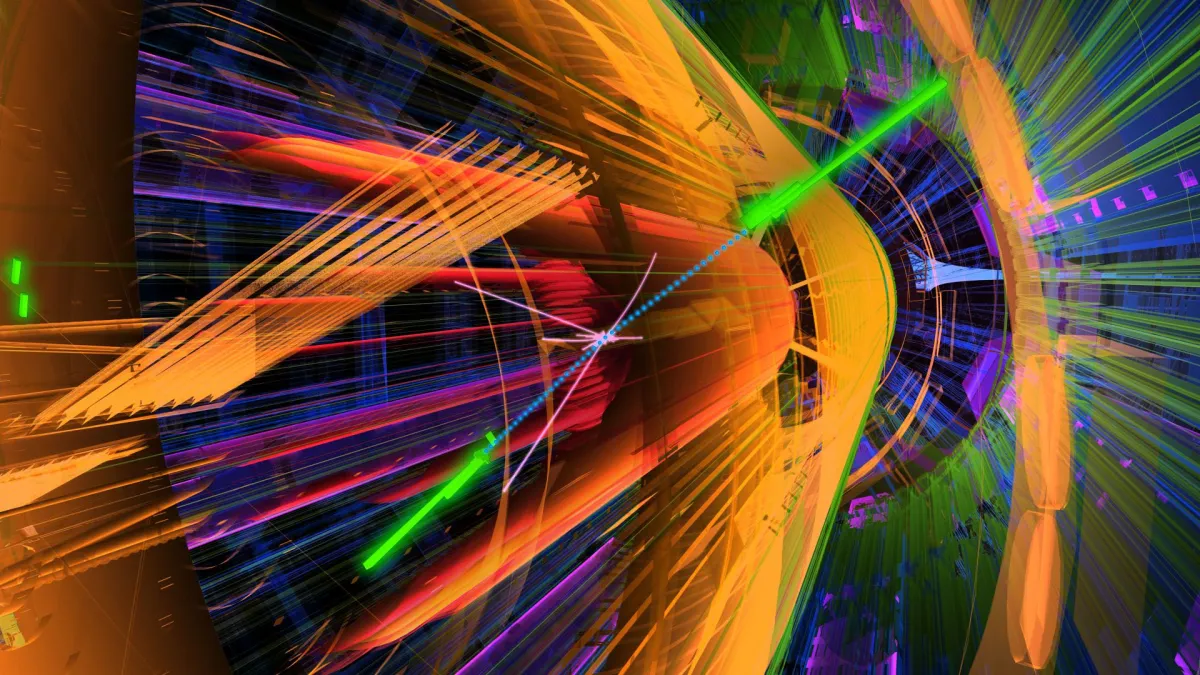
Later on, CERN scientists used another AI ancestor to make use of the LHC. In the LHC, particles collide at energies of up to 13 trillion electron volts (TeV) and produce forty million collisions every second. Each collision results in traces that are picked up by detectors, giant machines that surround the LHC collision zones. The stream of data is so huge and fast that“no computing infrastructure on this planet can handle it,” Pierini says.“You need to filter the data, and you need to have an algorithm that decides what's interesting and what's not.”
That's exactly what happened when CERN was hunting for the Higgs Boson. The so-called God Particle gives mass to other particles, but it's rarely produced during a collision, and it exists only for a fleeting instant. Scientists, however, knew what they were looking for. Peter Higgs predicted the existence of the boson in the 1960s based on existing understandings of particle physics, and finding it was a matter of filtering the data to find evidence.
To do this, researchers loaded machine learning algorithms onto the LHC's hardware and programmed it to look for traces that would be consistent with Peter Higgs's calculations. From the streams of data, the machine selected the most likely instances where a Higgs boson was produced. In the end, the algorithms could filter 1,000 signals per second, allowing for the first clear observations of the God Particle.“That's why we can say that AI helped the Higgs boson discovery,” Pierini says.
>> Science is not cheap, and CERN is no stranger to fights over funding:
More More Research frontiers Can CERN's $19bn effort to rewrite physics survive a fracturing world?This content was published on May 18, 2026 The science behind CERN's proposed Future Circular Collider is settled, but the funding is not.
Read more: Can CERN's $19bn effort to rewrite physics survive a fracturing w
Legal Disclaimer:
MENAFN provides the
information “as is” without warranty of any kind. We do not accept
any responsibility or liability for the accuracy, content, images,
videos, licenses, completeness, legality, or reliability of the information
contained in this article. If you have any complaints or copyright
issues related to this article, kindly contact the provider above.


Comments
No comment