


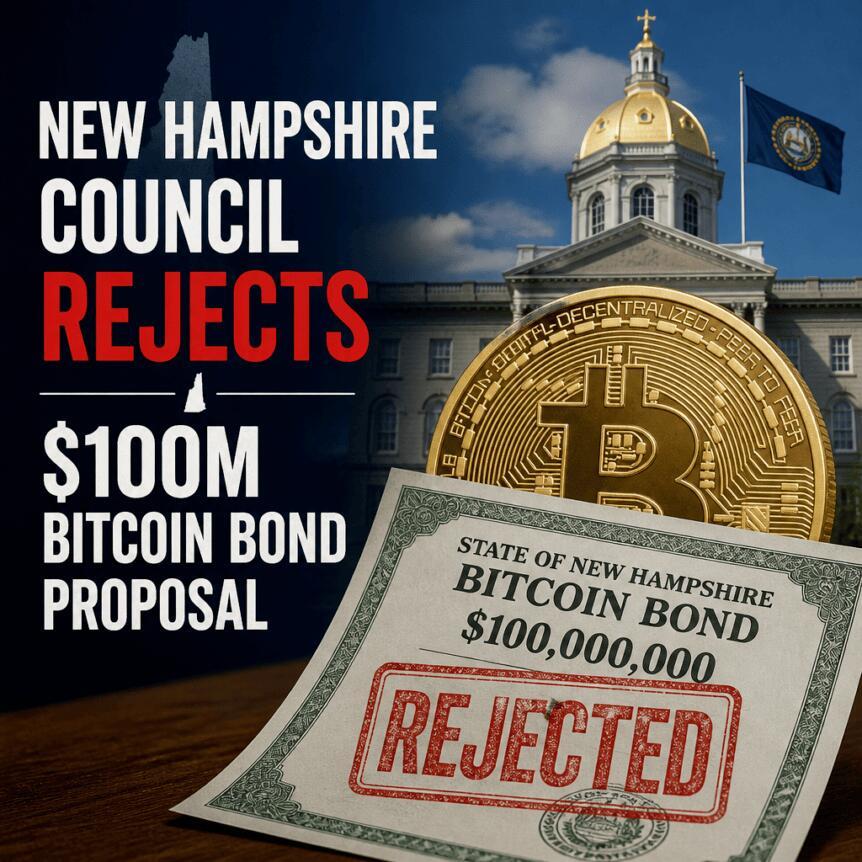
New Hampshire Council Rejects $100M Bitcoin Bond Proposal


During a Wednesday hearing, the five-member panel voted 3-2 against the New Hampshire Business Finance Authority's (BFA) request to issue BTC -backed bonds. The BFA had approved the issuance in November 2025, and the measure also had support from Governor Kelly Ayotte.
Key takeaways- The executive council voted 3-2 to block New Hampshire's proposed $100 million Bitcoin -collateralized bond issuance. CleanSpark was named as the entity providing Bitcoin collateral for the proposed vehicles issued by the BFA. The decision follows New Hampshire's May 2025 crypto reserve law, which set the stage for further state-level digital asset policy. Moody's assigned the proposed Bitcoin bond a provisional Ba2 rating in March, according to prior coverage. Public debate included warnings from experts about risk to residents, even as parts of the crypto industry supported the concept.
The rejection came after a split decision among councilors. According to the vote record, councilors Karen Liot Hill, Dave Wheeler, and Janet Stevens voted against the measure. Joseph Kenney and John Stephen voted in favor.
In the aftermath, state representative Keith Ammon criticized the outcome in a post on X, saying the decision was“extremely short-sighted” and urging the panel to“gather all relevant facts and information and reconsider their vote at a future meeting.”
Why New Hampshire's crypto finance experiment matteredThe BTC -backed bonds were designed to be issued by the New Hampshire Business Finance Authority, with Bitcoin placed as collateral through CleanSpark. If approved, the proposal would have represented another step in New Hampshire's evolving posture toward cryptocurrency after the state passed a crypto reserve law in May 2025.
Supporters in the broader crypto community had argued that Bitcoin-backed instruments could help mainstream digital asset exposure into traditional financial structures. However, opposition reflected concerns that such products may introduce risks that are difficult for retail and local stakeholders to evaluate-particularly in a vehicle intended to function like municipal-style financing.
Risk concerns and Moody's provisional ratingNot all market participants viewed the plan as straightforward. Some experts warned against the proposal, describing it as carrying“substantial risk” for New Hampshire residents. Their objections centered on the potential volatility and custody-related complexities of using Bitcoin as collateral for public finance-style instruments.
Prior reporting also noted that Moody's assigned the Bitcoin bond a provisional Ba2 rating in March, underscoring that the credit assessment-while not final-still considered meaningful risk factors. That provisional rating added another layer to the debate: even with an external rating process underway, the executive council ultimately concluded that the plan should not move forward at this time.
What happens next for digital asset policy in New HampshireWith the council vote going against the issuance, New Hampshire's near-term path to using Bitcoin within state-backed financial tools appears to narrow. The move also signals that political and regulatory appetite for crypto-linked public finance may vary sharply even when a state's leadership has already supported broader crypto legislation.
For builders and investors tracking the state as a potential“proof of concept” location, the rejection is a reminder that approval for crypto-adjacent instruments depends not only on legislative frameworks, but also on executive-level risk decisions and the way collateral arrangements are perceived in practice.
Readers should watch whether the BFA revisits the structure of the proposed BTC-backed vehicles, seeks a revised vote, or instead shifts toward other compliance-forward approaches that align with both the state's crypto reserve direction and the council's risk concerns; the council's split decision suggests that future proposals could still find a narrow path to approval if they address those objections directly.
Risk & affiliate notice: Crypto assets are volatile and capital is at risk. This article may contain affiliate links.
Legal Disclaimer:
MENAFN provides the
information “as is” without warranty of any kind. We do not accept
any responsibility or liability for the accuracy, content, images,
videos, licenses, completeness, legality, or reliability of the information
contained in this article. If you have any complaints or copyright
issues related to this article, kindly contact the provider above.


Comments
No comment