

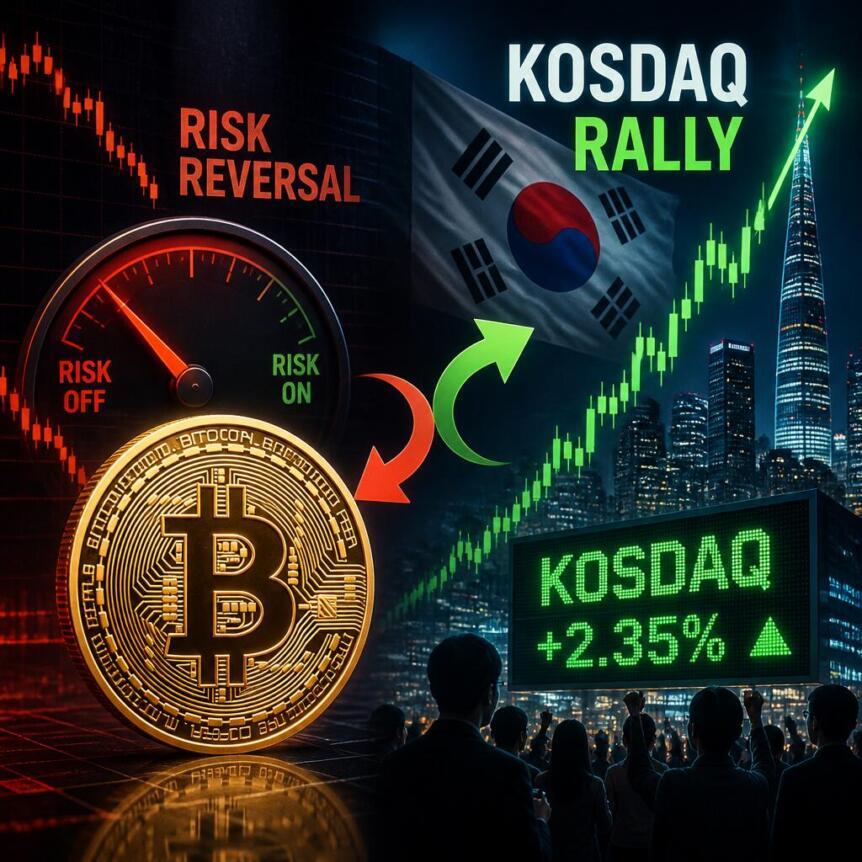
Bitcoin Looks At A Risk Reversal As KOSDAQ Rally In South Korea Points To Speculation


This contrast may lead market participants to speculate whether the improvement in risk appetite could possibly move into other asset classes, including digital currencies like Bitcoin. There is no indication of any capital inflow into cryptos at the moment, but previous developments have been similar in nature.
Rotation of Capital Pushes Up KOSDAQ IndexAccording to market information provided by CryptoSavingExpert, about $65 billion worth of market capitalization was lost by firms listed on the KOSPI during the latest market trading session. On the other hand, KOSDAQ gained over $100 billion worth of market capitalization while appreciating by roughly 7.5%.
The trend did not indicate a general pullback from the South Korean stock market. Instead, it pointed to investors shifting their capital from big companies to small companies with high growth prospects. It indicated growing confidence among speculators and their preference for companies with higher risks but potentially bigger gains.
Pressure on Large-Cap Stocks From All SidesMarket heat maps highlighted weaknesses of major stocks in the Korean market, showing mostly red across major industry groups.
Samsung Electronics, the biggest listed firm in South Korea based on its market capitalization, saw a decline of 0.93%, which was one of the causes of weakness for the KOSPI index. The list of weak firms includes many others.
Among the biggest losers:
- Samsung Electronics – 0.93% SK Hynix – 0.97% Kumho Tire – 1.30% Hyosung – 0.90%
The companies belong to various industries, such as technology, manufacturing, automotive, and industrial. This indicates that institutions were selling off large-cap stocks rather than anything specific going on within a certain company.
Bitcoin Under Investor Watch AgainThe equity rotation cycle has put the spotlight back on Bitcoin, as the question remains whether improved risk sentiment will extend into crypto assets.
It has been observed in the past that during periods of high interest in risky assets, crypto assets-especially Bitcoin -have occasionally seen positive performance, as they are considered high-risk assets. When investors start being more risk-tolerant, their attention tends to move towards alternate asset classes outside traditional stocks. Nevertheless, there is no certainty involved.
Prices of cryptocurrency will still be determined by a host of other factors, such as liquidity conditions in the global economy, monetary policies, macroeconomic trends, institutional involvement, and investor positioning in general. Equity rotation alone will not suffice in driving flows into Bitcoin.
Market Sentiment Might Give Early IndicationsEven though Bitcoin has not enjoyed any particular upside because of changes in South Korea's market dynamics, there is another way changing investor sentiment can be tracked through equity rotation.
The performance of the KOSDAQ and selling pressure in the KOSPI are indicators that investors have become more comfortable taking risks following a period when they preferred safe havens.
Market players will keep track of how far this changing sentiment spreads into other financial markets around the world before it starts affecting cryptocurrencies. If speculative demand strengthens, Bitcoin might be one of the coins set to gain as investor sentiment shifts toward risky assets.
Risk & affiliate notice: Crypto assets are volatile and capital is at risk. This article may contain affiliate links.
Legal Disclaimer:
MENAFN provides the
information “as is” without warranty of any kind. We do not accept any
responsibility or liability for the accuracy, content, images, videos,
licenses, completeness, legality, or reliability of the information
contained in this article. If you have any complaints or copyright issues
related to this article, kindly contact the provider above.
Comments
No comment